September 2026
Both of us have been around cars our whole lives, which is the real reason this part of the business exists. We know the specific feeling of looking at thirty years of baked grease in an engine bay and deciding to leave it alone, because every method you can think of would cost you something you cannot replace.
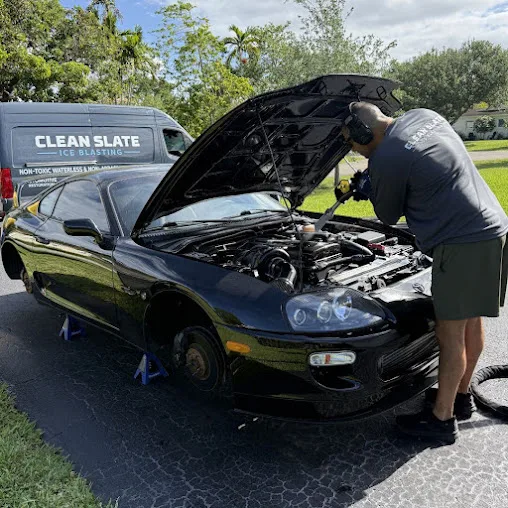
Here is what each of those methods does to a car, and what a dry ice job on an engine bay actually looks like.
What is in there after thirty years
An old engine bay is layered, and the layers came from different places.
On top there is road film: dust, brake dust and oil mist that arrived through the front of the car and stuck to whatever was already greasy. Underneath that is the grease itself, from a valve cover gasket that wept for a decade, a rear main, a power steering line. Baked onto the exhaust side and the manifold area there is carbon. And somewhere in the middle of it are the things that are supposed to be there: the factory paint, the inspection markings, the cad-plated brackets, the original hose clamps, decals, the ink stamps on the block.
That last group is why this is difficult. On a driver you can be aggressive. On a car somebody is keeping original, the markings and the plating are the value.
Media blasting will cost you the aluminum
Abrasive is the first thing people reach for and the fastest way to wreck an engine bay.
Soft alloy is the immediate problem. Aluminum intakes, timing covers, water pump housings and valve covers pit under abrasive, and once the surface is pitted there is no getting the cast finish back. Machined sealing faces lose their flatness. Plating comes off brackets and fasteners.
The second problem is where the media ends up. In an assembled engine bay there is no realistic way to keep grit out of the intake tract, the alternator, the distributor, the throttle linkage, the pulleys or any seal you did not remove. And unlike the dirt you started with, grit is hard. It stays in there and works on bearing surfaces for as long as the engine runs.
We hear about this after the fact more often than we would like. Somebody blasted a frame or a bay, and now the plating is gone off everything and nobody planned for a refinish.
Pressure washing drives water where water cannot go
A wand and a bucket of degreaser is the traditional approach, and on a well-sealed modern car with a plastic engine cover it is mostly survivable.
On an older car it is a bad afternoon. Water follows seams into connector bodies, into distributor caps, into alternator and starter housings, into fuse boxes and relay bases and behind rubber boots that have been hard and cracked since 1994. The car usually runs badly for a week and then mostly recovers, which is the frustrating version, because you never learn which connector was the one.
Then there is the degreaser itself. Caustic cleaners will dull aluminum, stain cad plating and take ink stamps and paper decals straight off. Those markings do not come back.
And one more thing nobody plans for: you cannot see progress while you work. Everything is wet and dark, so you finish, dry it, and discover where you missed.
Why the ice approach suits an old car
The pellet is softer than the aluminum it hits, and it stops existing on contact. That combination is what leaves the cast finish, the plating, the paint and the gasket edges where they were.
Nothing gets wet, so the electrical side of the car is not part of the risk conversation. No standing water in a harness, a connector or a distributor.
And the whole thing is dry the moment it is finished, which means you can look at it immediately, decide whether a section needs another pass, and drive the car home.
On the originality question, careful settings will take grease off a block and leave an inspection mark. We do not guarantee that on the phone and we would be lying if we did, because it depends entirely on what the marking is and how it was applied. What we do is find a hidden equivalent, test it, and show you the result before we go anywhere near a visible one.
How a bay job runs
You send photos of the bay through the contact page. Overall shot plus close-ups of the worst areas, and tell us what the car is and what you are protecting.
We bring the rig to you. The compressor and hose reel run off your driveway or your shop floor, so the car does not go anywhere.
Masking comes first. Intake openings, the alternator, anything with an exposed opening, plus whatever you have told us matters. This is the part that takes the time, and the part an impatient operator skips.
Then a test area, out of sight, to set pressure and pellet size. Painted inner fenders, bare alloy and a greasy block all want different settings.
Then the work, and it goes in stages so you can see it happening. What is on the floor afterward is the grease that came off your car, on our drop cloths, and that leaves with us.
You look at it before we pack up. If a section wants another pass we do it then, while the rig is still running, rather than scheduling a return trip.
A South Florida car has a different problem
Cars that have lived their whole lives down here do not have the rust profile a northern car has, and that changes what you are actually cleaning.
There is no road salt, so frames and floors tend to be sound. What there is instead is salt air, sun and constant humidity. That gives you surface corrosion on bare fasteners and brackets rather than structural rot, hardened and cracked rubber everywhere, and a particular greasy film that never really dries because it never stops being humid.
It also gives you biological growth. A car that sat under a tree or in a carport for a few years picks up mildew in the cowl, in the bay corners and along the firewall seams. That is a staining and deposit problem, which this method handles, rather than a metal problem, which it does not.
The practical note for a local car: the plating and the markings are more often salvageable here than the rubber is. Plan on cleaning revealing some hose and boot replacements you had not budgeted for, because the grease was holding them together as much as anything else.
The rest of the car
A bay is often where it starts and rarely where it stops. Undercarriage and frame work is the bigger job on most older cars, because that is where undercoating, road film and forty years of surface grime live. Brake and suspension components come up on the same visit, and full restoration cleaning is its own conversation about how much comes off and how much stays.
What owners ask us
Will it strip my paint?
Healthy paint stays. Failing paint that is already lifting or chalked may come away, which is worth knowing before rather than after. The test patch settles it on a specific car, and if your inner fenders are original and delicate we will say so.
Do I need to pull the engine or drain anything?
No. Cleaning in place is the point. A mostly assembled bay gets masked and cleaned where it sits.
Can it go wrong?
Any tool in the wrong hands can. The failures in this method come from setting the pressure too high on a soft or aged surface, and that is why the test area exists and why we would rather spend ten minutes finding the setting than explain a mistake on a car you spent years on.
Send us the bay
Photos and a short description get you a straight answer, including a no if it is warranted. Giancarlo at 786-302-6553, or the contact page if it is easier to type it out. We are in Miami and run out roughly a hundred miles, so the rig comes to the car.