Home / Service areas / Broward County / Hollywood
Broward County · Florida
Hollywood dry ice blasting
When we take a job in Hollywood, the rig comes to the machine rather than the other way round.
How the work runs here
Nothing about the setup needs a drain, a hookup or a bay. It is also why nothing has to be crated up and driven across town, the work happens where the machine already sits in Hollywood.
Nothing of the ice survives the blast. That removes the entire cleanup problem every other method creates, leaving only the deposit that came off the equipment.
What we clean
Where this method earns its keep in Hollywood
Nearby
Also working across Broward County
Questions from Hollywood
Is Hollywood in your area?
Yes. Hollywood is inside our regular working area, and the rig travels to the job rather than the other way round.
What does the site need to have?
Access to the equipment and somewhere to park the compressor. No water hookup, no drain and no wash bay.
Can you work around our schedule?
Most of the time. Shutdowns and after-hours work are normal for us; what matters is knowing the window early.
Who calls you around here?
A mix, vehicle work, shop equipment, marine and light industrial. Same rig, different constraint each time.
Does distance affect the price?
Distance can factor in. You will hear about it up front, not on the invoice.
What is the first step?
A short description and a couple of pictures is enough to start. An owner rings you back.
Why Hollywood equipment ends up like this
The heat matters more than people expect: baked-on residue cures harder in a South Florida summer. That is why so much of the work is removing what has bonded to a surface without taking the surface with it.
Light industrial, automotive and marine make up most of what we are called out for. Driveway or plant floor, the requirement is the same: room for the rig and access to the machine.
With no slurry to contain and no media to recover, a confined Broward County site stops being a problem.
What comes off
The deposits we see most
This list covers the bulk of what people ask us about. All of it is buildup sitting on top of something worth keeping.
- Grease and oil
The greasy base coat that traps grit and dust. It releases early and takes the loose material with it.
- Carbon and soot
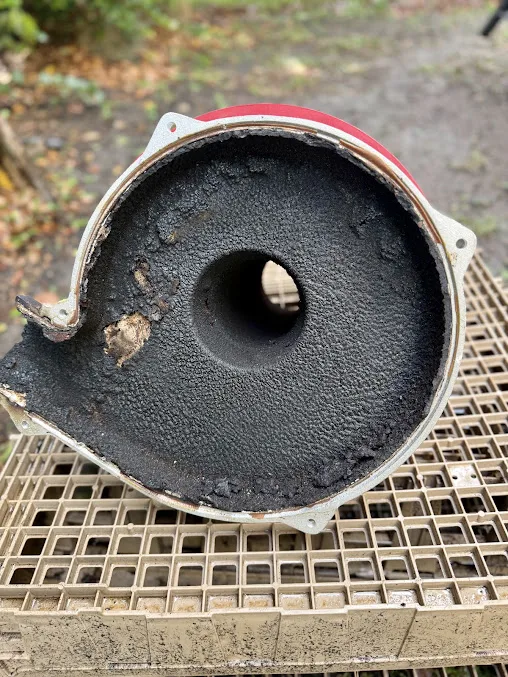
Hard black buildup on weld cells, ovens and engine parts. Fast cooling cracks it loose from the surface instead of grinding it off.
- Adhesive and sealant
The stubborn film under old tape, or the gasket that tore and left half of itself behind.
- Resin and mold release
Residue from production that has hardened onto molds. We remove it with cold instead of chemistry, so there is nothing to rinse away afterward.
- Paint and coatings
Selective removal, layer by layer, on parts where media blasting would cut into the substrate.
- Salt and corrosion product
A constant in South Florida. Removing it without stripping the protective finish is the whole trick.
- Ink and printing residue
Dried ink and coating build-up on rollers and press components, where the surface texture is the product.
How a job runs
What happens once you call
Here is what a job looks like from our side. Ask about any of it; none of it is a trade secret.
- You describe the job
Send images if you can, they settle most of the questions. A wrong-tool verdict comes on that first call, not after the invoice.
- We look at access and containment
Where the compressor sits, how far the hose has to reach, what gets masked or moved, and where the removed contaminant ends up. On food and electrical work this is most of the planning.
- We test a small area
The rig gets tuned to your surface, never the last job’s. We try it on a concealed spot, look closely, and change pressure or pellet size before going anywhere obvious.
- We blast, then clean up
One mess instead of two: the pellet vanishes and we take away what it removed.
- You look before we pack up
Walk it with us before the hose goes away. A second pass while the compressor is still running costs nothing; a return visit costs us both.
The comparison
The other ways to do this
- Media blasting
It takes the top off whatever it touches. That is the point on rusted plate and the problem everywhere else.
- Pressure washing
It is fast and it is wet, which is fine outdoors and unusable on anything with a winding in it.
- Solvent and degreaser
Good at softening, bad at leaving. There is always a residue and always a drum to get rid of.
- Hand scraping
Hours of work for an inconsistent result, with gouges where the blade slipped.
- Dry ice
The pellet is soft and the mechanism is temperature, not abrasion. It turns to gas on impact, so the only thing left to sweep up is what came off.
What happens in your space
Masking happens first. Whatever is adjacent and vulnerable gets covered before the hose is picked up.
Dry ice is plain carbon dioxide. It is not toxic and leaves nothing behind, but in a closed room it crowds out oxygen, so we sort out airflow before we start.
Expect noise. Everybody inside the working area wears hearing protection, us included.
Expect the part to be cold to the touch when we finish. Give it a few minutes before handling, and do not be surprised by a little condensation as it warms up.
Send us the job.
Send the equipment, the location and a short description. Photos help. You will hear back from Giancarlo or Kenny, not a call center.