Home / Service areas / Broward County / Sea Ranch Lakes
Broward County · Florida
Sea Ranch Lakes dry ice blasting
Sea Ranch Lakes work comes to us the same way most of it does: something is coated in build-up and cannot be sanded, soaked or dissolved.
How we work in this area
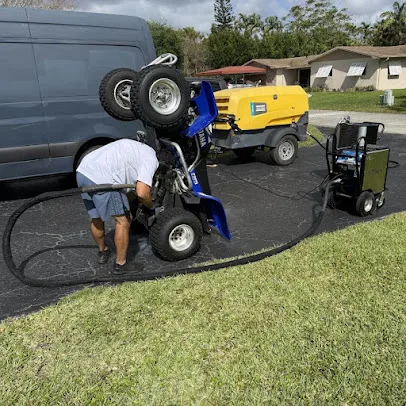
Everything arrives on the van: compressor, hose, operator and containment. So the equipment stays put. Everything that has to move arrives on the truck instead.
Nothing of the ice survives the blast. That removes the entire cleanup problem every other method creates, leaving only the deposit that came off the equipment.
What we clean
What we get called for in Sea Ranch Lakes
Nearby
Also working across Broward County
Questions from Sea Ranch Lakes
What do you need from us on site?
Access to the equipment and somewhere to park the compressor. No water hookup, no drain and no wash bay.
How flexible are the hours?
Yes, within reason. Planned outages are easiest because everybody already knows the window.
What sort of work do you get called for?
A mix, vehicle work, shop equipment, marine and light industrial. Same rig, different constraint each time.
Do you charge for the drive?
Distance can factor in. You will hear about it up front, not on the invoice.
How do we book it in?
Send the equipment, the location and a short description with photos if you have them. One of the owners calls you back.
Do you actually come out to Sea Ranch Lakes?
Yes, Sea Ranch Lakes is well within range, and the compressor comes on the truck with everything else.
What the climate does here
Humidity is the constant. Anything bare oxidizes faster than it would almost anywhere else. So the job is usually less about scrubbing harder and more about not making the underlying problem worse.
The mix here runs from vehicle work in driveways to production equipment inside industrial units. In every case the truck brings its own air and its own containment, so you are not adapting the site to suit the method.
The pellet turns to gas, so nothing runs off toward a drain and nothing abrasive stays behind in a bearing. On a cramped Broward County site that usually decides it.
What comes off
What dry ice actually removes
The rule of thumb is simple: anything stuck on rather than built in. These are the deposits we see most.
- Resin and mold release
Buildup on a mold face that shows up in every part it makes. Dry ice takes it off without wearing the texture of the tool.
- Paint and coatings
Removed selectively where the substrate underneath has to survive, which rules out most abrasive approaches.
- Salt and corrosion product
The year-round problem on the coast. The finish holding corrosion back has to survive the cleaning.
- Ink and printing residue
Ink and coating on anilox and press rollers, surfaces where changing the texture changes the print.
- Food residue
Carbonized product build-up in a plant where neither standing water nor a chemical film is acceptable.
- Grease and oil
Oil film is the layer everything else sticks to. Remove it and half the job is already done.
- Carbon and soot
Heat-bonded black deposit. Because heat put it there, a sudden cold front is what breaks its grip.
How a job runs
How a job actually runs
The process is short to explain. These are the stages, start to finish, so you know where we are at any point in the job.
- We look at access and containment
In a small enclosed bay, the question is mostly where the dust and grime will settle. We protect the floor and nearby surfaces, then point everything we remove toward one spot.
- We test a small area
Pressure and pellet size get dialed in on an inconspicuous spot before we touch anything visible. Painted parts, soft alloys and older finishes all behave differently, and the right setting on one is the wrong setting on another.
- We blast, then clean up
There is no spent media to recover, only the deposit, which we collect before packing up.
- You look before we pack up
We would rather you find the missed spot while we are standing there than a week later. Another pass on the day is the cheapest fix available.
- You describe the job
Send images if you can, they settle most of the questions. A wrong-tool verdict comes on that first call, not after the invoice.
The comparison
What the alternatives actually do
- Hand scraping
Fine on a patch, hopeless on a machine, and the blade leaves its own evidence.
- Media blasting
Abrasive by definition. Anything with a tolerance or a finish worth keeping comes out changed.
- Pressure washing
It is fast and it is wet, which is fine outdoors and unusable on anything with a winding in it.
- Solvent and degreaser
Softens the contaminant but leaves a film, fumes and a disposal problem, and attacks finishes you meant to keep.
- Dry ice
Thermal shock breaks the bond. The pellet sublimates, so nothing abrasive touches the part and nothing is left to collect but the contaminant.
What the job is like to stand next to
Nothing from you is required to run the rig. Our compressor and hose come with us on every job.
Masking happens first. Whatever is adjacent and vulnerable gets covered before the hose is picked up.
People ask whether dry ice is safe to have indoors. It is non-toxic and leaves no residue. The care point is a confined space, where the gas replaces oxygen, so we set up ventilation before the work begins rather than partway through.
It sounds like heavy compressed-air work, because that is what it is. Hearing protection is standard for us and for anyone standing near.
Describe what you are dealing with.
If you are not sure dry ice is the answer, ask anyway. We will tell you straight if it is the wrong method.