What builds up, and why it matters
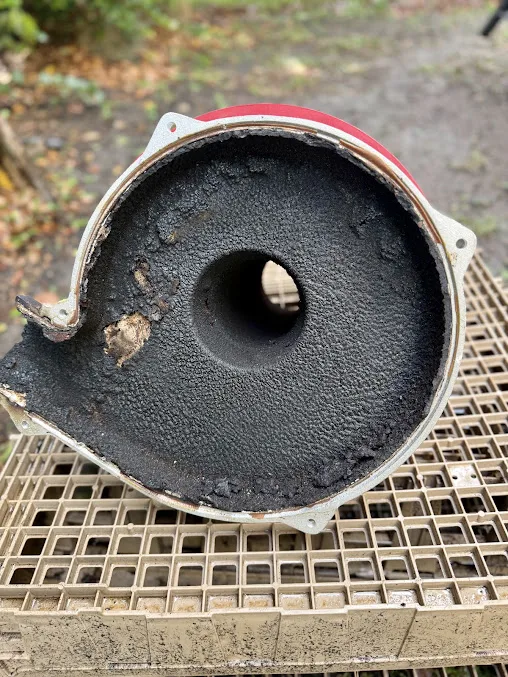
On this kind of work the problem is carbonized product, fat, starch, sugar residue and burnt-on build-up. Dry ice leaves no chemical residue on a food contact surface, and no water in a place where standing water is a sanitation problem. That is the whole reason it is used in food production.
Cleaning is usually scheduled around sanitation and production windows. The people who call us about food processing equipment are usually sanitation and plant managers, and the thing they are actually worried about is a chemical residue finding its way onto product.
The method
Why dry ice and not the alternatives
- Non-abrasive
Rubber seals, wiring and plastic covers can be cleaned in place. With no abrasive in the mix, they are not worn away in the process.
- Low moisture
No standing water in a harness, a bearing or a cabinet, and no dry time before the equipment goes back into service.
- No secondary waste
The pellets turn to gas, so you are left with one thing to deal with: the dirt we took off.
- Often no teardown
The machine stays where it is and mostly in one piece. Reassembly, where most of the labor normally goes, largely drops out of the job.
More food work
Related jobs we get called for
Questions we get asked first
Will it damage the surface underneath?
On most substrates, no. The pellet is soft and sublimates on impact, so it does thermal work rather than mechanical work. We still test an inconspicuous spot first on anything unusual.
Do you have to take the equipment apart for food processing equipment?
Less than with almost any other method. There is no water to keep out and no grit to flush from inside afterward, so parts can stay where they are while we clean.
How much mess does it make?
The only debris is what was on the part to begin with. We lay down protection before we start and gather it up when we finish.
Do you come to us?
That is the only way we do it. A mobile rig means plants, shops, driveways and docks are all fair game across South Florida, up to roughly a hundred miles out from Miami.
What does a job cost?
Most of the price is time on site, and time depends on how much buildup there is and how easy it is to reach. Send photos and a description and you get an actual number back, not a range pulled out of the air.
How soon can you look at it?
The first answer comes quickly even when it is a no. If dry ice is the wrong fit for your job, we will tell you on that first call so you are not waiting on us for nothing.
The comparison
What the alternatives actually do
- Hand scraping
Slow, inconsistent, and the tool marks the surface. Fine for a small area, unworkable across a machine.
- Media blasting
It takes the top off whatever it touches. That is the point on rusted plate and the problem everywhere else.
- Pressure washing
The water has to go somewhere, and on most equipment that somewhere is inside it.
- Solvent and degreaser
Good at softening, bad at leaving. There is always a residue and always a drum to get rid of.
- Dry ice
It is the only one on this list where the media stops existing the moment it has worked.
What comes off
The deposits we see most
Most calls involve one of the following. The common factor is a bond between two things that should not be bonded.
- Food residue
Carbonized product build-up in a plant where neither standing water nor a chemical film is acceptable.
- Grease and oil
Oil film is the layer everything else sticks to. Remove it and half the job is already done.
- Carbon and soot
The deposit that forms wherever things run hot. Because heat bonded it, a sharp temperature drop is the quickest way to undo it.
- Adhesive and sealant
The stubborn film under old tape, or the gasket that tore and left half of itself behind.
- Resin and mold release
A mold has to keep its exact dimensions. Ice removes the cured residue and leaves the face untouched, so parts keep coming out right.
- Paint and coatings
Removed selectively where the substrate underneath has to survive, which rules out most abrasive approaches.
- Salt and corrosion product
A constant in South Florida. Removing it without stripping the protective finish is the whole trick.
How a job runs
What happens once you call
The process is simple, and we would rather you know it before we show up than wonder about it while we work.
- We look at access and containment
Anything that should not be blasted gets covered first. On a control cabinet that might be a few components, and on a food line it might be most of what surrounds the area we are cleaning.
- We test a small area
First pass goes somewhere out of sight. We look at it with you if you want, adjust if needed, and only then work the visible surfaces.
- We blast, then clean up
The media disappears on contact; the contaminant does not. Gathering what came off is included, not a line added afterward.
- You look before we pack up
A second pass while everything is still connected is free in every sense. A return trip is not.
- You describe the job
Send images if you can, they settle most of the questions. A wrong-tool verdict comes on that first call, not after the invoice.
What happens in your space
Expect it to be loud while the hose is running. If people on your site are still working nearby, we plan for that before we start.
The process ends with cold equipment rather than wet equipment. A short wait, and sometimes some condensation as it warms, is all there is to it.
Even a field with no building nearby works. Our own compressor supplies everything the blaster needs.
Anything nearby that should not be touched gets masked before we start. That is quicker than explaining it afterward.

Send us the job.
Keep it short. Describe the job, add a photo if you have one, and expect a call from an owner.