Home / Services / Printing / Paper Dust Removal With Dry
Printing · Miami, FL
Paper Dust Removal With Dry Ice Blasting
Paper Dust Removal With Dry comes to us when the usual cleaning methods are too harsh for the part. We clean it without water, without chemicals and without anything abrasive touching the surface.
What builds up, and why it matters
On this kind of work the problem is dried ink, adhesive, paper dust and coating build-up. Anilox and press rollers are precision surfaces. Anything abrasive changes the cell structure and changes the print, which is why solvent soaking and manual scrubbing are the usual compromise.
Presses are cleaned in place between runs or during planned maintenance. The people who call us about paper dust removal with dry are usually press operators and production managers, and the thing they are actually worried about is altering a roller surface and with it the print result.

The method
Why dry ice and not the alternatives
- Non-abrasive
Sand and soda wear the surface down along with the dirt. Dry ice uses cold to break the bond, so the metal under it stays as it was.
- Low moisture
Nothing gets wet, so nothing has to sit and dry. The time saved goes straight back into running the equipment.
- No secondary waste
The pellets turn to gas, so you are left with one thing to deal with: the dirt we took off.
- Often no teardown
The machine stays where it is and mostly in one piece. Reassembly, where most of the labor normally goes, largely drops out of the job.
More printing work
Related jobs we get called for
Questions we get asked first
Will it damage the surface underneath?
On most substrates, no. The pellet is soft and sublimates on impact, so it does thermal work rather than mechanical work. We still test an inconspicuous spot first on anything unusual.
Do you have to take the equipment apart for paper dust removal with dry?
Minimal disassembly is one of the main reasons people call us. Most work is done in place, and the occasional panel we do remove is usually a quick job.
How much mess does it make?
The only debris is what was on the part to begin with. We lay down protection before we start and gather it up when we finish.
Do you come to us?
We come to you. Moving a machine is usually the expensive part, so we skip it and bring the cleaning to the machine instead, anywhere across South Florida within about a hundred miles of Miami.
What does a job cost?
We price every job on its own, because a greasy engine bay and a carbon-caked oven are different work. Guessing over the phone helps nobody. Send the details and one of the owners comes back with a figure we will stand behind.
How soon can you look at it?
The first answer comes quickly even when it is a no. If dry ice is the wrong fit for your job, we will tell you on that first call so you are not waiting on us for nothing.
The comparison
Why not just pressure wash it
- Pressure washing
Water gets into everything and has to come out again before the equipment runs. Around electrics it is off the table entirely.
- Solvent and degreaser
It dissolves the deposit and often the finish underneath, then leaves a film behind either way.
- Hand scraping
Hours of work for an inconsistent result, with gouges where the blade slipped.
- Media blasting
Effective and indiscriminate. On soft metal or a finished surface it does damage you then have to fix.
- Dry ice
Cold breaks the bond and the media vanishes. The substrate is untouched and there is no second mess to clean up.
What comes off
The deposits we see most
Most jobs start with one of these. The details differ, but the job is always to separate a deposit from what it is stuck to.
- Carbon and soot
Heat-bonded black deposit. Because heat put it there, a sudden cold front is what breaks its grip.
- Adhesive and sealant
Bonded material that outlived whatever it was bonding, usually harder to shift than the part it is on.
- Resin and mold release
Buildup on a mold face that shows up in every part it makes. Dry ice takes it off without wearing the texture of the tool.
- Paint and coatings
Selective removal, layer by layer, on parts where media blasting would cut into the substrate.
- Salt and corrosion product
The year-round problem on the coast. The finish holding corrosion back has to survive the cleaning.
- Ink and printing residue
Dried ink on precision roller faces, cleaned without altering the cell structure that does the work.
- Food residue
Carbonized product, fat, starch and sugar build-up on processing equipment, cleaned without chemicals touching a food contact surface.
How a job runs
What happens once you call
Every job follows the same basic steps. They are laid out below in plain terms, so you know what you are agreeing to.
- We test a small area
Aluminum, chrome and painted steel each have their own limits. We find each one’s limit on a corner out of sight, then work the visible areas inside it.
- We blast, then clean up
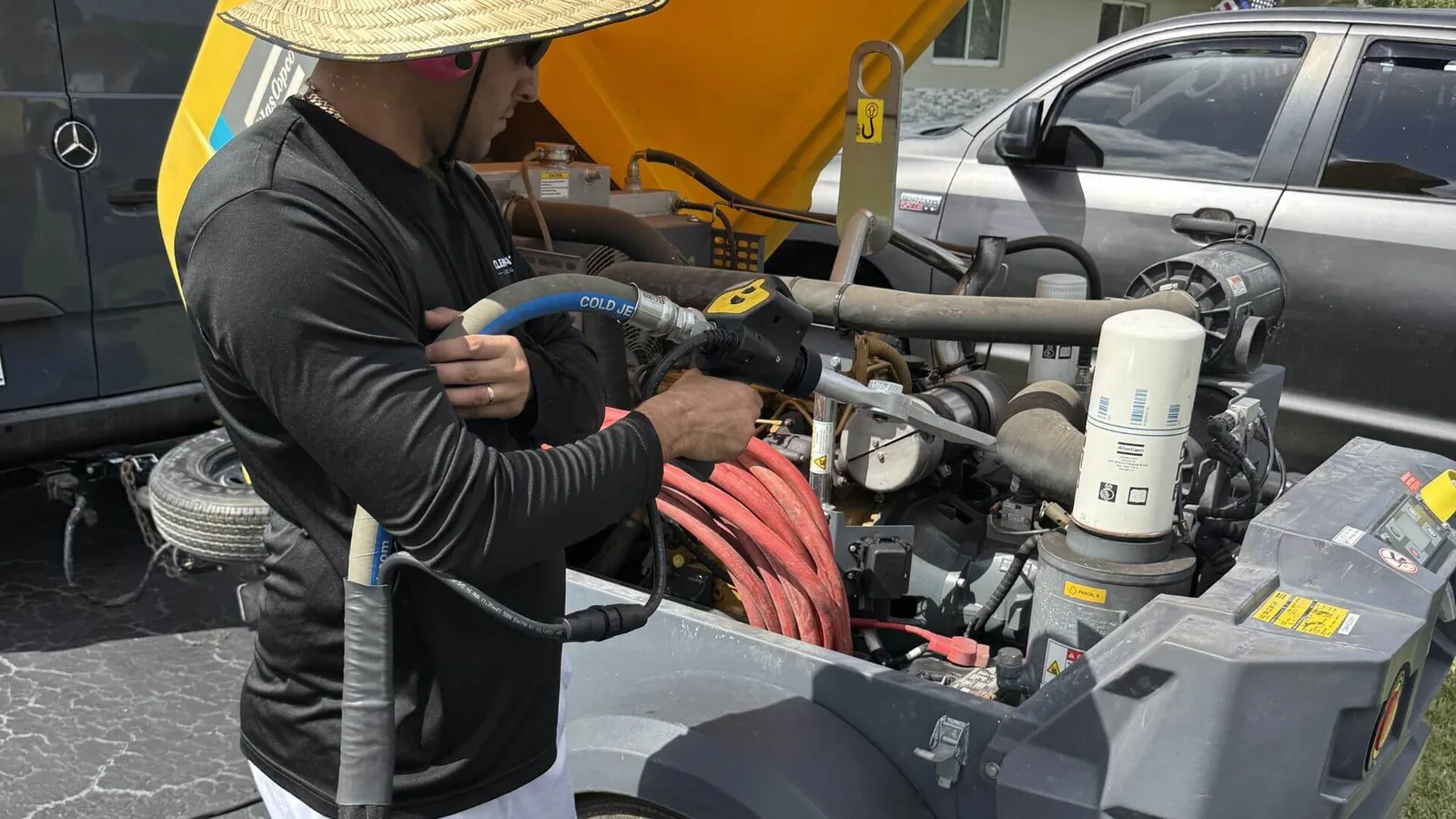
We put sheeting down before we start so the grime lands where we can gather it. When the hose is coiled, the area goes back to how we found it, minus the dirt.
- You look before we pack up
We would rather you find the missed spot while we are standing there than a week later. Another pass on the day is the cheapest fix available.
- You describe the job
Tell us if the equipment can stop and for how long. A machine that can only go down for one shift needs a different plan from a car sitting in a garage all week.
- We look at access and containment
Hose run, compressor position, what needs masking, and where the contaminant is collected. For food and electrical jobs the containment plan takes longer to settle than the blasting does.
What happens in your space
Expect noise. Everybody inside the working area wears hearing protection, us included.
Cleaned surfaces will be cold. We mention it so nobody grabs a part straight off the nozzle, and so a little moisture as it warms does not look like a problem. It is not.
Your shop air stays yours. Our compressor rides on the truck, so nothing on your side gets tied up while we clean.
Masking happens first. Whatever is adjacent and vulnerable gets covered before the hose is picked up.
Describe what you are dealing with.
Where is it, and how easy is it to get to? Add the equipment and the contaminant, and we have what we need to call you back.