What builds up, and why it matters
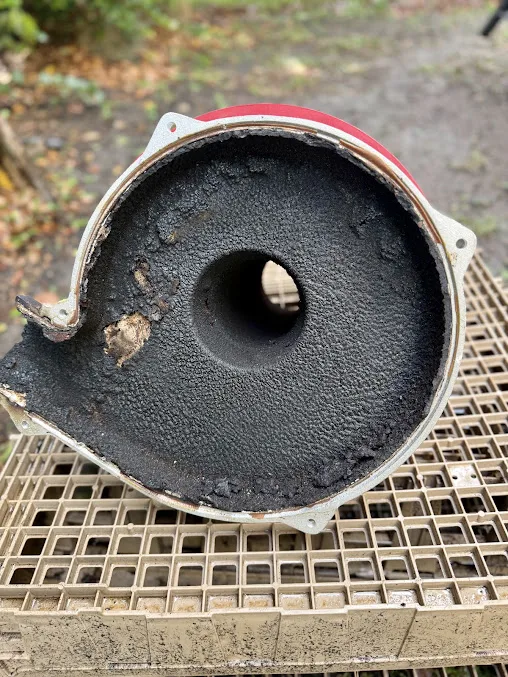
On this kind of work the problem is carbonized product, fat, starch, sugar residue and burnt-on build-up. Dry ice leaves no chemical residue on a food contact surface, and no water in a place where standing water is a sanitation problem. That is the whole reason it is used in food production.
Cleaning is usually scheduled around sanitation and production windows. The people who call us about bakery equipment are usually sanitation and plant managers, and the thing they are actually worried about is a chemical residue finding its way onto product.
The method
Why dry ice and not the alternatives
- Non-abrasive
Cleaning should not shorten the life of what you are cleaning. Because nothing scours the surface, a part can be cleaned again and again without wearing.
- Low moisture
Bearings and wiring hate water. The ice turns to gas instead of liquid, so there is none to work its way inside.
- No secondary waste
Walnut shell and soda end up in every crack of a machine. Dry ice leaves no media behind, only the removed deposit.
- Often no teardown
Cleaning in place cuts the downtime. A machine that stays assembled is back in service sooner than one that had to be stripped and rebuilt.
More food work
Related jobs we get called for
Questions we get asked first
Will it damage the surface underneath?
Done right, no. The risk is in the wrong settings, which is why we start gentle on a test spot and work up instead of opening up on the part itself.
Do you have to take the equipment apart for bakery equipment?
Usually far less than you would expect, and often not at all. Cleaning in place is where most of the saving comes from, because the labor is normally in the teardown and reassembly.
How much mess does it make?
Very little. The ice is gone on contact, so there is no sand or soda to sweep out of corners afterward. You just have the grime, and we collect that.
Do you come to us?
Yes, and nothing of yours needs to move. The equipment rides with us, and we travel across South Florida from Miami, out to about the hundred-mile mark.
What does a job cost?
The figure is tied to the work itself, so we price it once we know what it is. Keep in mind the bigger saving is often the teardown you no longer pay for. Tell us about the job and we will put a real number on it.
How soon can you look at it?
Send a description today, photos if you have them. An owner looks at it and comes back to you, and if your timeline is tight we will say whether it is doable before you plan around us.
The comparison
What the alternatives actually do
- Media blasting
Grit removes material to do its job, so a machined face or a plated part pays for the cleaning.
- Pressure washing
The water has to go somewhere, and on most equipment that somewhere is inside it.
- Solvent and degreaser
It dissolves the deposit and often the finish underneath, then leaves a film behind either way.
- Hand scraping
Slow, inconsistent, and the tool marks the surface. Fine for a small area, unworkable across a machine.
- Dry ice
It is the only one on this list where the media stops existing the moment it has worked.
What comes off
The deposits we see most
Below is what we remove most often. What they share is a bond, and breaking bonds is what dry ice does.
- Grease and oil
The soft film that holds dust and swarf against metal. It is what makes a part feel dirty long after it looks clean, and it comes off first.
- Carbon and soot
Heat-bonded black deposit. Because heat put it there, a sudden cold front is what breaks its grip.
- Adhesive and sealant
The stubborn film under old tape, or the gasket that tore and left half of itself behind.
- Resin and mold release
Molds can often be cleaned in place, without pulling the tool out of the press. Cured residue comes off and the surface stays true.
- Paint and coatings
Selective removal, layer by layer, on parts where media blasting would cut into the substrate.
- Salt and corrosion product
Salt deposit and the oxidation it starts. Anything abrasive removes the protection along with the salt.
- Ink and printing residue
Dried ink on precision roller faces, cleaned without altering the cell structure that does the work.
How a job runs
What happens once you call
If this is your first time hiring dry ice blasting, here is how a job goes from the first call to the last pass.
- You look before we pack up
If something needs another pass we do it then, on site, while the rig is still running. That is a better outcome for everyone than a callback.
- You describe the job
Send images if you can, they settle most of the questions. A wrong-tool verdict comes on that first call, not after the invoice.
- We look at access and containment
If something has to be unbolted to reach the dirt, we say so before we arrive. Most of the time it doesn’t, but we will not spring it on you on the day.
- We test a small area
An out-of-sight patch comes first so pressure and pellet size are proven before anything that shows. Soft alloys, older paint and bare metal each want different numbers.
- We blast, then clean up
There is no spent media to recover, only the deposit, which we collect before packing up.
What happens in your space
The piece will feel like it came out of a freezer. Thin parts warm up quickly, while thick castings take longer and may collect some condensation along the way.
We are fully self-supplied. No outlet, no water and no air line from your building are needed.
Anything nearby that should not be touched gets masked before we start. That is quicker than explaining it afterward.
Part of every indoor job is airflow. Dry ice turns from solid to gas without leaving residue, and that gas displaces oxygen in a closed area. We plan for it at the start, the same way we plan the hose run.

Tell us what needs cleaning.
Start with the basics and we will ask the rest on the phone. The call comes from one of the owners.