Home / Service areas / Broward County / Lauderdale-by-the-Sea
Broward County · Florida
Lauderdale-by-the-Sea dry ice blasting
Lauderdale-by-the-Sea work comes to us the same way most of it does: something is coated in build-up and cannot be sanded, soaked or dissolved.
How we work in this area
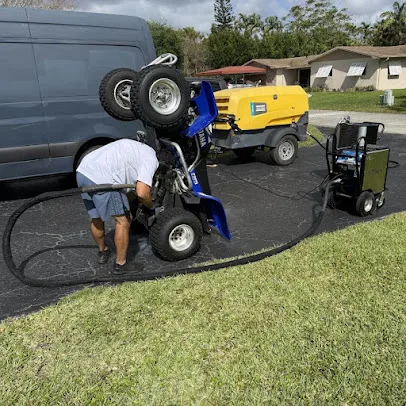
Everything arrives on the van: compressor, hose, operator and containment. So the equipment stays put. Everything that has to move arrives on the truck instead.
Solid to gas on impact. Nothing settles into a bearing, nothing runs toward a drain, and the only residue is what was already on the part.

What we clean
What we get called for in Lauderdale-by-the-Sea
Nearby
Also working across Broward County
Questions from Lauderdale-by-the-Sea
Do you charge for the drive?
It depends how far out the job is. We will be straight with you about it when you describe the work.
How do we book it in?
Send the equipment, the location and a short description with photos if you have them. One of the owners calls you back.
Do you actually come out to Lauderdale-by-the-Sea?
Yes, Lauderdale-by-the-Sea is well within range, and the compressor comes on the truck with everything else.
What do you need from us on site?
Space for the rig and a way to reach the machine. Everything else arrives with us.
How flexible are the hours?
Yes, within reason. Planned outages are easiest because everybody already knows the window.
What sort of work do you get called for?
Everything from an engine bay in a driveway to a production line at shutdown. The process is the same, pointed at a different problem.
What the climate does here
Salt carries a long way inland here, and it keeps working on metal every day of the year. Which is exactly the situation where a non-abrasive, low-moisture method is worth the call.
Shops, marine yards, warehouses and home garages all end up with the same problem in different forms. Driveway or plant floor, the requirement is the same: room for the rig and access to the machine.
The pellet turns to gas, so nothing runs off toward a drain and nothing abrasive stays behind in a bearing. On a cramped Broward County site that usually decides it.
What comes off
What dry ice actually removes
The rule of thumb is simple: anything stuck on rather than built in. These are the deposits we see most.
- Grease and oil
Oil film is the layer everything else sticks to. Remove it and half the job is already done.
- Carbon and soot
The hard black crust on a housing, an oven or a weld cell. Bonded by heat, and the first thing to release under thermal shock.
- Adhesive and sealant
Sealant squeezed out and cured where it was never supposed to set.
- Resin and mold release
Production residue cured onto tooling. Solvent softens it and leaves its own film; the ice lifts it and takes nothing with it.
- Paint and coatings
Taken off in a controlled way when what is underneath matters more than speed.
- Salt and corrosion product
Salt deposit and the oxidation it starts. Anything abrasive removes the protection along with the salt.
- Ink and printing residue
Dried ink and coating build-up on rollers and press components, where the surface texture is the product.
How a job runs
How a job actually runs
Most people have never watched dry ice blasting happen and are not sure what they are agreeing to. Here is the whole sequence, start to finish.
- You look before we pack up
If something needs another pass we do it then, on site, while the rig is still running. That is a better outcome for everyone than a callback.
- You describe the job
We start with what it is and what is on it. Whether it can come offline matters as much as the contaminant, and a wrong-tool answer is one we give up front rather than after the invoice.
- We look at access and containment
Hose run, compressor position, what needs masking, and where the contaminant is collected. For food and electrical jobs the containment plan takes longer to settle than the blasting does.
- We test a small area
Settings get proven somewhere nobody looks before they get used somewhere everybody does. What is correct on cast iron will mark aluminum, so the test is not a formality.
- We blast, then clean up
The media disappears on contact; the contaminant does not. Gathering what came off is included, not a line added afterward.
The comparison
What the alternatives actually do
- Media blasting
It takes the top off whatever it touches. That is the point on rusted plate and the problem everywhere else.
- Pressure washing
Pressure pushes moisture past seals and into connectors, and then you wait. Panels and motors rule it out.
- Solvent and degreaser
Chemistry works, but you inherit ventilation, waste handling and a film on the surface.
- Hand scraping
Hours of work for an inconsistent result, with gouges where the blade slipped.
- Dry ice
Thermal contraction cracks the bond between deposit and surface, then the pellet gasses off. Nothing abrasive, nothing wet, nothing left.
What the job is like to stand next to
This is not a quiet method. Ear defenders are standard issue on site for anyone nearby.
The part will be cold when we finish. Sometimes that means a short wait before handling; sometimes it means a film of condensation as it warms back up.
Everything the rig needs arrives with it. No tap, no drain, no outlet.
Anything nearby that should not be touched gets masked before we start. That is quicker than explaining it afterward.
Send us the job.
A short description and a location is enough to start. Add photos if you can. You will speak to an owner, not a scheduler.