Home / Service areas / Palm Beach County / Schall Circle
Palm Beach County · Florida
Schall Circle dry ice blasting
Most of what we clean around Schall Circle is equipment somebody cannot afford to damage.
How the work runs here
The compressor runs off the truck, so there is no wash pad to find and no runoff to manage. It is also why nothing has to be crated up and driven across town, the work happens where the machine already sits in Schall Circle.
The pellet turns straight to gas when it hits, which means no sand in the machine and no sludge on the floor. The only thing to collect is the contaminant itself, and that is included.

What we clean
Where this method earns its keep in Schall Circle
Nearby
Also working across Palm Beach County
Questions from Schall Circle
What do most jobs look like?
It ranges from a single restoration project to a plant maintenance window. The method does not change much.
Is there a travel charge?
Distance can factor in. You will hear about it up front, not on the invoice.
What is the first step?
Describe the job and send a photo or two. Giancarlo or Kenny will call you, not a scheduler.
Will you travel to Schall Circle?
Yes. Schall Circle is inside our regular working area, and the rig travels to the job rather than the other way round.
Do you need anything set up before you arrive?
Access to the equipment and somewhere to park the compressor. No water hookup, no drain and no wash bay.
Can you come outside business hours?
Generally yes. Weekend and overnight work is routine, and the limiting factor is usually noise, not us.
The local conditions
The heat matters more than people expect: baked-on residue cures harder in a South Florida summer. That is why so much of the work is removing what has bonded to a surface without taking the surface with it.
Light industrial, automotive and marine make up most of what we are called out for. In every case the truck brings its own air and its own containment, so you are not adapting the site to suit the method.
With no slurry to contain and no media to recover, a confined Palm Beach County site stops being a problem.
What comes off
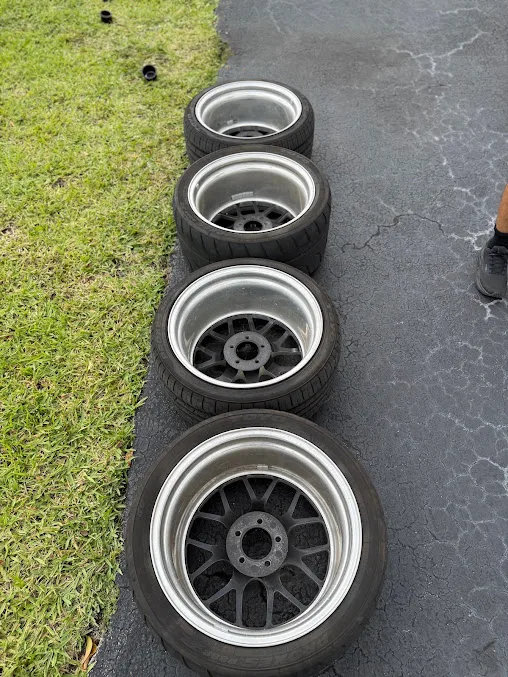
The deposits we see most
Most calls involve one of the following. The common factor is a bond between two things that should not be bonded.
- Salt and corrosion product
A constant in South Florida. Removing it without stripping the protective finish is the whole trick.
- Ink and printing residue
Dried ink and coating build-up on rollers and press components, where the surface texture is the product.
- Food residue
Burnt-on product, fat and sugar on processing gear, with no chemical residue left on a contact surface.
- Grease and oil
The soft film that holds dust and swarf against metal. It is what makes a part feel dirty long after it looks clean, and it comes off first.
- Carbon and soot
Heat-bonded black deposit. Because heat put it there, a sudden cold front is what breaks its grip.
- Adhesive and sealant
The stubborn film under old tape, or the gasket that tore and left half of itself behind.
- Resin and mold release
Production residue cured onto tooling. Solvent softens it and leaves its own film; the ice lifts it and takes nothing with it.
How a job runs
What happens once you call
If you have not seen this done before, the process is worth reading once. Nothing below is hidden in a footnote.
- We test a small area
Settings get proven somewhere nobody looks before they get used somewhere everybody does. What is correct on cast iron will mark aluminum, so the test is not a formality.
- We blast, then clean up
Nothing is left of the pellet, so the only thing to collect is what was on your equipment. That collection is part of the work we quoted.
- You look before we pack up
Inspect it with the rig still set up. Anything you are not happy with gets another go before we leave.
- You describe the job
Send images if you can, they settle most of the questions. A wrong-tool verdict comes on that first call, not after the invoice.
- We look at access and containment
Where the compressor sits, how far the hose has to reach, what gets masked or moved, and where the removed contaminant ends up. On food and electrical work this is most of the planning.
The comparison
Why not just pressure wash it
- Pressure washing
Pressure pushes moisture past seals and into connectors, and then you wait. Panels and motors rule it out.
- Solvent and degreaser
Chemistry works, but you inherit ventilation, waste handling and a film on the surface.
- Hand scraping
Slow, inconsistent, and the tool marks the surface. Fine for a small area, unworkable across a machine.
- Media blasting
It takes the top off whatever it touches. That is the point on rusted plate and the problem everywhere else.
- Dry ice
Cold breaks the bond and the media vanishes. The substrate is untouched and there is no second mess to clean up.
What happens in your space
The process is loud. Hearing protection is standard for anyone in the working area, which is why you will see ear defenders in most of our photographs.
Cold surfaces are the one aftereffect. Depending on the piece that is either a few minutes of patience or some condensation while it returns to room temperature.
Air comes from our own compressor. You do not need to provide power, water or a connection of any kind.
We cover what should not be hit before anything gets blasted. It takes minutes and saves arguments.
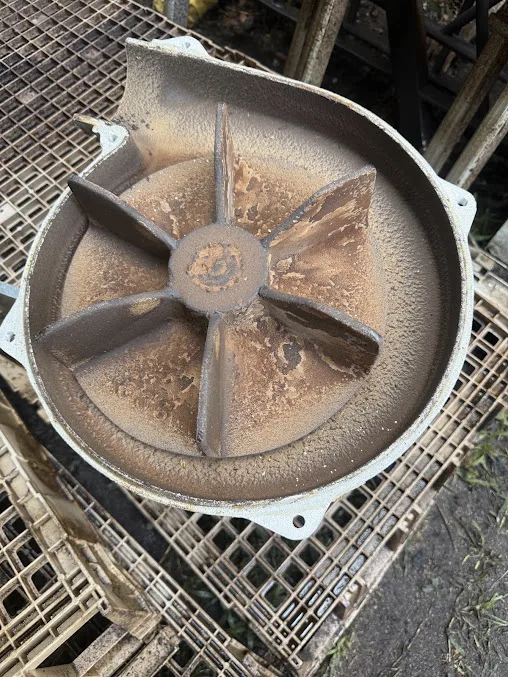
Tell us what needs cleaning.
Tell us what the machine is, where it is and what is on it. A photo or two speeds it up. One of the owners calls you back.