18 services · Miami, FL
Automotive Ice Blasting
Media blasting will cut into aluminum and pit a frame. Pressure washing drives water into looms and bearings. Solvent strips the finishes you wanted to keep. Dry ice takes the contamination and leaves the part.
What we clean, and what it is covered in
The build-up here is baked grease, road film, undercoating, sound deadening, adhesive and brake dust. Engine bays, frames and undercarriages are cleaned on a lift, on stands or in your driveway.
Most of the people who call are restorers, shops and owners who actually care about the vehicle. What they are protecting against is damage to a car that took years to put together, which is exactly why an abrasive or a solvent is the wrong answer.

All 18 services
Every automotive job we take
Questions about this work
What makes dry ice right for this work?
Media blasting will cut into aluminum and pit a frame. Pressure washing drives water into looms and bearings. Solvent strips the finishes you wanted to keep. Dry ice takes the contamination and leaves the part.
Do you clean in place?
Engine bays, frames and undercarriages are cleaned on a lift, on stands or in your driveway. Most of this work does not need a teardown.
Will it damage the surface?
On most substrates, no. The pellet is soft and sublimates on impact, so the work is thermal rather than abrasive. We test an inconspicuous spot first on anything unusual.
Is there any residue afterward?
None from the media. Dry ice sublimates, so what is left is the contaminant we came to remove, and that is ours to clean up.
Do you come to us?
Yes. The rig is mobile and works across South Florida from Miami out to roughly a hundred miles.
What does it cost?
It depends on the equipment, the contaminant and the access. Describe the job and we will give you a real figure rather than a guess over the phone.
What comes off
What dry ice actually removes
The rule of thumb is simple: anything stuck on rather than built in. These are the deposits we see most.
- Paint and coatings
Removed selectively where the substrate underneath has to survive, which rules out most abrasive approaches.
- Salt and corrosion product
The year-round problem on the coast. The finish holding corrosion back has to survive the cleaning.
- Ink and printing residue
Dried ink on precision roller faces, cleaned without altering the cell structure that does the work.
- Food residue
Burnt-on product, fat and sugar on processing gear, with no chemical residue left on a contact surface.
- Grease and oil
The greasy base coat that traps grit and dust. It releases early and takes the loose material with it.
- Carbon and soot
The layer of black on anything that runs hot, from an engine to a fryer. Scraping it gouges the surface; the cold pops it off instead.
- Adhesive and sealant
Bonded material that outlived whatever it was bonding, usually harder to shift than the part it is on.
How a job runs
How a job actually runs
Straight answers start with how the work happens. Read through these steps once and you will know what the day looks like.
- You look before we pack up
Inspect it with the rig still set up. Anything you are not happy with gets another go before we leave.
- You describe the job
Send images if you can, they settle most of the questions. A wrong-tool verdict comes on that first call, not after the invoice.
- We look at access and containment
Siting the compressor, masking what must not be touched, and catching what comes off, settled before the first pellet.
- We test a small area
Aluminum, cast iron and painted steel all want different settings, and guessing is how surfaces get marked. A small hidden test settles it before the real work starts.
- We blast, then clean up
The media disappears on contact; the contaminant does not. Gathering what came off is included, not a line added afterward.
The comparison
Why not just pressure wash it
- Media blasting
It takes the top off whatever it touches. That is the point on rusted plate and the problem everywhere else.
- Pressure washing
It is fast and it is wet, which is fine outdoors and unusable on anything with a winding in it.
- Solvent and degreaser
Trades the deposit for a residue, plus ventilation and waste to deal with, and it is hard on the finish.
- Hand scraping
Labor-intensive and uneven, and whatever you scrape with eventually marks what you are scraping.
- Dry ice
Thermal shock breaks the bond. The pellet sublimates, so nothing abrasive touches the part and nothing is left to collect but the contaminant.
What the job is like to stand next to
Ventilation comes before anything else on an indoor job. Dry ice is non-toxic and residue-free, but the gas it gives off displaces oxygen in a confined space.
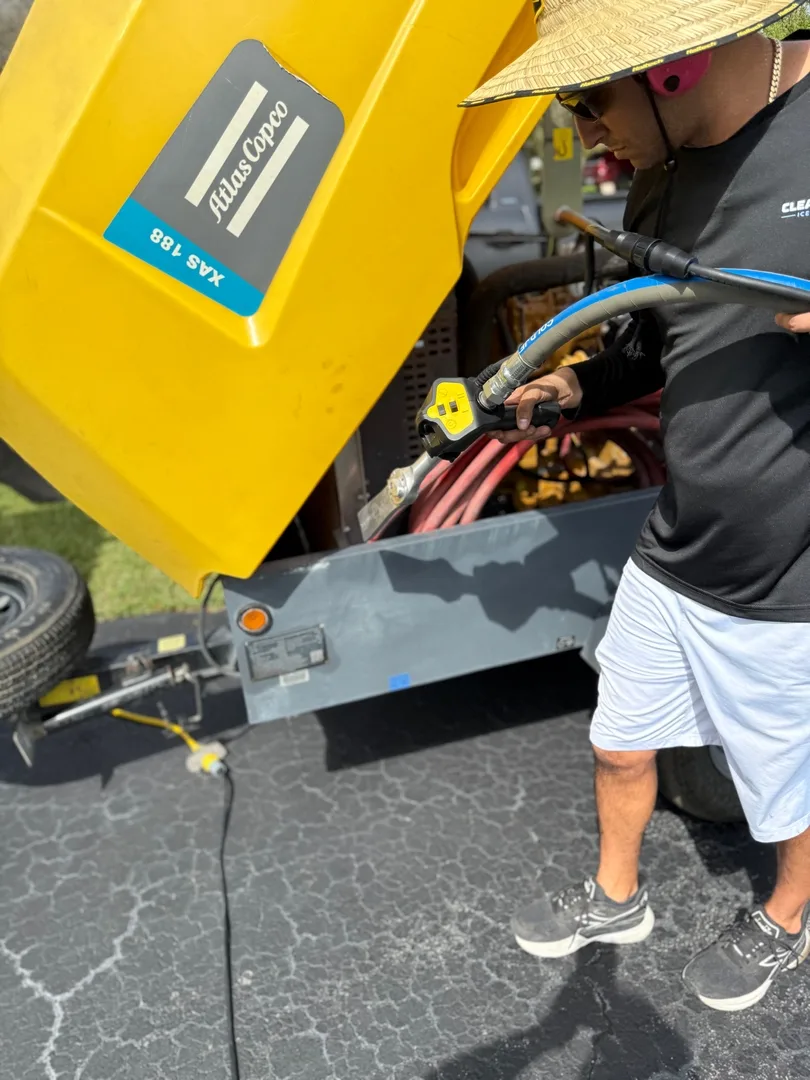
The process is loud. Hearing protection is standard for anyone in the working area, which is why you will see ear defenders in most of our photographs.
The process ends with cold equipment rather than wet equipment. A short wait, and sometimes some condensation as it warms, is all there is to it.
Everything the rig needs arrives with it. No tap, no drain, no outlet.
Why us
Why people call us back
- We test before we commit
Unfamiliar material gets a hidden test patch before anything visible is touched.
- The rig comes to you
We are mobile. The equipment stays where it is and we bring everything needed to it.
- We clean up after ourselves
The ice is gone; what came off your equipment is not. Gathering it is included.
- Firefighter owned and operated
Giancarlo and Kenny both came out of the fire service, and the discipline that job demands is the discipline this one gets.
- You speak to an owner
No dispatcher, no account manager. You talk to whoever is going to be holding the hose.
- We will tell you no
Not everything should be dry ice blasted. Being told that early is worth more than being sold the job.
Tell us what needs cleaning.
Snap a couple of photos of the dirty area and send them over with a sentence or two. Seeing the buildup tells us more than a long description could.