Home / Service areas / Miami-Dade County / North Miami Beach
Miami-Dade County · Florida
North Miami Beach dry ice blasting
Most of what we clean around North Miami Beach is equipment somebody cannot afford to damage.
How the work runs here
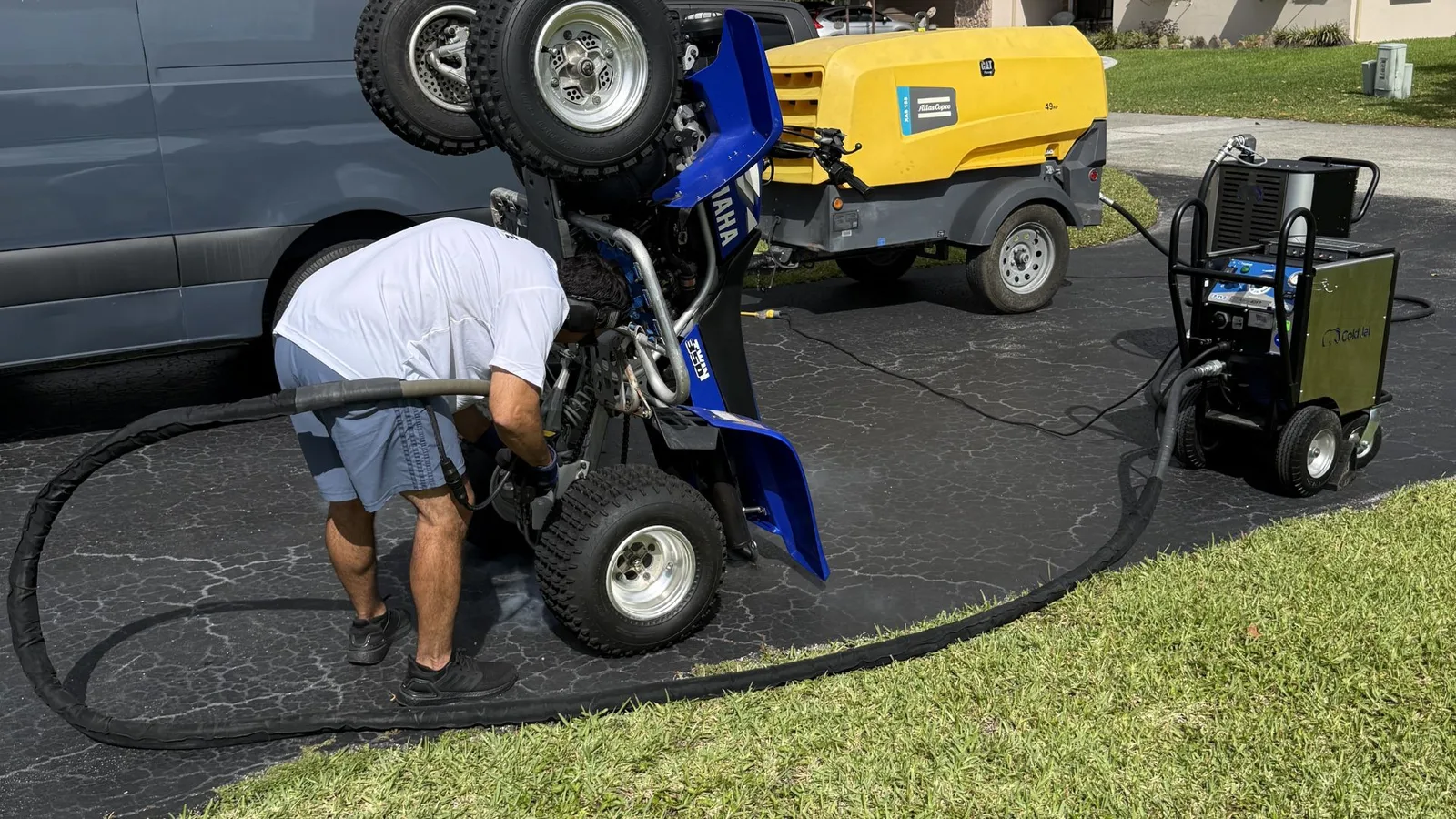
The compressor runs off the truck, so there is no wash pad to find and no runoff to manage. It is also why nothing has to be crated up and driven across town, the work happens where the machine already sits in North Miami Beach.
The pellet turns straight to gas when it hits, which means no sand in the machine and no sludge on the floor. The only thing to collect is the contaminant itself, and that is included.

What we clean
Where this method earns its keep in North Miami Beach
Nearby
Also working across Miami-Dade County
Questions from North Miami Beach
How do we book it in?
Describe the job and send a photo or two. Giancarlo or Kenny will call you, not a scheduler.
Will you travel to North Miami Beach?
Yes, North Miami Beach is well within range, and the compressor comes on the truck with everything else.
Do you need anything set up before you arrive?
Space for the rig and a way to reach the machine. Everything else arrives with us.
Can you come outside business hours?
Yes, within reason. Planned outages are easiest because everybody already knows the window.
What do most jobs look like?
Everything from an engine bay in a driveway to a production line at shutdown. The process is the same, pointed at a different problem.
Does distance affect the price?
Distance can factor in. You will hear about it up front, not on the invoice.
The local conditions
The heat matters more than people expect: baked-on residue cures harder in a South Florida summer. That is why so much of the work is removing what has bonded to a surface without taking the surface with it.
Light industrial, automotive and marine make up most of what we are called out for. In every case the truck brings its own air and its own containment, so you are not adapting the site to suit the method.
With no slurry to contain and no media to recover, a confined Miami-Dade County site stops being a problem.
What comes off
The deposits we see most
This list covers the bulk of what people ask us about. All of it is buildup sitting on top of something worth keeping.
- Resin and mold release
Vents and fine details on a mold are where residue hides. The pellet stream reaches into them without rounding over a single edge.
- Paint and coatings
Taken off in a controlled way when what is underneath matters more than speed.
- Salt and corrosion product
Salt deposit and the oxidation it starts. Anything abrasive removes the protection along with the salt.
- Ink and printing residue
Ink and coating on anilox and press rollers, surfaces where changing the texture changes the print.
- Food residue
Burnt-on product, fat and sugar on processing gear, with no chemical residue left on a contact surface.
- Grease and oil
Grease packs into the corners and recesses a brush cannot reach. The ice gets in there and lifts it without anything scraping the part.
- Carbon and soot
Carbon that has been cooked on over months of use. It turns brittle in the cold, so it cracks away from the steel instead of being ground off it.
How a job runs
What happens once you call
Here is what a job looks like from our side. Ask about any of it; none of it is a trade secret.
- We look at access and containment
Siting the compressor, masking what must not be touched, and catching what comes off, settled before the first pellet.
- We test a small area
Old paint can be fragile in ways that don’t show until it is hit. A small patch out of view tells us how it will behave.
- We blast, then clean up
The media disappears on contact; the contaminant does not. Gathering what came off is included, not a line added afterward.
- You look before we pack up
Inspect it with the rig still set up. Anything you are not happy with gets another go before we leave.
- You describe the job
Some people call us after another method has already caused damage. Tell us the history of the part, because we would rather know about a soft spot or a past repair before we plan anything.
The comparison
Why not just pressure wash it
- Hand scraping
Slow enough to be uneconomic on a machine, and the tool always leaves a trace.
- Media blasting
Cuts into the substrate by design. Fine on structural steel, wrong on aluminum, plating, machined faces or anything with a tolerance.
- Pressure washing
Drives water into harnesses, bearings, panels and seams, then everything waits to dry. On electrical work it is simply not an option.
- Solvent and degreaser
It loosens the mess and leaves its own behind, along with fumes and something to dispose of.
- Dry ice
The pellet is soft and the mechanism is temperature, not abrasion. It turns to gas on impact, so the only thing left to sweep up is what came off.
What happens in your space
The noise is the one thing that surprises people the first time. It stops the moment the hose does, and nothing about it lingers.
Expect the part to be cold to the touch when we finish. Give it a few minutes before handling, and do not be surprised by a little condensation as it warms up.
The rig needs compressed air, which the truck supplies. There is no hookup to find and nothing of yours to plug into.
We cover what should not be hit before anything gets blasted. It takes minutes and saves arguments.
Send us the job.
Tell us what you are working on and what is stuck to it. If there is a deadline or a shutdown date, put that in too.