Home / Service areas / Broward County / Boulevard Gardens
Broward County · Florida
Boulevard Gardens dry ice blasting
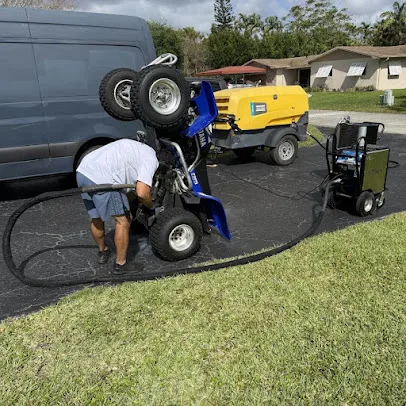
When we take a job in Boulevard Gardens, the rig comes to the machine rather than the other way round.
How the work runs here
Everything arrives on the van: compressor, hose, operator and containment. It is also why nothing has to be crated up and driven across town, the work happens where the machine already sits in Boulevard Gardens.
The pellet turns straight to gas when it hits, which means no sand in the machine and no sludge on the floor. The only thing to collect is the contaminant itself, and that is included.
What we clean
Where this method earns its keep in Boulevard Gardens
Nearby
Also working across Broward County
Questions from Boulevard Gardens
What do you need from us on site?
Space for the rig and a way to reach the machine. Everything else arrives with us.
How flexible are the hours?
Yes, within reason. Planned outages are easiest because everybody already knows the window.
What sort of work do you get called for?
It ranges from a single restoration project to a plant maintenance window. The method does not change much.
Is there a travel charge?
It depends how far out the job is. We will be straight with you about it when you describe the work.
How do I get started?
Describe the job and send a photo or two. Giancarlo or Kenny will call you, not a scheduler.
Do you actually come out to Boulevard Gardens?
Yes, Boulevard Gardens is well within range, and the compressor comes on the truck with everything else.
What the climate does here
Afternoon storms mean equipment that lives outside is wet, then hot, then wet again. It is also why an abrasive method costs you twice: once in the cleaning, again in the finish you removed.
Residential garages and small shops sit alongside the commercial work on any given week. Driveway or plant floor, the requirement is the same: room for the rig and access to the machine.
With no slurry to contain and no media to recover, a confined Broward County site stops being a problem.

What comes off
The deposits we see most
Most calls involve one of the following. The common factor is a bond between two things that should not be bonded.
- Food residue
Burnt-on product, fat and sugar on processing gear, with no chemical residue left on a contact surface.
- Grease and oil
The soft film that holds dust and swarf against metal. It is what makes a part feel dirty long after it looks clean, and it comes off first.
- Carbon and soot
Heat-bonded black deposit. Because heat put it there, a sudden cold front is what breaks its grip.
- Adhesive and sealant
Bonded material that outlived whatever it was bonding, usually harder to shift than the part it is on.
- Resin and mold release
Production residue cured onto tooling. Solvent softens it and leaves its own film; the ice lifts it and takes nothing with it.
- Paint and coatings
Taken off in a controlled way when what is underneath matters more than speed.
- Salt and corrosion product
A constant in South Florida. Removing it without stripping the protective finish is the whole trick.
How a job runs
What happens once you call
If you have not seen this done before, the process is worth reading once. Nothing below is hidden in a footnote.
- You look before we pack up
Walk it with us before the hose goes away. A second pass while the compressor is still running costs nothing; a return visit costs us both.
- You describe the job
What the equipment is, what is on it, where it lives, and whether it can be shut down. Photos tell us more than a paragraph. If dry ice is the wrong tool we say so on that call rather than after taking your money.
- We look at access and containment
How close the truck can get, how far the hose must run, what needs covering, and where the debris goes. That is the bulk of the planning on a tight site.
- We test a small area
Pressure and pellet size get dialed in on an inconspicuous spot before we touch anything visible. Painted parts, soft alloys and older finishes all behave differently, and the right setting on one is the wrong setting on another.
- We blast, then clean up
There is no spent media to recover, only the deposit, which we collect before packing up.
The comparison
What the alternatives actually do
- Hand scraping
Fine on a patch, hopeless on a machine, and the blade leaves its own evidence.
- Media blasting
Cuts into the substrate by design. Fine on structural steel, wrong on aluminum, plating, machined faces or anything with a tolerance.
- Pressure washing
Water gets into everything and has to come out again before the equipment runs. Around electrics it is off the table entirely.
- Solvent and degreaser
Trades the deposit for a residue, plus ventilation and waste to deal with, and it is hard on the finish.
- Dry ice
Cold breaks the bond and the media vanishes. The substrate is untouched and there is no second mess to clean up.
What happens in your space
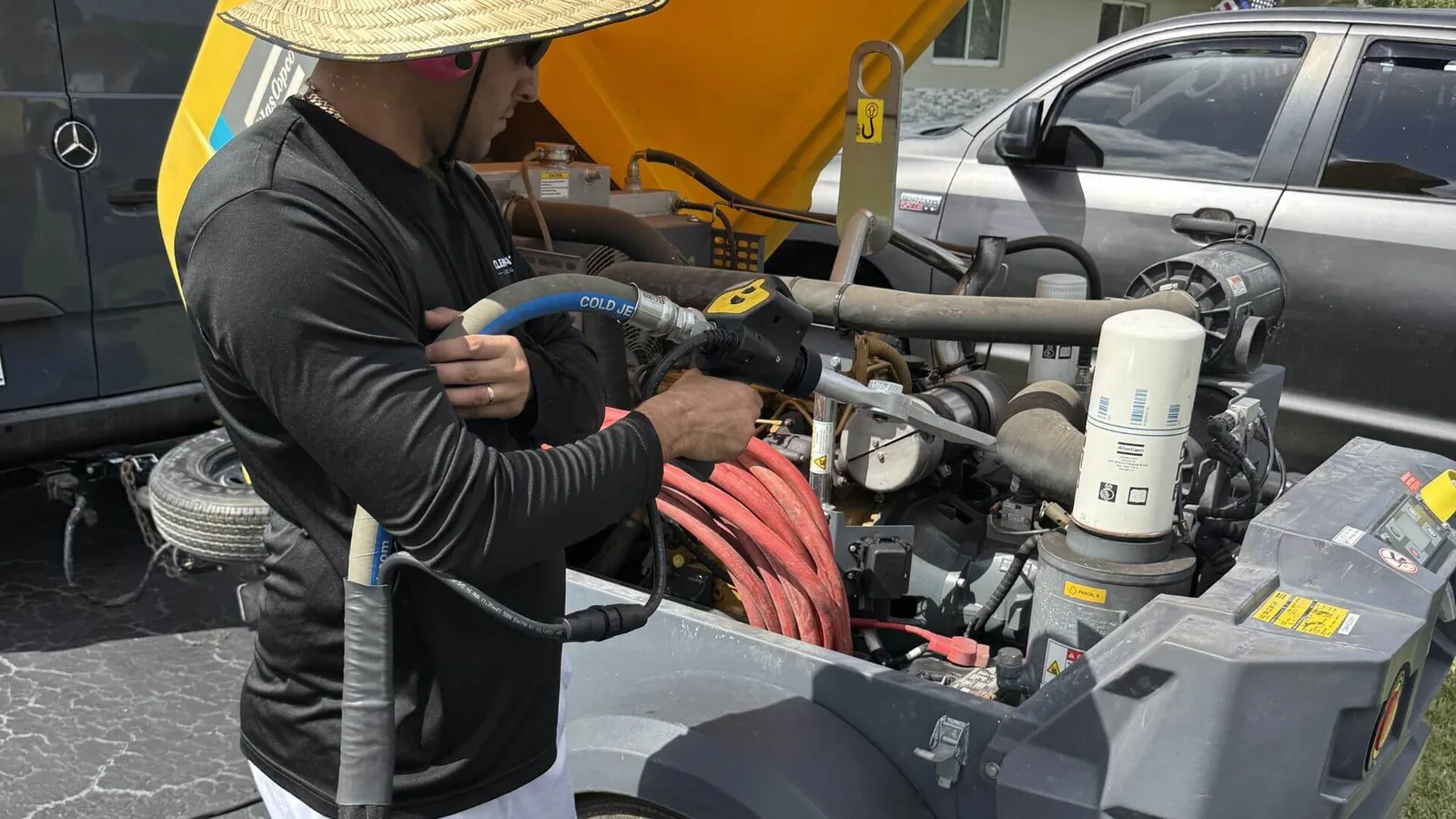
Air comes from our own compressor. You do not need to provide power, water or a connection of any kind.
We cover what should not be hit before anything gets blasted. It takes minutes and saves arguments.
Dry ice is carbon dioxide in solid form. It is non-toxic and leaves no residue, but it does displace oxygen in an enclosed space, so ventilation is part of the setup rather than an afterthought.
This is not a quiet method. Ear defenders are standard issue on site for anyone nearby.
Tell us what needs cleaning.
A short description and a location is enough to start. Add photos if you can. You will speak to an owner, not a scheduler.