Home / Service areas / Miami-Dade County / Richmond Heights
Miami-Dade County · Florida
Richmond Heights dry ice blasting
Richmond Heights calls tend to arrive with a constraint attached, which is exactly where this method earns its keep.
How the work runs here
We work on driveways, in yards and inside shops that cannot take water on the floor. It is also why nothing has to be crated up and driven across town, the work happens where the machine already sits in Richmond Heights.
Nothing of the ice survives the blast. That removes the entire cleanup problem every other method creates, leaving only the deposit that came off the equipment.

What we clean
Where this method earns its keep in Richmond Heights
Nearby
Also working across Miami-Dade County
Questions from Richmond Heights
What do you need from us on site?
Access to the equipment and somewhere to park the compressor. No water hookup, no drain and no wash bay.
How flexible are the hours?
Yes, within reason. Planned outages are easiest because everybody already knows the window.
What sort of work do you get called for?
It ranges from a single restoration project to a plant maintenance window. The method does not change much.
Do you charge for the drive?
It depends how far out the job is. We will be straight with you about it when you describe the work.
What is the first step?
Send the equipment, the location and a short description with photos if you have them. One of the owners calls you back.
Do you actually come out to Richmond Heights?
Yes, Richmond Heights is well within range, and the compressor comes on the truck with everything else.
What the climate does here
The heat matters more than people expect: baked-on residue cures harder in a South Florida summer. That is why so much of the work is removing what has bonded to a surface without taking the surface with it.
Light industrial, automotive and marine make up most of what we are called out for. The setup is the same in all of them, because everything the job needs turns up on the van.
With no slurry to contain and no media to recover, a confined Miami-Dade County site stops being a problem.
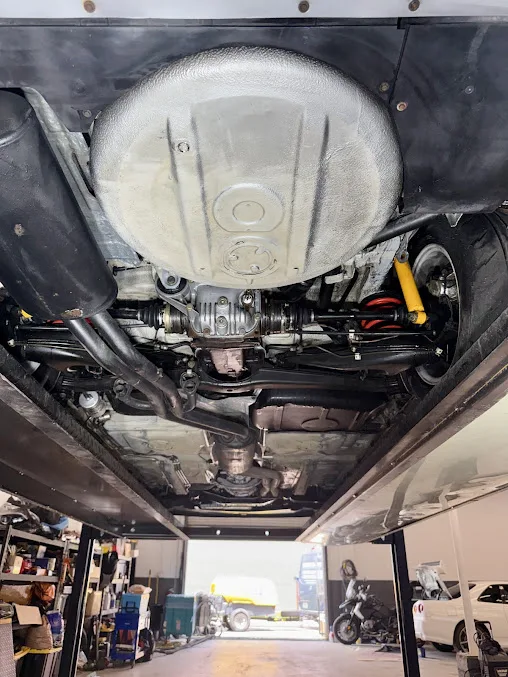
What comes off
The deposits we see most
The same handful of problems come up over and over. In every case, something has bonded to a surface it does not belong on.
- Resin and mold release
Release agent and resin build-up on tooling, where a solvent fix trades one residue for another.
- Paint and coatings
Removed selectively where the substrate underneath has to survive, which rules out most abrasive approaches.
- Salt and corrosion product
Salt deposit and the oxidation it starts. Anything abrasive removes the protection along with the salt.
- Ink and printing residue
Ink and coating on anilox and press rollers, surfaces where changing the texture changes the print.
- Food residue
Carbonized product build-up in a plant where neither standing water nor a chemical film is acceptable.
- Grease and oil
The greasy base coat that traps grit and dust. It releases early and takes the loose material with it.
- Carbon and soot
Heat-bonded black deposit. Because heat put it there, a sudden cold front is what breaks its grip.
How a job runs
What happens once you call
Most people have never watched this done. The steps below are exactly what happens, with nothing left out.
- You describe the job
What it is, what is on it and whether it can stop. If the answer is that dry ice is wrong for it, you get that answer first, not last.
- We look at access and containment
Siting the compressor, masking what must not be touched, and catching what comes off, settled before the first pellet.
- We test a small area
Nothing visible gets blasted until the settings have been tried on a hidden area. What suits heavy steel can be too much for a thin or soft part, and the test catches that.
- We blast, then clean up
One mess instead of two: the pellet vanishes and we take away what it removed.
- You look before we pack up
We would rather you find the missed spot while we are standing there than a week later. Another pass on the day is the cheapest fix available.
The comparison
What the alternatives actually do
- Hand scraping
Labor-intensive and uneven, and whatever you scrape with eventually marks what you are scraping.
- Media blasting
Grit removes material to do its job, so a machined face or a plated part pays for the cleaning.
- Pressure washing
It is fast and it is wet, which is fine outdoors and unusable on anything with a winding in it.
- Solvent and degreaser
Trades the deposit for a residue, plus ventilation and waste to deal with, and it is hard on the finish.
- Dry ice
Thermal shock breaks the bond. The pellet sublimates, so nothing abrasive touches the part and nothing is left to collect but the contaminant.
What happens in your space
Expect noise. Everybody inside the working area wears hearing protection, us included.
Cleaned surfaces will be cold. We mention it so nobody grabs a part straight off the nozzle, and so a little moisture as it warms does not look like a problem. It is not.
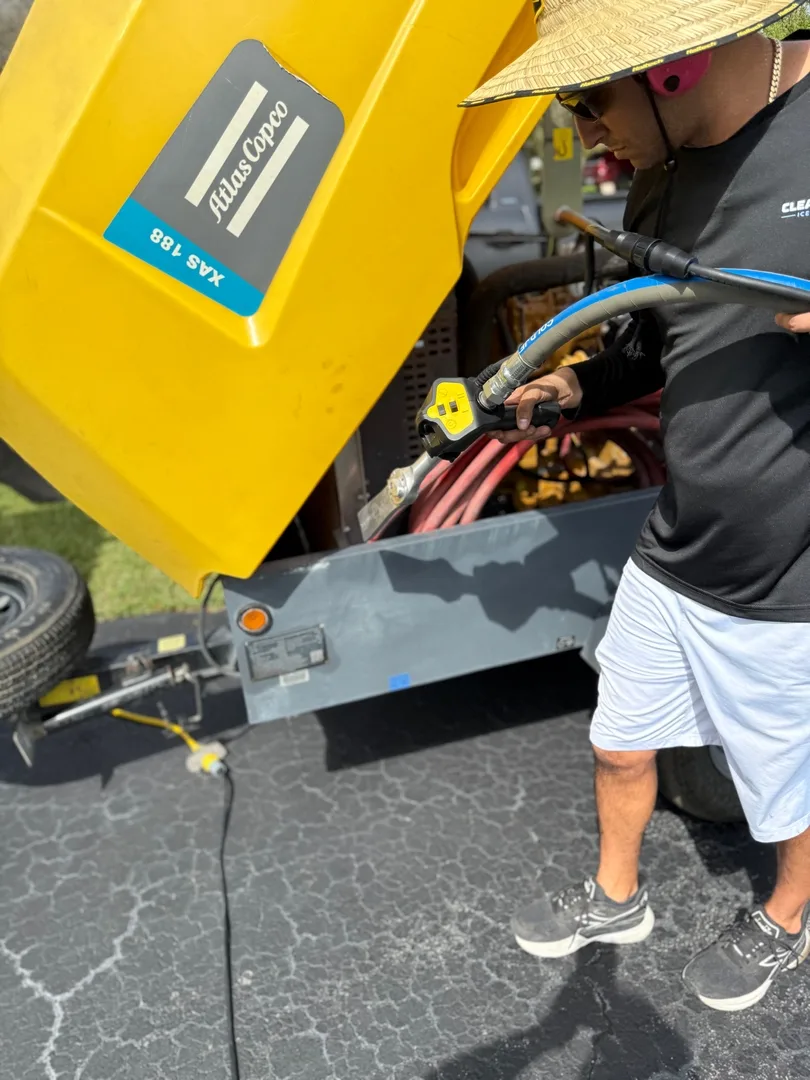
Nothing from you is required to run the rig. Our compressor and hose come with us on every job.
Anything nearby that should not be touched gets masked before we start. That is quicker than explaining it afterward.
Send us the job.
What is the equipment, and what is caked on it? That plus a location is enough for us to call you back.