Home / Service areas / Palm Beach County / Seminole Manor
Palm Beach County · Florida
Seminole Manor dry ice blasting
Seminole Manor calls tend to arrive with a constraint attached, which is exactly where this method earns its keep.
The practical side
Nothing about the setup needs a drain, a hookup or a bay. Which means no downtime spent in transit and no risk of damage moving it out of Seminole Manor and back.
Dry ice sublimates on contact, so there is no grit, no slurry and no secondary media to sweep up afterward. What is left on the floor is the grease or carbon that came off, and collecting that is part of the job.

What we clean
The work we take on around Seminole Manor
Nearby
Also working across Palm Beach County
Questions from Seminole Manor
Can you work around our schedule?
Nearly always. Give us the hours you can spare and we will say what genuinely fits inside them.
Who calls you around here?
Everything from an engine bay in a driveway to a production line at shutdown. The process is the same, pointed at a different problem.
Is there a travel charge?
It depends how far out the job is. We will be straight with you about it when you describe the work.
How do I get started?
Send the equipment, the location and a short description with photos if you have them. One of the owners calls you back.
Is Seminole Manor in your area?
Yes. Seminole Manor is inside our regular working area, and the rig travels to the job rather than the other way round.
What does the site need to have?
Space for the rig and a way to reach the machine. Everything else arrives with us.
Why Seminole Manor equipment ends up like this
Afternoon storms mean equipment that lives outside is wet, then hot, then wet again. It is also why an abrasive method costs you twice: once in the cleaning, again in the finish you removed.
Residential garages and small shops sit alongside the commercial work on any given week. None of those settings need modifying: the compressor, hose and collection all come with us.
Because the media sublimates, there is no slurry running toward a storm drain and no grit left in a machine. On a tight site in Palm Beach County that is often the deciding factor.
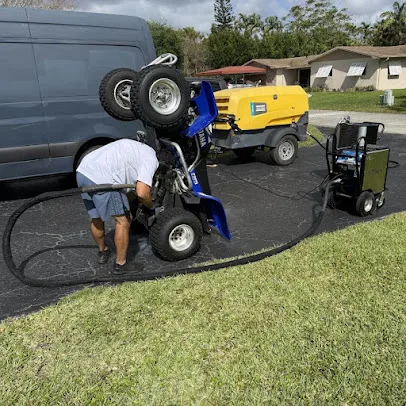
What comes off
What comes off, and why
The rule of thumb is simple. If something is stuck on top of the material rather than being the material, dry ice has a good chance of lifting it. These are the deposits we get called about most.
- Adhesive and sealant
Bonded material that outlived whatever it was bonding, usually harder to shift than the part it is on.
- Resin and mold release
Molds can often be cleaned in place, without pulling the tool out of the press. Cured residue comes off and the surface stays true.
- Paint and coatings
Selective removal, layer by layer, on parts where media blasting would cut into the substrate.
- Salt and corrosion product
The year-round problem on the coast. The finish holding corrosion back has to survive the cleaning.
- Ink and printing residue
Ink and coating on anilox and press rollers, surfaces where changing the texture changes the print.
- Food residue
Carbonized product, fat, starch and sugar build-up on processing equipment, cleaned without chemicals touching a food contact surface.
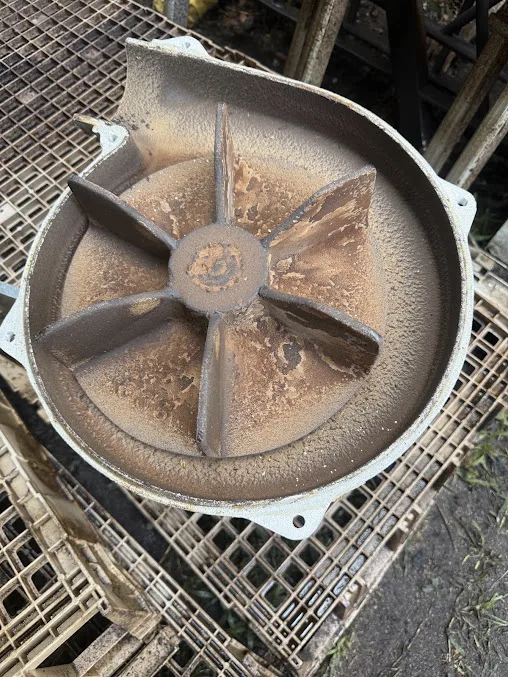
- Grease and oil
Oil film is the layer everything else sticks to. Remove it and half the job is already done.
How a job runs
Nothing about this should be a surprise
Nobody should have to guess what they booked. This is every stage of a job in the order it happens.
- You describe the job
It starts with a conversation about what you have and what is stuck to it. Tell us what you have already tried too. If solvent or pressure washing has failed, that tells us a lot about the bond.
- We look at access and containment
Siting the compressor, masking what must not be touched, and catching what comes off, settled before the first pellet.
- We test a small area
Sensitive equipment gets the same treatment as a show car: a hidden patch first, at low pressure, before the hose goes anywhere near what matters.
- We blast, then clean up
The media disappears on contact; the contaminant does not. Gathering what came off is included, not a line added afterward.
- You look before we pack up
Inspect it with the rig still set up. Anything you are not happy with gets another go before we leave.
The comparison
The other ways to do this
- Solvent and degreaser
It loosens the mess and leaves its own behind, along with fumes and something to dispose of.
- Hand scraping
Labor-intensive and uneven, and whatever you scrape with eventually marks what you are scraping.
- Media blasting
It takes the top off whatever it touches. That is the point on rusted plate and the problem everywhere else.
- Pressure washing
Forces water where water should not go, looms, bearings, seams, and then the job stops while it dries.
- Dry ice
The deposit shrinks away from the surface it is stuck to and releases. The ice is gone before it can do any harm.
What to expect on site
We cover what should not be hit before anything gets blasted. It takes minutes and saves arguments.
Dry ice is plain carbon dioxide. It is not toxic and leaves nothing behind, but in a closed room it crowds out oxygen, so we sort out airflow before we start.
This is not a quiet method. Ear defenders are standard issue on site for anyone nearby.
Thick castings hold the cold longer than thin panels. On heavy pieces, plan on a short wait before anyone works on them.
Tell us what needs cleaning.
Tell us about the job in your own words and attach photos if you can. One of the two owners, Giancarlo or Kenny, calls you back.