What builds up, and why it matters
On this kind of work the problem is grease, carbon, adhesive and production residue across every kind of substrate. Most cleaning problems arrive with a constraint attached: it cannot get wet, it cannot be scratched, it cannot be taken apart, or it has to be back in service the same shift.
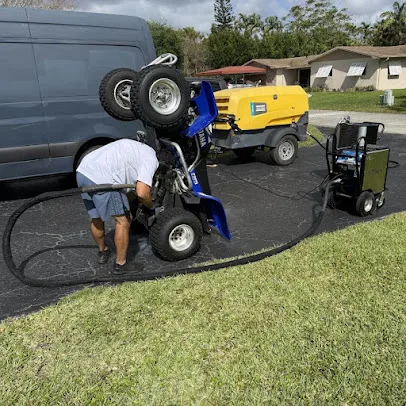
A mobile rig means the compressor, hose and operator arrive at your shop, plant or driveway. The people who call us about robotic dry are usually anyone who has been told their part is too delicate to clean properly, and the thing they are actually worried about is that the cleaning does more harm than the dirt did.
The method
Why dry ice and not the alternatives
- Non-abrasive
The pellet is soft and sublimates on impact, so the work is thermal rather than mechanical. Machined faces, plating, paint and gaskets survive it.
- Low moisture
Nothing is left wet, so no water sits in seams, channels or behind covers. The equipment goes back into service dry.
- No secondary waste
The pellets turn to gas, so you are left with one thing to deal with: the dirt we took off.
- Often no teardown
No water and no grit means nothing has to be protected by taking it out first. Most parts stay installed while we work.
More core work
Related jobs we get called for
Questions we get asked first
Will it damage the surface underneath?
That is the whole reason people pick this method. Machined faces, plating, paint and gaskets generally come through untouched, and we prove the setting on a small test patch before working anything you will see.
Do you have to take the equipment apart for robotic dry?
Less than with almost any other method. There is no water to keep out and no grit to flush from inside afterward, so parts can stay where they are while we clean.
How much mess does it make?
Far less than the alternatives, because the blasting media disappears. What is left is the contaminant itself, which we contain and clean up.
Do you come to us?
That is the only way we do it. A mobile rig means plants, shops, driveways and docks are all fair game across South Florida, up to roughly a hundred miles out from Miami.
What does a job cost?
Most of the price is time on site, and time depends on how much buildup there is and how easy it is to reach. Send photos and a description and you get an actual number back, not a range pulled out of the air.
How soon can you look at it?
As soon as we have seen what the job is. Send a description and a photo, an owner reads it and comes back with a date, and because the rig travels to you there is nothing of yours to ship first.
The comparison
The other ways to do this
- Solvent and degreaser
Softens the contaminant but leaves a film, fumes and a disposal problem, and attacks finishes you meant to keep.
- Hand scraping
Slow, inconsistent, and the tool marks the surface. Fine for a small area, unworkable across a machine.
- Media blasting
It takes the top off whatever it touches. That is the point on rusted plate and the problem everywhere else.
- Pressure washing
Forces water where water should not go, looms, bearings, seams, and then the job stops while it dries.
- Dry ice
Cold breaks the bond and the media vanishes. The substrate is untouched and there is no second mess to clean up.
What comes off
What comes off, and why
Buildup that sits on a surface can usually be lifted off it. Damage that is part of the surface itself is a different problem. The deposits below all fall in the first group.
- Adhesive and sealant
Sealant squeezed out and cured where it was never supposed to set.
- Resin and mold release
Cured process residue on a mold or fixture. The surface has to come out dimensionally unchanged, which rules out anything abrasive.
- Paint and coatings
Selective removal, layer by layer, on parts where media blasting would cut into the substrate.
- Salt and corrosion product
The year-round problem on the coast. The finish holding corrosion back has to survive the cleaning.
- Ink and printing residue
Dried ink on precision roller faces, cleaned without altering the cell structure that does the work.
- Food residue
Burnt-on product, fat and sugar on processing gear, with no chemical residue left on a contact surface.
- Grease and oil
The greasy base coat that traps grit and dust. It releases early and takes the loose material with it.
How a job runs
Nothing about this should be a surprise
Nobody should have to guess what they booked. This is every stage of a job in the order it happens.
- We look at access and containment
Hose run, compressor position, what needs masking, and where the contaminant is collected. For food and electrical jobs the containment plan takes longer to settle than the blasting does.
- We test a small area
The test patch also answers whether the buildup releases at all. Bonded grime usually lets go on the first pass, but if something on your part won’t move, we would rather find out on a hidden corner and tell you.
- We blast, then clean up
The ice is gone on impact. What is on the floor afterward came off your machine, and clearing it is ours to do.
- You look before we pack up
A second pass while everything is still connected is free in every sense. A return trip is not.
- You describe the job
Tell us the machine, the mess and the constraint. A couple of photos answers more than a long description, and if the honest answer is that something else suits it better, we say so.
What to expect on site
This is not a quiet method. Ear defenders are standard issue on site for anyone nearby.
The part will be cold when we finish. Sometimes that means a short wait before handling; sometimes it means a film of condensation as it warms back up.
Your shop air stays yours. Our compressor rides on the truck, so nothing on your side gets tied up while we clean.
Anything nearby that should not be touched gets masked before we start. That is quicker than explaining it afterward.

Tell us what needs cleaning.
Describe the buildup and where the machine is. There is no call center here, just the two owners, Giancarlo and Kenny.