What builds up, and why it matters
On this kind of work the problem is fine dust and particulate loading on switchgear, busway, fans and mechanical plant. A data hall cannot take water and cannot take downtime. Cleaning has to be dry, contained, and finished inside the window you were given.
Work is planned around the maintenance window and the containment the facility requires. The people who call us about colocation data center are usually critical facility and data center operations teams, and the thing they are actually worried about is particulate migrating somewhere it should not, or a window overrunning.

The method
Why dry ice and not the alternatives
- Non-abrasive
The pellets are frozen carbon dioxide, softer than the metal they hit. They break up and vanish, taking the bond with them and leaving the surface intact.
- Low moisture
Pressure washing leaves water in every crevice. Dry ice leaves none, so there is nothing to dry before you power things back up.
- No secondary waste
Walnut shell and soda end up in every crack of a machine. Dry ice leaves no media behind, only the removed deposit.
- Often no teardown
Hard-to-reach spots get cleaned without pulling the equipment apart. That alone often matters more than how fast the blasting goes.
More data work
Related jobs we get called for
Questions we get asked first
Will it damage the surface underneath?
Done right, no. The risk is in the wrong settings, which is why we start gentle on a test spot and work up instead of opening up on the part itself.
Do you have to take the equipment apart for colocation data center?
Sometimes a guard or a cover comes off so we can get the nozzle where it needs to go. Full teardown is rare. We will tell you which parts, if any, before the day of the job.
How much mess does it make?
Less than you would think. There is no water, so there is no runoff, and no media, so there is nothing to recover except the dirt.
Do you come to us?
Every job is on site. Your car can stay in your garage and your boat at the dock while we work. We cover South Florida, from Miami out to about a hundred miles.
What does a job cost?
It depends on the equipment, the contaminant and the access, so we will not throw a number at you over the phone without understanding the work. Describe the job and we will give you a real figure.
How soon can you look at it?
There is no dispatcher in the middle. Giancarlo or Kenny reads what you send and calls you back, so the conversation about timing starts with the people doing the work.
The comparison
The other ways to do this
- Media blasting
Effective and indiscriminate. On soft metal or a finished surface it does damage you then have to fix.
- Pressure washing
Forces water where water should not go, looms, bearings, seams, and then the job stops while it dries.
- Solvent and degreaser
Chemistry works, but you inherit ventilation, waste handling and a film on the surface.
- Hand scraping
Slow enough to be uneconomic on a machine, and the tool always leaves a trace.
- Dry ice
Thermal shock breaks the bond. The pellet sublimates, so nothing abrasive touches the part and nothing is left to collect but the contaminant.
What comes off
What this takes off
The method does not care much what the contaminant is, only that it sits on top of something. Here is the usual list.
- Grease and oil
The soft film that holds dust and swarf against metal. It is what makes a part feel dirty long after it looks clean, and it comes off first.
- Carbon and soot
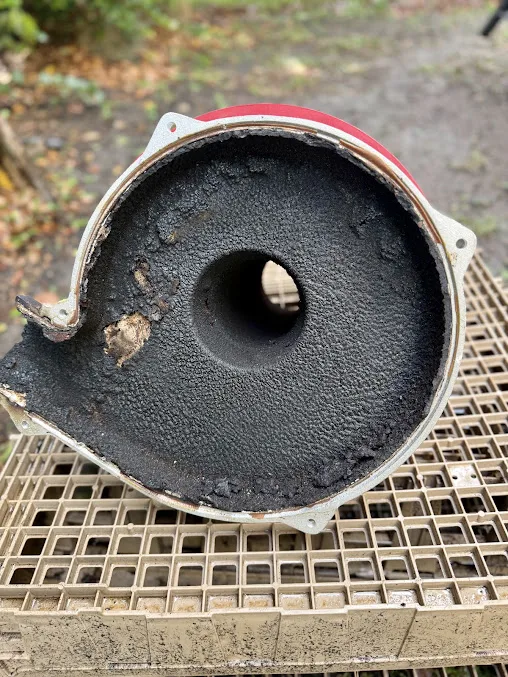
Heat-bonded black deposit. Because heat put it there, a sudden cold front is what breaks its grip.
- Adhesive and sealant
The stubborn film under old tape, or the gasket that tore and left half of itself behind.
- Resin and mold release
Release agent and resin build-up on tooling, where a solvent fix trades one residue for another.
- Paint and coatings
Removed selectively where the substrate underneath has to survive, which rules out most abrasive approaches.
- Salt and corrosion product
The year-round problem on the coast. The finish holding corrosion back has to survive the cleaning.
- Ink and printing residue
Dried ink and coating build-up on rollers and press components, where the surface texture is the product.
How a job runs
The sequence, start to finish
There is no mystery to how these jobs run, and no part of it we would rather you did not ask about.
- You look before we pack up
A second pass while everything is still connected is free in every sense. A return trip is not.
- You describe the job
The machine, the deposit and the downtime you can afford. Those three things decide the whole job, and we would rather know all of them before quoting.
- We look at access and containment
Tight sites need a plan for where people walk. We mark out a working zone so staff and visitors stay clear while the hose is live.
- We test a small area
A test spot takes minutes and protects the whole job. It tells us how hard to push on this particular surface, which matters more than any rule of thumb.
- We blast, then clean up
One mess instead of two: the pellet vanishes and we take away what it removed.
Before we turn the rig on
Everything the rig needs arrives with it. No tap, no drain, no outlet.
Anything nearby that should not be touched gets masked before we start. That is quicker than explaining it afterward.
Working outdoors, ventilation takes care of itself. Indoors, in a small room or a cabinet, we plan how air will move before the hose is ever connected, because the gas displaces oxygen.
If the job is somewhere people live or work close by, they may hear us. Let us know if there is a time of day that works better for them.
Send us the job.
A few lines and a picture are plenty. Your message goes straight to Giancarlo or Kenny, the two owners of the business.