What builds up, and why it matters
On this kind of work the problem is grease, carbon, adhesive and production residue across every kind of substrate. Most cleaning problems arrive with a constraint attached: it cannot get wet, it cannot be scratched, it cannot be taken apart, or it has to be back in service the same shift.
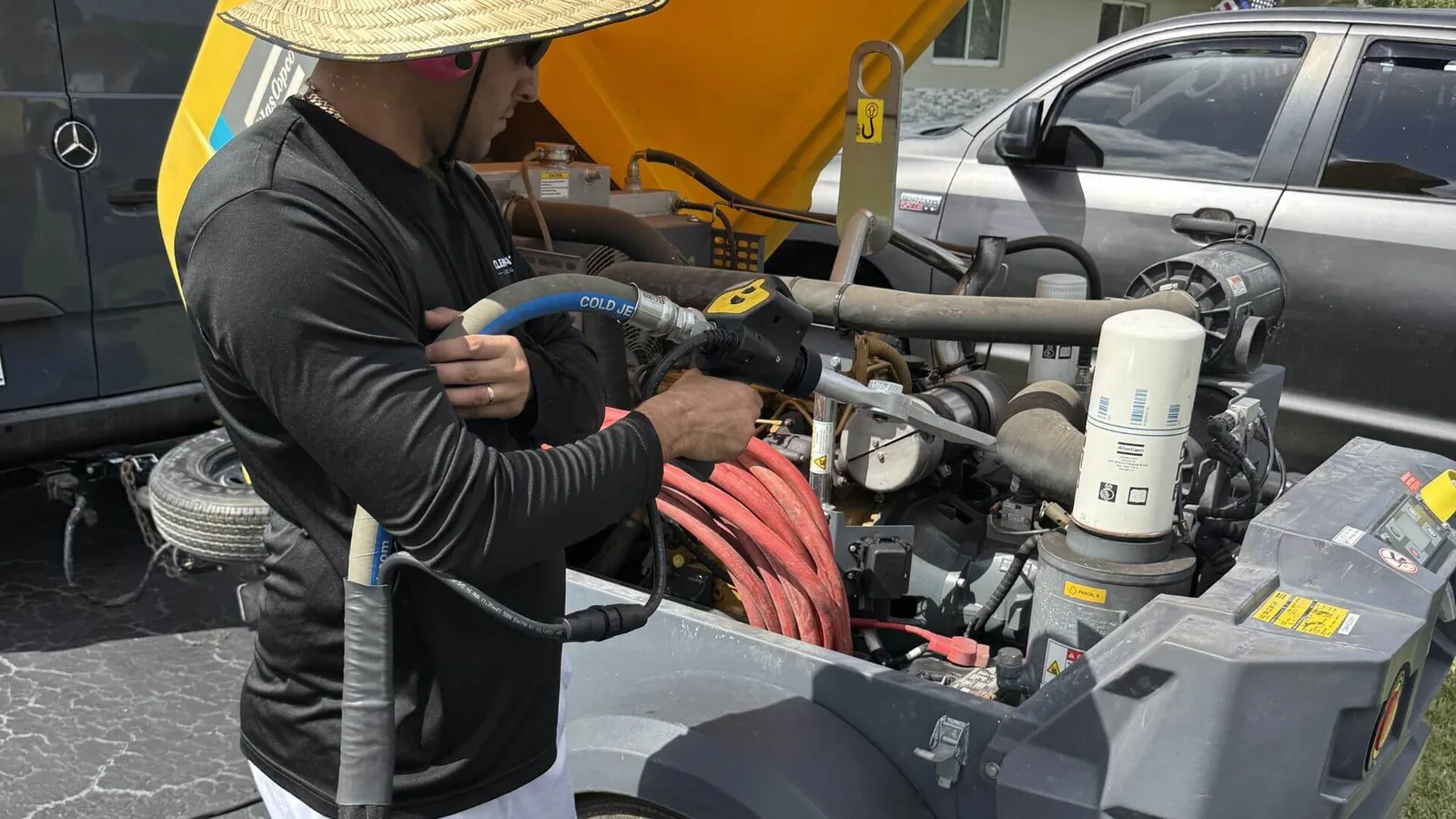
A mobile rig means the compressor, hose and operator arrive at your shop, plant or driveway. The people who call us about waterless dry are usually anyone who has been told their part is too delicate to clean properly, and the thing they are actually worried about is that the cleaning does more harm than the dirt did.
The method
Why dry ice and not the alternatives
- Non-abrasive
The pellet is soft and sublimates on impact, so the work is thermal rather than mechanical. Machined faces, plating, paint and gaskets survive it.
- Low moisture
No standing water in a harness, a bearing or a cabinet, and no dry time before the equipment goes back into service.
- No secondary waste
Sand, soda and walnut shell all have to be swept and hauled. Dry ice leaves only the contaminant it removed.
- Often no teardown
Much of this work is done in place, which is usually where the real saving is. The labor is in the disassembly, not the cleaning.
More core work
Related jobs we get called for
Questions we get asked first
Will it damage the surface underneath?
On most substrates, no. The pellet is soft and sublimates on impact, so it does thermal work rather than mechanical work. We still test an inconspicuous spot first on anything unusual.
Do you have to take the equipment apart for waterless dry?
Usually far less than you would expect, and often not at all. Cleaning in place is where most of the saving comes from, because the labor is normally in the teardown and reassembly.
How much mess does it make?
Far less than the alternatives, because the blasting media disappears. What is left is the contaminant itself, which we contain and clean up.
Do you come to us?
Yes. The whole rig is mobile. Compressor, hose and operator arrive at your shop, plant, driveway or dock, anywhere across South Florida from Miami out to roughly a hundred miles.
What does a job cost?
It depends on the equipment, the contaminant and the access, so we will not throw a number at you over the phone without understanding the work. Describe the job and we will give you a real figure.
How soon can you look at it?
Send photos and a short description and one of the owners gets back to you. If you have a shutdown or a deadline, say so up front and we will tell you honestly whether we can hit it.
The comparison
How this compares to the usual methods
- Hand scraping
Fine on a patch, hopeless on a machine, and the blade leaves its own evidence.
- Media blasting
Effective and indiscriminate. On soft metal or a finished surface it does damage you then have to fix.
- Pressure washing
It is fast and it is wet, which is fine outdoors and unusable on anything with a winding in it.
- Solvent and degreaser
Good at softening, bad at leaving. There is always a residue and always a drum to get rid of.
- Dry ice
Cold breaks the bond and the media vanishes. The substrate is untouched and there is no second mess to clean up.
What comes off
The deposits we see most
Most calls involve one of the following. The common factor is a bond between two things that should not be bonded.
- Resin and mold release
Production residue cured onto tooling. Solvent softens it and leaves its own film; the ice lifts it and takes nothing with it.
- Paint and coatings
Removed selectively where the substrate underneath has to survive, which rules out most abrasive approaches.
- Salt and corrosion product
Salt deposit and the oxidation it starts. Anything abrasive removes the protection along with the salt.
- Ink and printing residue
Dried ink on precision roller faces, cleaned without altering the cell structure that does the work.
- Food residue
Carbonized product, fat, starch and sugar build-up on processing equipment, cleaned without chemicals touching a food contact surface.
- Grease and oil
The greasy base coat that traps grit and dust. It releases early and takes the loose material with it.
- Carbon and soot
The hard black crust on a housing, an oven or a weld cell. Bonded by heat, and the first thing to release under thermal shock.
How a job runs
What happens once you call
If you have not seen this done before, the process is worth reading once. Nothing below is hidden in a footnote.
- We blast, then clean up
There is no spent media to recover, only the deposit, which we collect before packing up.
- You look before we pack up
Inspect it with the rig still set up. Anything you are not happy with gets another go before we leave.
- You describe the job
Tell us the machine, the mess and the constraint. A couple of photos answers more than a long description, and if the honest answer is that something else suits it better, we say so.
- We look at access and containment
How close the truck can get, how far the hose must run, what needs covering, and where the debris goes. That is the bulk of the planning on a tight site.
- We test a small area
Pressure and pellet size get dialed in on an inconspicuous spot before we touch anything visible. Painted parts, soft alloys and older finishes all behave differently, and the right setting on one is the wrong setting on another.
What happens in your space
We cover what should not be hit before anything gets blasted. It takes minutes and saves arguments.
The media is solid CO2, nothing toxic and nothing left behind, but it pushes oxygen out of a closed room. Ventilation gets planned before the hose is connected.
The process is loud. Hearing protection is standard for anyone in the working area, which is why you will see ear defenders in most of our photographs.
The part will be cold when we finish. Sometimes that means a short wait before handling; sometimes it means a film of condensation as it warms back up.
Send us the job.
Give us the job, the address and a rough description, pictures if you have them. The call back comes from Giancarlo or Kenny directly.