Home / Service areas / St. Lucie County
4 communities · Florida
Dry ice blasting across St. Lucie County
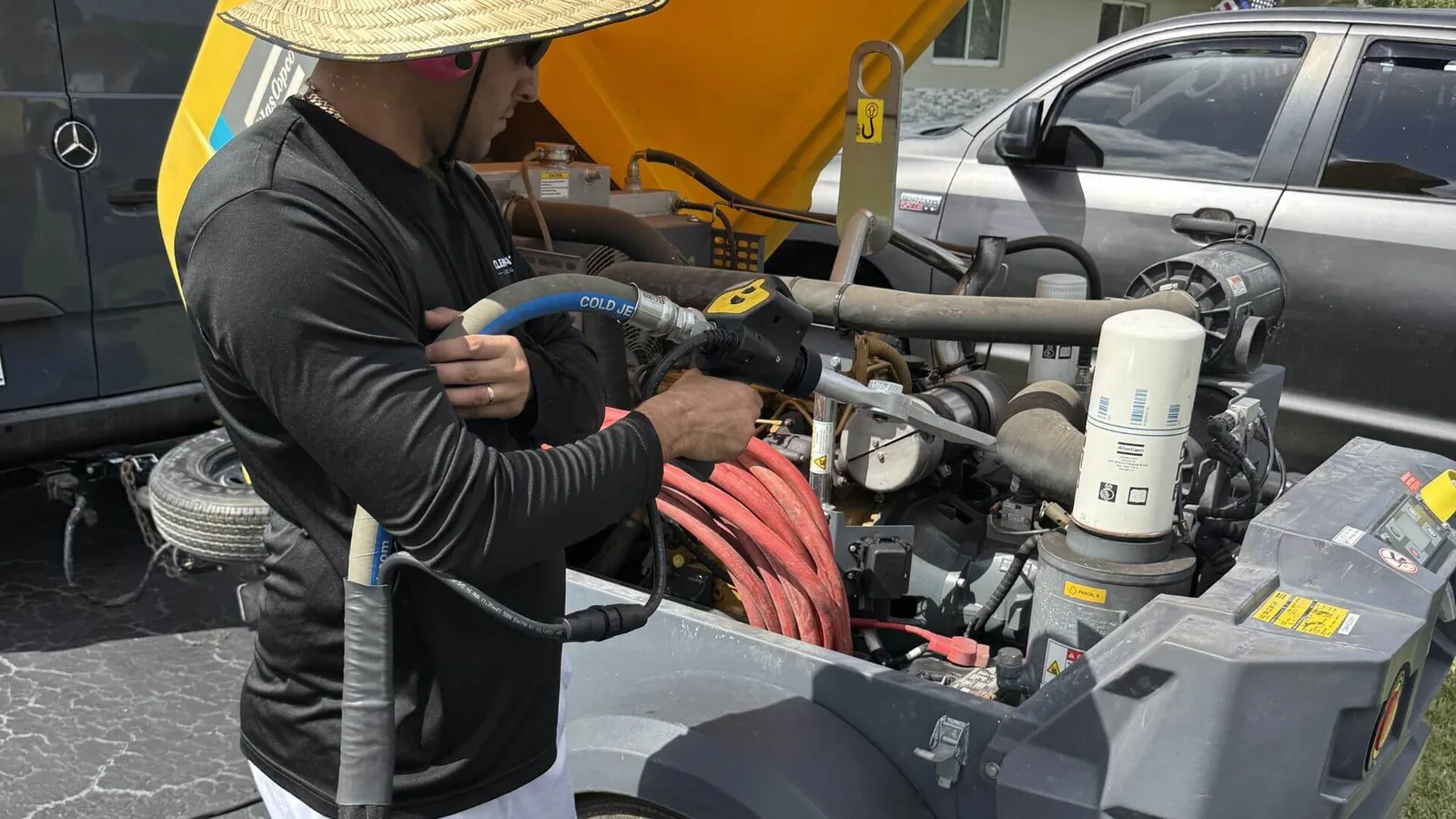
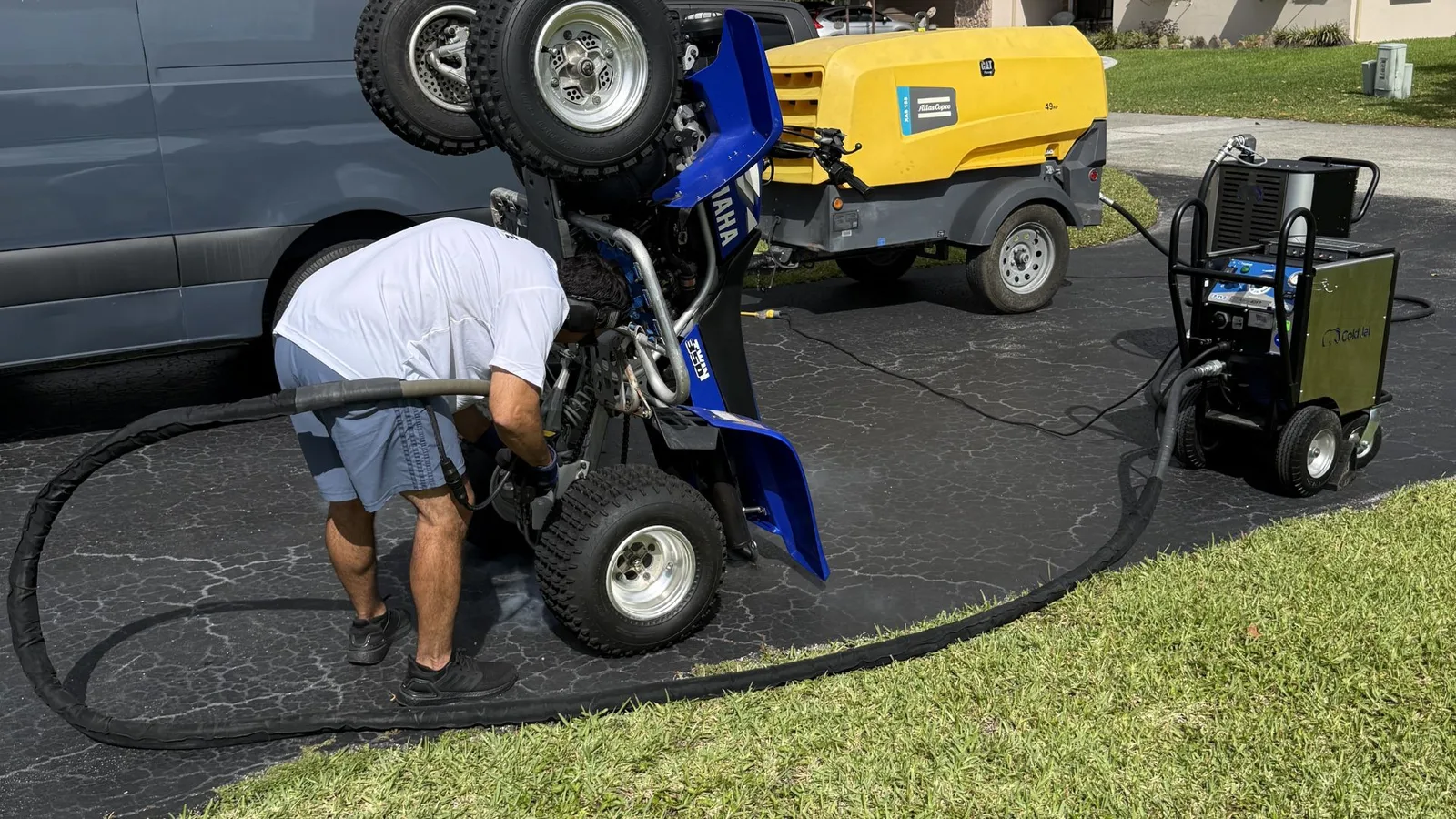
We are mobile, so the job site is wherever the machine is. The compressor, hose and operator come to you anywhere in St. Lucie County.
Working in St. Lucie County
Everything we do runs off our own compressor, so there is no wash pad to find and no drain to worry about. That matters in St. Lucie County, where a lot of the work happens on a driveway, in a yard, or inside a shop that cannot be flooded.
South Florida salt air keeps corrosion moving all year, which is why so much of the work here is about removing what has bonded to a surface without taking the surface with it.
Common questions
Will you travel to St. Lucie County?
Yes, St. Lucie County is well within range, and the compressor comes on the truck with everything else.
Do you need anything set up before you arrive?
Just access and parking. There is no tap to find, no drain to use and nothing of yours to plug into.
Can you come outside business hours?
Generally yes. Weekend and overnight work is routine, and the limiting factor is usually noise, not us.
What do most jobs look like?
It ranges from a single restoration project to a plant maintenance window. The method does not change much.
Do you charge for the drive?
Sometimes, on the longer runs. Either way it is discussed before anyone commits.
How do we book it in?
A short description and a couple of pictures is enough to start. An owner rings you back.
What comes off
What dry ice actually removes
The rule of thumb is simple: anything stuck on rather than built in. These are the deposits we see most.
- Adhesive and sealant
Cured sealant, old gasket, tape glue and sound deadening, the residue left when something was removed but its bond was not.
- Resin and mold release
Production residue cured onto tooling. Solvent softens it and leaves its own film; the ice lifts it and takes nothing with it.
- Paint and coatings
Selective removal, layer by layer, on parts where media blasting would cut into the substrate.
- Salt and corrosion product
The year-round problem on the coast. The finish holding corrosion back has to survive the cleaning.
- Ink and printing residue
Dried ink and coating build-up on rollers and press components, where the surface texture is the product.
- Food residue
Carbonized product build-up in a plant where neither standing water nor a chemical film is acceptable.
- Grease and oil
The soft film that holds dust and swarf against metal. It is what makes a part feel dirty long after it looks clean, and it comes off first.
How a job runs
How a job actually runs
Most people have never watched dry ice blasting happen and are not sure what they are agreeing to. Here is the whole sequence, start to finish.
- We look at access and containment
Siting the compressor, masking what must not be touched, and catching what comes off, settled before the first pellet.
- We test a small area
An out-of-sight patch comes first so pressure and pellet size are proven before anything that shows. Soft alloys, older paint and bare metal each want different numbers.
- We blast, then clean up
There is no spent media to recover, only the deposit, which we collect before packing up.
- You look before we pack up
If something needs another pass we do it then, on site, while the rig is still running. That is a better outcome for everyone than a callback.
- You describe the job
Tell us the machine, the mess and the constraint. A couple of photos answers more than a long description, and if the honest answer is that something else suits it better, we say so.
The comparison
Why not just pressure wash it
- Solvent and degreaser
Good at softening, bad at leaving. There is always a residue and always a drum to get rid of.
- Hand scraping
Slow, inconsistent, and the tool marks the surface. Fine for a small area, unworkable across a machine.
- Media blasting
Grit removes material to do its job, so a machined face or a plated part pays for the cleaning.
- Pressure washing
Drives water into harnesses, bearings, panels and seams, then everything waits to dry. On electrical work it is simply not an option.
- Dry ice
Thermal shock breaks the bond. The pellet sublimates, so nothing abrasive touches the part and nothing is left to collect but the contaminant.
Why us
Why people call us back
- We test before we commit
Every substrate reacts differently, so settings get proven on a spot nobody sees first.
- The rig comes to you
Compressor, hose and operator arrive at your shop, plant, driveway or dock. Nothing needs to be transported to us.
- We clean up after ourselves
The ice is gone; what came off your equipment is not. Gathering it is included.
- Firefighter owned and operated
Both founders came up in the fire service. That background is about preparation, accountability and performing under pressure, and it is how every job gets approached.
- You speak to an owner
Giancarlo or Kenny answers, quotes the work and turns up to do it. There is no call center and no handoff where the details get lost.
- We will tell you no
Some jobs want a different method. We would rather say that up front than discover it on your machine.
What the job is like to stand next to
Cold surfaces are the one aftereffect. Depending on the piece that is either a few minutes of patience or some condensation while it returns to room temperature.
Air comes from our own compressor. You do not need to provide power, water or a connection of any kind.
We cover what should not be hit before anything gets blasted. It takes minutes and saves arguments.
The media is solid CO2, nothing toxic and nothing left behind, but it pushes oxygen out of a closed room. Ventilation gets planned before the hose is connected.
Tell us what needs cleaning.
Tell us what the machine is, where it is and what is on it. A photo or two speeds it up. One of the owners calls you back.