What we clean, and what it is covered in
The build-up here is process residue, flux, particulate and film on sensitive equipment. Work is scoped against the facility's own procedures and containment requirements.
Most of the people who call are facilities and validation teams. What they are protecting against is introducing a contaminant while removing one, which is exactly why an abrasive or a solvent is the wrong answer.
All 10 services
Every pharmaceutical job we take
Questions about this work
What makes dry ice right for this work?
These environments have documented cleaning requirements and very low tolerance for residue, moisture or abrasive media. Dry ice leaves nothing behind because the media is gone.
Do you clean in place?
Work is scoped against the facility's own procedures and containment requirements. Most of this work does not need a teardown.
Will it damage the surface?
On most substrates, no. The pellet is soft and sublimates on impact, so the work is thermal rather than abrasive. We test an inconspicuous spot first on anything unusual.
Is there any residue afterward?
None from the media. Dry ice sublimates, so what is left is the contaminant we came to remove, and that is ours to clean up.
Do you come to us?
Yes. The rig is mobile and works across South Florida from Miami out to roughly a hundred miles.
What does it cost?
It depends on the equipment, the contaminant and the access. Describe the job and we will give you a real figure rather than a guess over the phone.
What comes off
What dry ice actually removes
The rule of thumb is simple: anything stuck on rather than built in. These are the deposits we see most.
- Salt and corrosion product
A constant in South Florida. Removing it without stripping the protective finish is the whole trick.
- Ink and printing residue
Dried ink on precision roller faces, cleaned without altering the cell structure that does the work.
- Food residue
Carbonized product build-up in a plant where neither standing water nor a chemical film is acceptable.
- Grease and oil
The soft film that holds dust and swarf against metal. It is what makes a part feel dirty long after it looks clean, and it comes off first.
- Carbon and soot
Heat-bonded black deposit. Because heat put it there, a sudden cold front is what breaks its grip.
- Adhesive and sealant
Bonded material that outlived whatever it was bonding, usually harder to shift than the part it is on.
- Resin and mold release
Release agent and resin build-up on tooling, where a solvent fix trades one residue for another.
How a job runs
How a job actually runs
Most people have never watched dry ice blasting happen and are not sure what they are agreeing to. Here is the whole sequence, start to finish.
- We test a small area
An out-of-sight patch comes first so pressure and pellet size are proven before anything that shows. Soft alloys, older paint and bare metal each want different numbers.
- We blast, then clean up
Nothing is left of the pellet, so the only thing to collect is what was on your equipment. That collection is part of the work we quoted.
- You look before we pack up
Walk it with us before the hose goes away. A second pass while the compressor is still running costs nothing; a return visit costs us both.
- You describe the job
Send images if you can, they settle most of the questions. A wrong-tool verdict comes on that first call, not after the invoice.
- We look at access and containment
Access drives the plan: reach, siting, masking, and the route the removed material takes off the job. It is the part customers think about least and we think about most.
The comparison
What the alternatives actually do
- Pressure washing
Drives water into harnesses, bearings, panels and seams, then everything waits to dry. On electrical work it is simply not an option.
- Solvent and degreaser
It dissolves the deposit and often the finish underneath, then leaves a film behind either way.
- Hand scraping
Fine on a patch, hopeless on a machine, and the blade leaves its own evidence.
- Media blasting
It works by removing material, which is the problem. Acceptable on heavy steel, damaging on soft alloy, plating or a machined surface.
- Dry ice
Thermal shock breaks the bond. The pellet sublimates, so nothing abrasive touches the part and nothing is left to collect but the contaminant.
What the job is like to stand next to
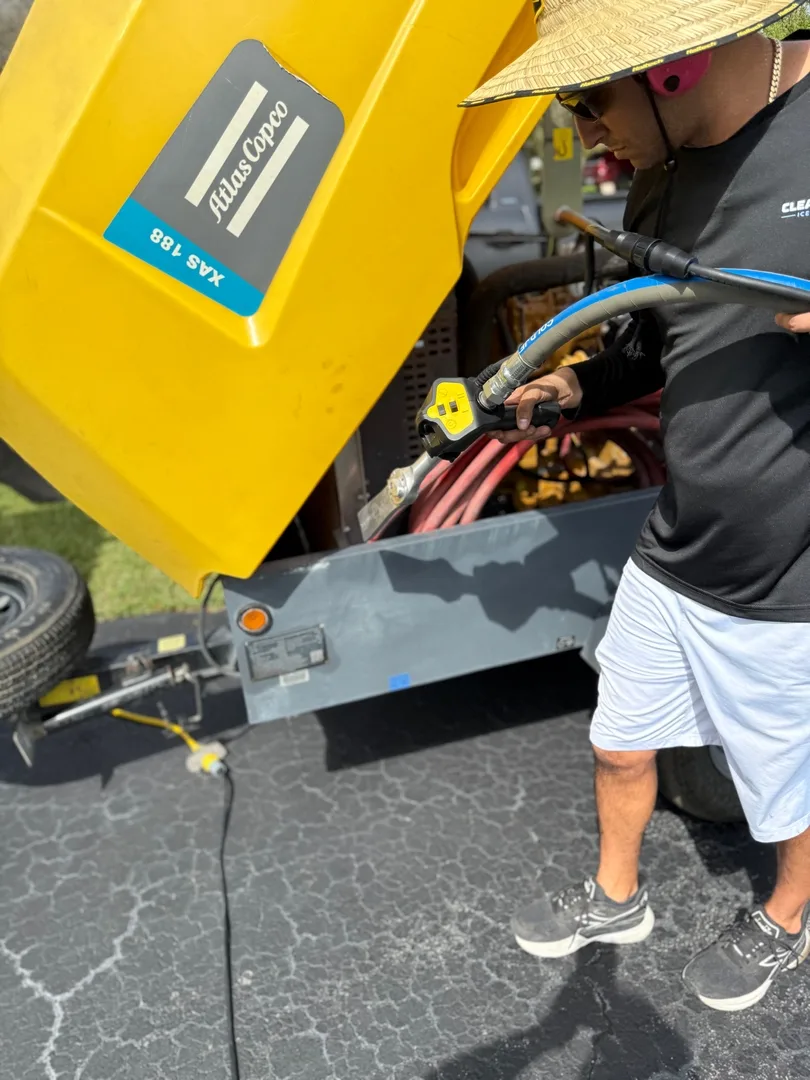
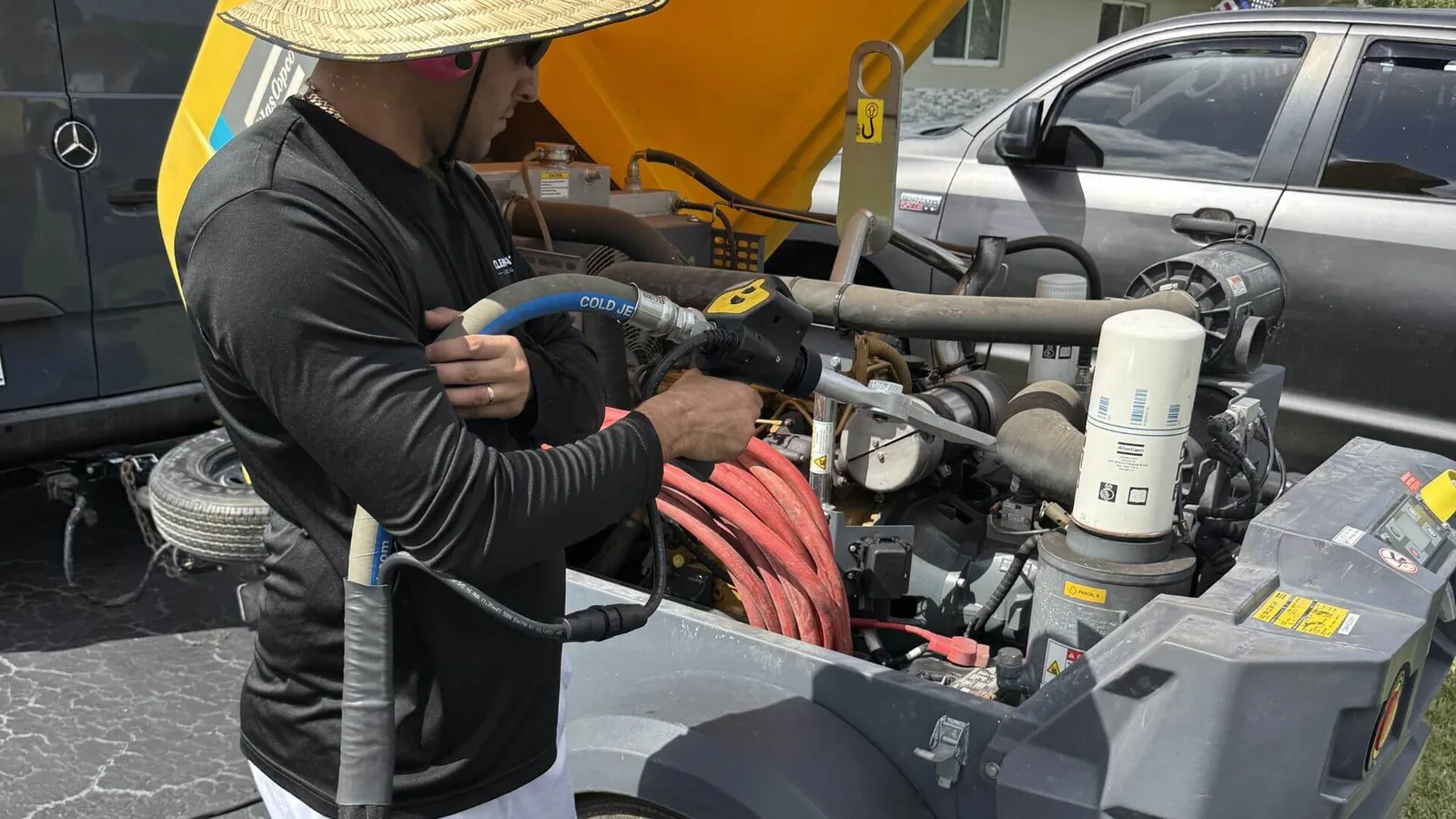
The process is loud. Hearing protection is standard for anyone in the working area, which is why you will see ear defenders in most of our photographs.
Cold surfaces are the one aftereffect. Depending on the piece that is either a few minutes of patience or some condensation while it returns to room temperature.
Everything the rig needs arrives with it. No tap, no drain, no outlet.
Anything nearby that should not be touched gets masked before we start. That is quicker than explaining it afterward.
Why us
Why people call us back
- We will tell you no
If dry ice is the wrong tool for what you have, we say so on the first call rather than finding out on your equipment. Honest beats a quick buck.
- We test before we commit
Anything unusual gets an inconspicuous test area first. Painted parts, soft alloys and older finishes all behave differently.
- The rig comes to you
We are mobile. The equipment stays where it is and we bring everything needed to it.
- We clean up after ourselves
The ice is gone; what came off your equipment is not. Gathering it is included.
- Firefighter owned and operated
Giancarlo and Kenny both came out of the fire service, and the discipline that job demands is the discipline this one gets.
- You speak to an owner
The person who picks up is the person doing the work. Nothing gets lost between the quote and the job.
Tell us what needs cleaning.
A short description and a location is enough to start. Add photos if you can. You will speak to an owner, not a scheduler.