Home / Service areas / Broward County / Fort Lauderdale
Broward County · Florida
Fort Lauderdale dry ice blasting
Fort Lauderdale calls tend to arrive with a constraint attached, which is exactly where this method earns its keep.
How we work in this area
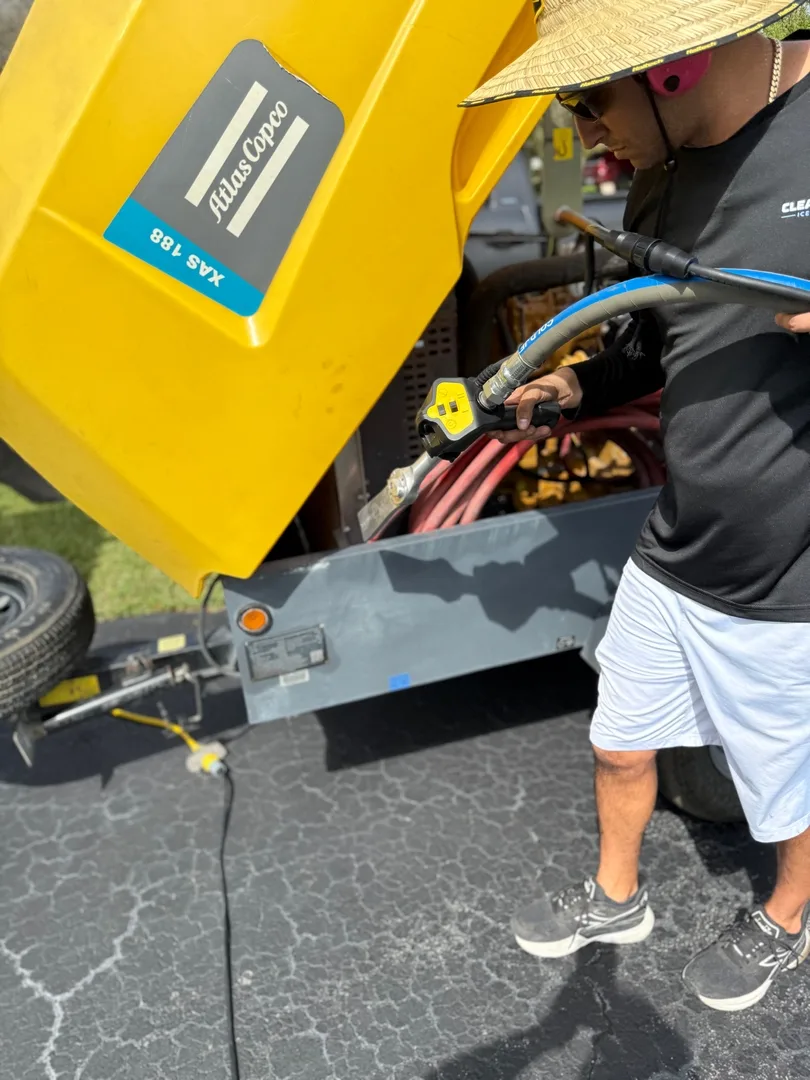
Nothing about the setup needs a drain, a hookup or a bay. So the equipment stays put. Everything that has to move arrives on the truck instead.
The pellet turns straight to gas when it hits, which means no sand in the machine and no sludge on the floor. The only thing to collect is the contaminant itself, and that is included.
What we clean
What we get called for in Fort Lauderdale
Nearby
Also working across Broward County
Questions from Fort Lauderdale
Do you cover Fort Lauderdale?
Yes, Fort Lauderdale is well within range, and the compressor comes on the truck with everything else.
What do we have to provide?
Access to the equipment and somewhere to park the compressor. No water hookup, no drain and no wash bay.
Will you work during a shutdown?
Usually. Tell us the window you have, including overnight or a planned shutdown, and we will tell you honestly what fits in it.
What kinds of jobs do you take here?
A mix, vehicle work, shop equipment, marine and light industrial. Same rig, different constraint each time.
Do you charge for the drive?
It depends how far out the job is. We will be straight with you about it when you describe the work.
How do we book it in?
Describe the job and send a photo or two. Giancarlo or Kenny will call you, not a scheduler.
Conditions around Fort Lauderdale
Humidity is the constant. Anything bare oxidizes faster than it would almost anywhere else. So the job is usually less about scrubbing harder and more about not making the underlying problem worse.
The mix here runs from vehicle work in driveways to production equipment inside industrial units. Driveway or plant floor, the requirement is the same: room for the rig and access to the machine.
The pellet turns to gas, so nothing runs off toward a drain and nothing abrasive stays behind in a bearing. On a cramped Broward County site that usually decides it.
What comes off
What dry ice actually removes
The rule of thumb is simple: anything stuck on rather than built in. These are the deposits we see most.
- Adhesive and sealant
Bonded material that outlived whatever it was bonding, usually harder to shift than the part it is on.
- Resin and mold release
Release agent and resin build-up on tooling, where a solvent fix trades one residue for another.
- Paint and coatings
Selective removal, layer by layer, on parts where media blasting would cut into the substrate.
- Salt and corrosion product
Salt deposit and the oxidation it starts. Anything abrasive removes the protection along with the salt.
- Ink and printing residue
Dried ink on precision roller faces, cleaned without altering the cell structure that does the work.
- Food residue
Carbonized product, fat, starch and sugar build-up on processing equipment, cleaned without chemicals touching a food contact surface.
- Grease and oil
The greasy base coat that traps grit and dust. It releases early and takes the loose material with it.
How a job runs
How a job actually runs
Most people have never watched dry ice blasting happen and are not sure what they are agreeing to. Here is the whole sequence, start to finish.
- We look at access and containment
Siting the compressor, masking what must not be touched, and catching what comes off, settled before the first pellet.
- We test a small area
Pressure and pellet size get dialed in on an inconspicuous spot before we touch anything visible. Painted parts, soft alloys and older finishes all behave differently, and the right setting on one is the wrong setting on another.
- We blast, then clean up
The ice is gone on impact. What is on the floor afterward came off your machine, and clearing it is ours to do.
- You look before we pack up
A second pass while everything is still connected is free in every sense. A return trip is not.
- You describe the job
What the equipment is, what is on it, where it lives, and whether it can be shut down. Photos tell us more than a paragraph. If dry ice is the wrong tool we say so on that call rather than after taking your money.
The comparison
How this compares to the usual methods
- Solvent and degreaser
Softens the contaminant but leaves a film, fumes and a disposal problem, and attacks finishes you meant to keep.
- Hand scraping
Slow, inconsistent, and the tool marks the surface. Fine for a small area, unworkable across a machine.
- Media blasting
Grit removes material to do its job, so a machined face or a plated part pays for the cleaning.
- Pressure washing
The water has to go somewhere, and on most equipment that somewhere is inside it.
- Dry ice
It is the only one on this list where the media stops existing the moment it has worked.
What the job is like to stand next to
The rig needs compressed air, which the truck supplies. There is no hookup to find and nothing of yours to plug into.
We cover what should not be hit before anything gets blasted. It takes minutes and saves arguments.
Dry ice is carbon dioxide in solid form. It is non-toxic and leaves no residue, but it does displace oxygen in an enclosed space, so ventilation is part of the setup rather than an afterthought.
This is not a quiet method. Ear defenders are standard issue on site for anyone nearby.

Tell us what needs cleaning.
Give us the job, the address and a rough description, pictures if you have them. The call back comes from Giancarlo or Kenny directly.