8 services · Miami, FL
Residential Ice Blasting
Household surfaces are usually softer than industrial ones, so the non-abrasive part matters more, not less.
What we clean, and what it is covered in
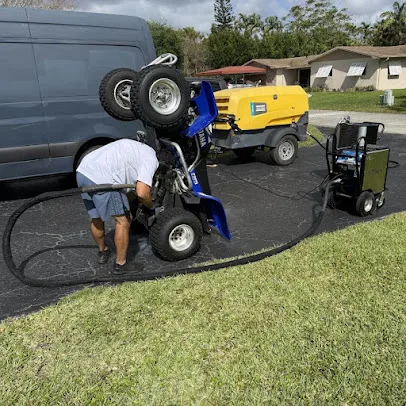
The build-up here is grease, soot, mildew staining, old finish and garage grime. We come to the house; the rig runs off the driveway.
Most of the people who call are homeowners and collectors. What they are protecting against is damage to something in your own home, which is exactly why an abrasive or a solvent is the wrong answer.
All 8 services
Every residential job we take
Questions about this work
What makes dry ice right for this work?
Household surfaces are usually softer than industrial ones, so the non-abrasive part matters more, not less.
Do you clean in place?
We come to the house; the rig runs off the driveway. Most of this work does not need a teardown.
Will it damage the surface?
On most substrates, no. The pellet is soft and sublimates on impact, so the work is thermal rather than abrasive. We test an inconspicuous spot first on anything unusual.
Is there any residue afterward?
None from the media. Dry ice sublimates, so what is left is the contaminant we came to remove, and that is ours to clean up.
Do you come to us?
Yes. The rig is mobile and works across South Florida from Miami out to roughly a hundred miles.
What does it cost?
It depends on the equipment, the contaminant and the access. Describe the job and we will give you a real figure rather than a guess over the phone.
What comes off
The deposits we see most
If you are not sure what you are dealing with, start here. These are the deposits most of our jobs come down to.
- Carbon and soot
Black buildup from heat and smoke on burners, housings and fixtures. Thermal shock does the work here, with no grit grinding at the part.
- Adhesive and sealant
Cured sealant, old gasket, tape glue and sound deadening, the residue left when something was removed but its bond was not.
- Resin and mold release
Release agent and resin build-up on tooling, where a solvent fix trades one residue for another.
- Paint and coatings
Selective removal, layer by layer, on parts where media blasting would cut into the substrate.
- Salt and corrosion product
The year-round problem on the coast. The finish holding corrosion back has to survive the cleaning.
- Ink and printing residue
Ink and coating on anilox and press rollers, surfaces where changing the texture changes the print.
- Food residue
Carbonized product build-up in a plant where neither standing water nor a chemical film is acceptable.
How a job runs
What happens once you call
If this is your first time hiring dry ice blasting, here is how a job goes from the first call to the last pass.
- We test a small area
An out-of-sight patch comes first so pressure and pellet size are proven before anything that shows. Soft alloys, older paint and bare metal each want different numbers.
- We blast, then clean up
The media disappears on contact; the contaminant does not. Gathering what came off is included, not a line added afterward.
- You look before we pack up
The job is not finished because we say so. It is finished when you have looked at it.
- You describe the job
Tell us the machine, the mess and the constraint. A couple of photos answers more than a long description, and if the honest answer is that something else suits it better, we say so.
- We look at access and containment
The layout decides the method more often than the contaminant does. We work out reach and containment before quoting anything.
The comparison
Why not just pressure wash it
- Pressure washing
Forces water where water should not go, looms, bearings, seams, and then the job stops while it dries.
- Solvent and degreaser
Good at softening, bad at leaving. There is always a residue and always a drum to get rid of.
- Hand scraping
Labor-intensive and uneven, and whatever you scrape with eventually marks what you are scraping.
- Media blasting
It takes the top off whatever it touches. That is the point on rusted plate and the problem everywhere else.
- Dry ice
Thermal contraction cracks the bond between deposit and surface, then the pellet gasses off. Nothing abrasive, nothing wet, nothing left.
What happens in your space
If the job is somewhere people live or work close by, they may hear us. Let us know if there is a time of day that works better for them.
Some dampness on the surface after we stop is normal. It is the part coming back to air temperature, and it clears without wiping.
Air comes from our own compressor. You do not need to provide power, water or a connection of any kind.
Masking happens first. Whatever is adjacent and vulnerable gets covered before the hose is picked up.
Why us
How we do business
- Firefighter owned and operated
The owners are firefighters. Preparation, checking your equipment and doing the job properly under pressure are habits that came with them.
- You speak to an owner
Giancarlo or Kenny answers, quotes the work and turns up to do it. There is no call center and no handoff where the details get lost.
- We will tell you no
Not everything should be dry ice blasted. Being told that early is worth more than being sold the job.
- We test before we commit
Every substrate reacts differently, so settings get proven on a spot nobody sees first.
- The rig comes to you
We are mobile. The equipment stays where it is and we bring everything needed to it.
- We clean up after ourselves
The ice is gone; what came off your equipment is not. Gathering it is included.
Send us the job.
Describe the job in plain words, no jargon needed. If dry ice is the wrong tool, you will hear that from us right away.