What we clean, and what it is covered in
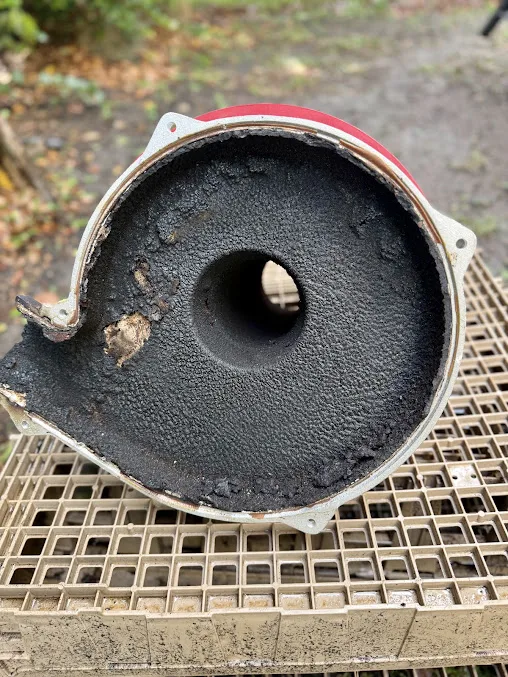
The build-up here is hardened concrete slurry, asphalt, hydraulic oil, clay and general site build-up. Machines are cleaned at the yard or on site, without a wash pad.
Most of the people who call are equipment managers and owner-operators. What they are protecting against is water forced into bearings and electrical connections, which is exactly why an abrasive or a solvent is the wrong answer.
All 11 services
Every construction job we take
Questions about this work
What makes dry ice right for this work?
Heavy equipment is usually cleaned with pressure and chemicals, which drives water into pins, bearings and electrics and leaves runoff to deal with.
Do you clean in place?
Machines are cleaned at the yard or on site, without a wash pad. Most of this work does not need a teardown.
Will it damage the surface?
On most substrates, no. The pellet is soft and sublimates on impact, so the work is thermal rather than abrasive. We test an inconspicuous spot first on anything unusual.
Is there any residue afterward?
None from the media. Dry ice sublimates, so what is left is the contaminant we came to remove, and that is ours to clean up.
Do you come to us?
Yes. The rig is mobile and works across South Florida from Miami out to roughly a hundred miles.
What does it cost?
It depends on the equipment, the contaminant and the access. Describe the job and we will give you a real figure rather than a guess over the phone.
What comes off
What comes off, and why
If it is bonded to the surface rather than part of it, there is a good chance this takes it off. The list below covers most of what we are called out for.
- Salt and corrosion product
A constant in South Florida. Removing it without stripping the protective finish is the whole trick.
- Ink and printing residue
Dried ink and coating build-up on rollers and press components, where the surface texture is the product.
- Food residue
Carbonized product build-up in a plant where neither standing water nor a chemical film is acceptable.
- Grease and oil
The soft film that holds dust and swarf against metal. It is what makes a part feel dirty long after it looks clean, and it comes off first.
- Carbon and soot
Heat-bonded black deposit. Because heat put it there, a sudden cold front is what breaks its grip.
- Adhesive and sealant
Whatever the last repair left stuck to the mating face: gasket, sealant, deadener or adhesive.
- Resin and mold release
Release agent and resin build-up on tooling, where a solvent fix trades one residue for another.
How a job runs
Nothing about this should be a surprise
Nobody should have to guess what they booked. This is every stage of a job in the order it happens.
- We test a small area
Pressure and pellet size get dialed in on an inconspicuous spot before we touch anything visible. Painted parts, soft alloys and older finishes all behave differently, and the right setting on one is the wrong setting on another.
- We blast, then clean up
There is no spent media to recover, only the deposit, which we collect before packing up.
- You look before we pack up
A second pass while everything is still connected is free in every sense. A return trip is not.
- You describe the job
Tell us the machine, the mess and the constraint. A couple of photos answers more than a long description, and if the honest answer is that something else suits it better, we say so.
- We look at access and containment
How close the truck can get, how far the hose must run, what needs covering, and where the debris goes. That is the bulk of the planning on a tight site.
The comparison
How this compares to the usual methods
- Pressure washing
Pressure pushes moisture past seals and into connectors, and then you wait. Panels and motors rule it out.
- Solvent and degreaser
Softens the contaminant but leaves a film, fumes and a disposal problem, and attacks finishes you meant to keep.
- Hand scraping
Labor-intensive and uneven, and whatever you scrape with eventually marks what you are scraping.
- Media blasting
Cuts into the substrate by design. Fine on structural steel, wrong on aluminum, plating, machined faces or anything with a tolerance.
- Dry ice
Thermal shock breaks the bond. The pellet sublimates, so nothing abrasive touches the part and nothing is left to collect but the contaminant.
What to expect on site
Solid carbon dioxide leaves no residue at all. What it does do is displace air, so an enclosed space gets ventilated as part of the job rather than as a precaution added later.
This is not a quiet method. Ear defenders are standard issue on site for anyone nearby.
Surfaces come out cold. On some jobs that means waiting a few minutes before handling, and on others it means condensation as the part returns to ambient temperature.
The rig needs compressed air, which the truck supplies. There is no hookup to find and nothing of yours to plug into.
Why us
How we work
- We will tell you no
If dry ice is the wrong tool for what you have, we say so on the first call rather than finding out on your equipment. Honest beats a quick buck.
- We test before we commit
Every substrate reacts differently, so settings get proven on a spot nobody sees first.
- The rig comes to you
Shop, yard, driveway or dockside, the van carries the whole setup, so nothing has to be moved.
- We clean up after ourselves
The ice is gone; what came off your equipment is not. Gathering it is included.
- Firefighter owned and operated
The owners are firefighters. Preparation, checking your equipment and doing the job properly under pressure are habits that came with them.
- You speak to an owner
No dispatcher, no account manager. You talk to whoever is going to be holding the hose.
Tell us what needs cleaning.
Give us the job, the address and a rough description, pictures if you have them. The call back comes from Giancarlo or Kenny directly.