Home / Service areas / Palm Beach County / The Glades
Palm Beach County · Florida
The Glades dry ice blasting
The Glades calls tend to arrive with a constraint attached, which is exactly where this method earns its keep.
The practical side
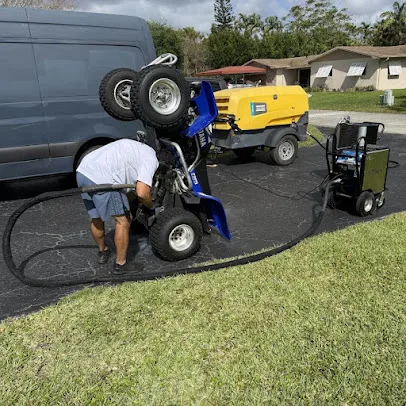
The compressor runs off the truck, so there is no wash pad to find and no runoff to manage. Which means no downtime spent in transit and no risk of damage moving it out of The Glades and back.
The media is gone by the time it has done its work, so there is no sand to vacuum and no water to mop. Only the contaminant is left, and that leaves with us.

What we clean
The work we take on around The Glades
Nearby
Also working across Palm Beach County
Questions from The Glades
Do you cover The Glades?
Yes. The Glades is inside our regular working area, and the rig travels to the job rather than the other way round.
What do we have to provide?
Access to the equipment and somewhere to park the compressor. No water hookup, no drain and no wash bay.
Will you work during a shutdown?
Usually. Tell us the window you have, including overnight or a planned shutdown, and we will tell you honestly what fits in it.
What kinds of jobs do you take here?
A mix, vehicle work, shop equipment, marine and light industrial. Same rig, different constraint each time.
Does distance affect the price?
It depends how far out the job is. We will be straight with you about it when you describe the work.
What is the first step?
Send the equipment, the location and a short description with photos if you have them. One of the owners calls you back.
Conditions around The Glades
The heat matters more than people expect: baked-on residue cures harder in a South Florida summer. That is why so much of the work is removing what has bonded to a surface without taking the surface with it.
Light industrial, automotive and marine make up most of what we are called out for. Whatever the setting, the rig arrives with its own compressor and containment, so nothing about the site has to change to accommodate us.
Because the media sublimates, there is no slurry running toward a storm drain and no grit left in a machine. On a tight site in Palm Beach County that is often the deciding factor.
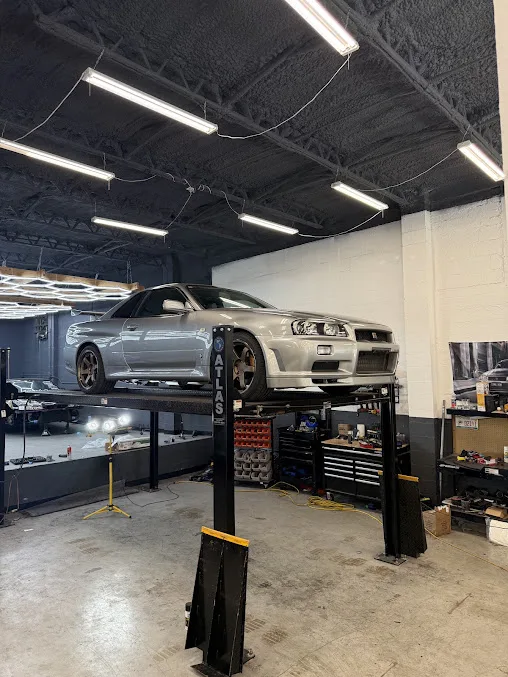
What comes off
What comes off, and why
Buildup that sits on a surface can usually be lifted off it. Damage that is part of the surface itself is a different problem. The deposits below all fall in the first group.
- Ink and printing residue
Dried ink on precision roller faces, cleaned without altering the cell structure that does the work.
- Food residue
Burnt-on product, fat and sugar on processing gear, with no chemical residue left on a contact surface.
- Grease and oil
The greasy base coat that traps grit and dust. It releases early and takes the loose material with it.
- Carbon and soot
The deposit that forms wherever things run hot. Because heat bonded it, a sharp temperature drop is the quickest way to undo it.
- Adhesive and sealant
Sound deadening, tape residue, gasket material and sealant that has cured onto a face it was never meant to stay on.
- Resin and mold release
Cured resin clings to fixtures and tooling. Grit would wear the tool as it cleaned, which is why this needs something softer.
- Paint and coatings
Selective removal, layer by layer, on parts where media blasting would cut into the substrate.
How a job runs
Nothing about this should be a surprise
Nobody should have to guess what they booked. This is every stage of a job in the order it happens.
- You look before we pack up
We would rather you find the missed spot while we are standing there than a week later. Another pass on the day is the cheapest fix available.
- You describe the job
Tell us the machine, the mess and the constraint. A couple of photos answers more than a long description, and if the honest answer is that something else suits it better, we say so.
- We look at access and containment
Hose run, compressor position, what needs masking, and where the contaminant is collected. For food and electrical jobs the containment plan takes longer to settle than the blasting does.
- We test a small area
Every material takes a different pressure. We start on an out-of-the-way patch, check the result, and only then move to the parts people will actually see.
- We blast, then clean up
The ice is gone on impact. What is on the floor afterward came off your machine, and clearing it is ours to do.
The comparison
How this compares to the usual methods
- Solvent and degreaser
It dissolves the deposit and often the finish underneath, then leaves a film behind either way.
- Hand scraping
Slow, inconsistent, and the tool marks the surface. Fine for a small area, unworkable across a machine.
- Media blasting
It takes the top off whatever it touches. That is the point on rusted plate and the problem everywhere else.
- Pressure washing
Water gets into everything and has to come out again before the equipment runs. Around electrics it is off the table entirely.
- Dry ice
Thermal contraction cracks the bond between deposit and surface, then the pellet gasses off. Nothing abrasive, nothing wet, nothing left.
What to expect on site
Expect noise. Everybody inside the working area wears hearing protection, us included.
Mostly what you notice afterward is the temperature. Wait a few minutes before touching the part, and expect some moisture on it as it comes back up to room temperature.
Setup does not depend on what your building has. Our own compressor supplies the air, so we can start as soon as the hose is run.
We cover what should not be hit before anything gets blasted. It takes minutes and saves arguments.
Tell us what needs cleaning.
Tell us what you have and where it is. If you can snap a picture, send it. Giancarlo or Kenny will be the one who calls.