Home / Service areas / Miami-Dade County / Bal Harbour
Miami-Dade County · Florida
Bal Harbour dry ice blasting
Bal Harbour work comes to us the same way most of it does: something is coated in build-up and cannot be sanded, soaked or dissolved.
How the work runs here
The compressor runs off the truck, so there is no wash pad to find and no runoff to manage. It is also why nothing has to be crated up and driven across town, the work happens where the machine already sits in Bal Harbour.
The pellet turns straight to gas when it hits, which means no sand in the machine and no sludge on the floor. The only thing to collect is the contaminant itself, and that is included.
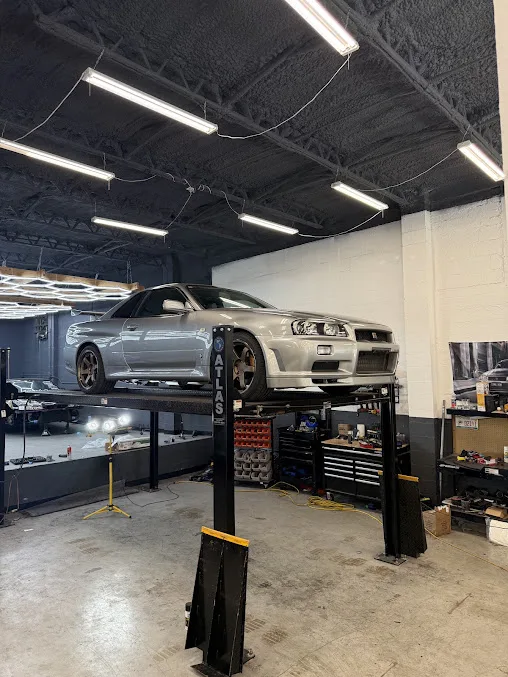
What we clean
Where this method earns its keep in Bal Harbour
Nearby
Also working across Miami-Dade County
Questions from Bal Harbour
How do we book it in?
Describe the job and send a photo or two. Giancarlo or Kenny will call you, not a scheduler.
Do you cover Bal Harbour?
Yes, Bal Harbour is well within range, and the compressor comes on the truck with everything else.
What do we have to provide?
Access to the equipment and somewhere to park the compressor. No water hookup, no drain and no wash bay.
Will you work during a shutdown?
Most of the time. Shutdowns and after-hours work are normal for us; what matters is knowing the window early.
What kinds of jobs do you take here?
A mix, vehicle work, shop equipment, marine and light industrial. Same rig, different constraint each time.
Do you charge for the drive?
Distance can factor in. You will hear about it up front, not on the invoice.
Conditions around Bal Harbour
Afternoon storms mean equipment that lives outside is wet, then hot, then wet again. It is also why an abrasive method costs you twice: once in the cleaning, again in the finish you removed.
Residential garages and small shops sit alongside the commercial work on any given week. The setup is the same in all of them, because everything the job needs turns up on the van.
With no slurry to contain and no media to recover, a confined Miami-Dade County site stops being a problem.
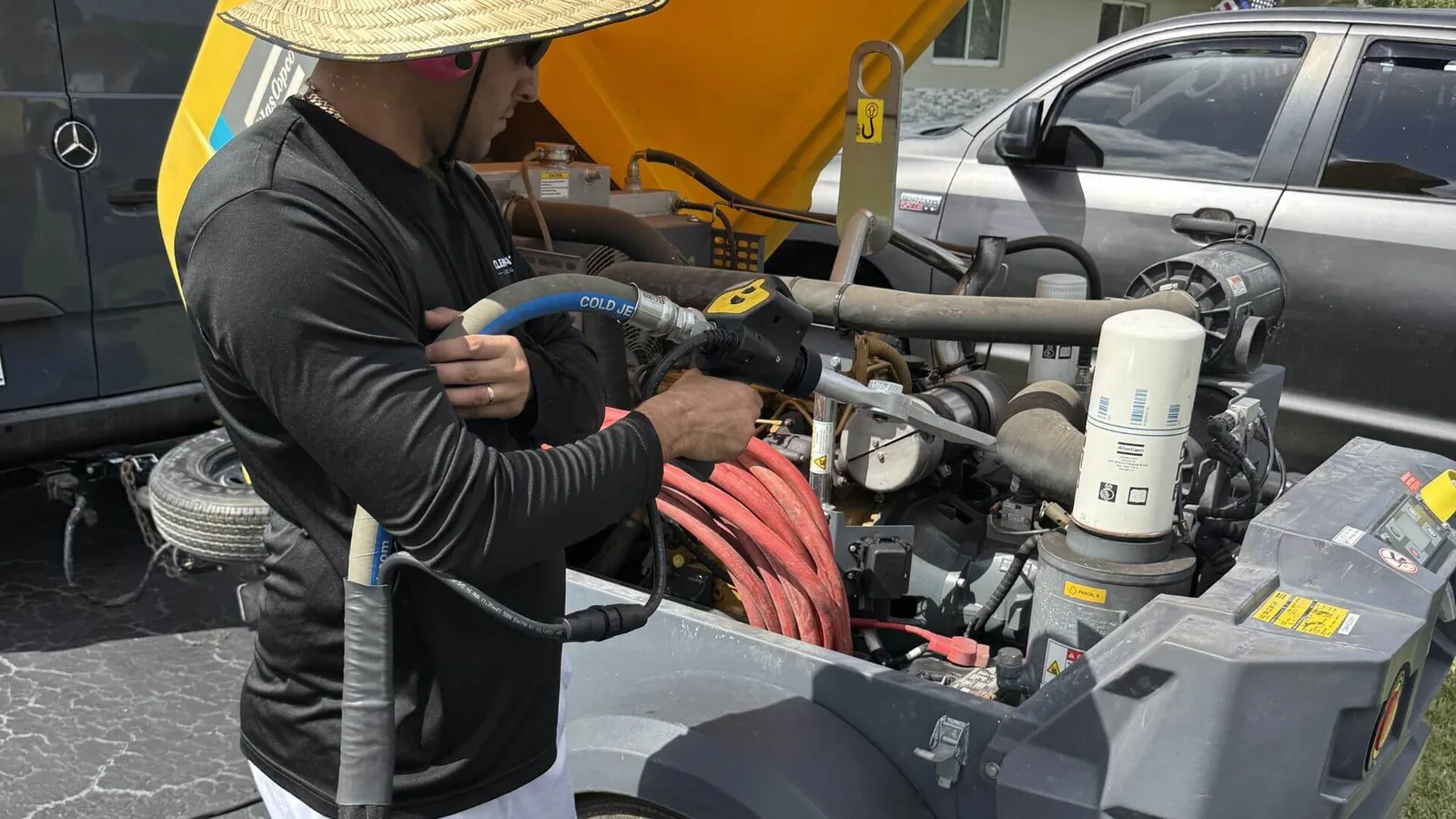
What comes off
The deposits we see most
What follows is the short list of regulars. Every one of them is a crust or film bonded to a working surface.
- Carbon and soot
Black, crusty and heat-set, on burners, manifolds and fixtures. Thermal shock breaks the grip early in the job.
- Adhesive and sealant
Whatever the last repair left stuck to the mating face: gasket, sealant, deadener or adhesive.
- Resin and mold release
Release agent and resin build-up on tooling, where a solvent fix trades one residue for another.
- Paint and coatings
Taken off in a controlled way when what is underneath matters more than speed.
- Salt and corrosion product
Salt deposit and the oxidation it starts. Anything abrasive removes the protection along with the salt.
- Ink and printing residue
Dried ink and coating build-up on rollers and press components, where the surface texture is the product.
- Food residue
Carbonized product build-up in a plant where neither standing water nor a chemical film is acceptable.
How a job runs
What happens once you call
The process is simple, and we would rather you know it before we show up than wonder about it while we work.
- We look at access and containment
If your people are still working nearby, we plan around them. That means deciding where the noise and the debris go, and keeping a clear line between the work area and everyone else.
- We test a small area
Some coatings are meant to stay. A test on an unseen spot shows whether the ice takes only the grime or starts to work on the finish underneath.
- We blast, then clean up
One mess instead of two: the pellet vanishes and we take away what it removed.
- You look before we pack up
If something needs another pass we do it then, on site, while the rig is still running. That is a better outcome for everyone than a callback.
- You describe the job
Send images if you can, they settle most of the questions. A wrong-tool verdict comes on that first call, not after the invoice.
The comparison
How this compares to the usual methods
- Pressure washing
Drives water into harnesses, bearings, panels and seams, then everything waits to dry. On electrical work it is simply not an option.
- Solvent and degreaser
Softens the contaminant but leaves a film, fumes and a disposal problem, and attacks finishes you meant to keep.
- Hand scraping
Slow enough to be uneconomic on a machine, and the tool always leaves a trace.
- Media blasting
Cuts into the substrate by design. Fine on structural steel, wrong on aluminum, plating, machined faces or anything with a tolerance.
- Dry ice
Thermal contraction cracks the bond between deposit and surface, then the pellet gasses off. Nothing abrasive, nothing wet, nothing left.
What happens in your space
Surfaces come out cold. On some jobs that means waiting a few minutes before handling, and on others it means condensation as the part returns to ambient temperature.
Everything the rig needs arrives with it. No tap, no drain, no outlet.
Anything nearby that should not be touched gets masked before we start. That is quicker than explaining it afterward.
Firefighters think about air before anything else, and so do we. The gas off the ice is not toxic, but it displaces oxygen in a closed area, so ventilation is settled first.

Tell us what needs cleaning.
Tell us what you have and where it is. If you can snap a picture, send it. Giancarlo or Kenny will be the one who calls.