Home / Services / Automotive / Automotive Dry
Automotive · Miami, FL
Automotive Dry Ice Blasting
Automotive Dry is one of the jobs dry ice blasting was made for. We clean it without water, without chemicals and without anything abrasive touching the surface.
What builds up, and why it matters
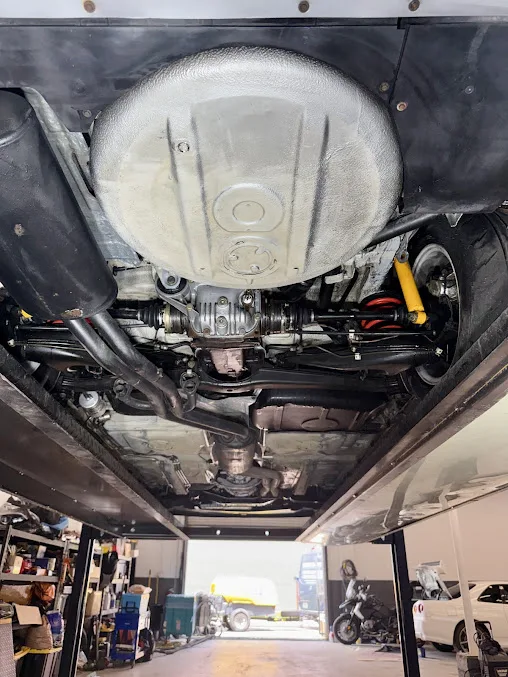
On this kind of work the problem is baked grease, road film, undercoating, sound deadening, adhesive and brake dust. Media blasting will cut into aluminum and pit a frame. Pressure washing drives water into looms and bearings. Solvent strips the finishes you wanted to keep. Dry ice takes the contamination and leaves the part.
Engine bays, frames and undercarriages are cleaned on a lift, on stands or in your driveway. The people who call us about automotive dry are usually restorers, shops and owners who actually care about the vehicle, and the thing they are actually worried about is damage to a car that took years to put together.

The method
Why dry ice and not the alternatives
- Non-abrasive
Cold does most of the work here. The contaminant shrinks and lets go, and the surface below it is left as it was.
- Low moisture
Nothing is left wet, so no water sits in seams, channels or behind covers. The equipment goes back into service dry.
- No secondary waste
Cleanup is just the buildup itself. The media vanishes, so nothing ends up in seams, drains or bearings that needs flushing out later.
- Often no teardown
No water and no grit means nothing has to be protected by taking it out first. Most parts stay installed while we work.
More automotive work
Related jobs we get called for
Questions we get asked first
Will it damage the surface underneath?
Rarely, and we take the risk out up front. Pressure and pellet size are set on a spot nobody will look at, so if a surface reacts badly we find out there and stop.
Do you have to take the equipment apart for automotive dry?
Usually not, and that is where most customers save. Equipment cleaned in place goes back to work sooner, without the hours of taking it down and putting it back together.
How much mess does it make?
Most of the mess is the buildup coming off in flakes and dust. We contain it while we work and clean it up before we leave.
Do you come to us?
Yes, that is how we work. Nothing needs to be loaded or shipped. We bring the full setup to you anywhere in South Florida, from Miami out to around a hundred miles.
What does a job cost?
We price every job on its own, because a greasy engine bay and a carbon-caked oven are different work. Guessing over the phone helps nobody. Send the details and one of the owners comes back with a figure we will stand behind.
How soon can you look at it?
Most of the delay is waiting on details. Once we know what the part is made of and what is stuck to it, we can tell you when we can come and whether dry ice is right for it.
The comparison
What the alternatives actually do
- Media blasting
Abrasive by definition. Anything with a tolerance or a finish worth keeping comes out changed.
- Pressure washing
Forces water where water should not go, looms, bearings, seams, and then the job stops while it dries.
- Solvent and degreaser
Trades the deposit for a residue, plus ventilation and waste to deal with, and it is hard on the finish.
- Hand scraping
Slow enough to be uneconomic on a machine, and the tool always leaves a trace.
- Dry ice
Thermal contraction cracks the bond between deposit and surface, then the pellet gasses off. Nothing abrasive, nothing wet, nothing left.
What comes off
What comes off, and why
Here is the short version of what comes off. Anything layered onto metal or tooling is a likely candidate, and the list covers the requests we see most.
- Paint and coatings
Removed selectively where the substrate underneath has to survive, which rules out most abrasive approaches.
- Salt and corrosion product
The year-round problem on the coast. The finish holding corrosion back has to survive the cleaning.
- Ink and printing residue
Dried ink on precision roller faces, cleaned without altering the cell structure that does the work.
- Food residue
Burnt-on product, fat and sugar on processing gear, with no chemical residue left on a contact surface.
- Grease and oil
The greasy base coat that traps grit and dust. It releases early and takes the loose material with it.
- Carbon and soot
Heat-bonded black deposit. Because heat put it there, a sudden cold front is what breaks its grip.
- Adhesive and sealant
Whatever the last repair left stuck to the mating face: gasket, sealant, deadener or adhesive.
How a job runs
Nothing about this should be a surprise
Nobody should have to guess what they booked. This is every stage of a job in the order it happens.
- You describe the job
Tell us the machine, the mess and the constraint. A couple of photos answers more than a long description, and if the honest answer is that something else suits it better, we say so.
- We look at access and containment
Access drives the plan: reach, siting, masking, and the route the removed material takes off the job. It is the part customers think about least and we think about most.
- We test a small area
The test patch also answers whether the buildup releases at all. Bonded grime usually lets go on the first pass, but if something on your part won’t move, we would rather find out on a hidden corner and tell you.
- We blast, then clean up
One mess instead of two: the pellet vanishes and we take away what it removed.
- You look before we pack up
We would rather you find the missed spot while we are standing there than a week later. Another pass on the day is the cheapest fix available.
What to expect on site
This is not a quiet method. Ear defenders are standard issue on site for anyone nearby.
The part will be cold when we finish. Sometimes that means a short wait before handling; sometimes it means a film of condensation as it warms back up.
Nothing from you is required to run the rig. Our compressor and hose come with us on every job.
Anything nearby that should not be touched gets masked before we start. That is quicker than explaining it afterward.
Send us the job.
Have a shutdown coming? Mention the date here so we can tell you honestly whether we can make it.