15 services · Miami, FL
Data Center Ice Blasting
A data hall cannot take water and cannot take downtime. Cleaning has to be dry, contained, and finished inside the window you were given.
What we clean, and what it is covered in
The build-up here is fine dust and particulate loading on switchgear, busway, fans and mechanical plant. Work is planned around the maintenance window and the containment the facility requires.
Most of the people who call are critical facility and data center operations teams. What they are protecting against is particulate migrating somewhere it should not, or a window overrunning, which is exactly why an abrasive or a solvent is the wrong answer.
All 15 services
Every data job we take
Questions about this work
What makes dry ice right for this work?
A data hall cannot take water and cannot take downtime. Cleaning has to be dry, contained, and finished inside the window you were given.
Do you clean in place?
Work is planned around the maintenance window and the containment the facility requires. Most of this work does not need a teardown.
Will it damage the surface?
On most substrates, no. The pellet is soft and sublimates on impact, so the work is thermal rather than abrasive. We test an inconspicuous spot first on anything unusual.
Is there any residue afterward?
None from the media. Dry ice sublimates, so what is left is the contaminant we came to remove, and that is ours to clean up.
Do you come to us?
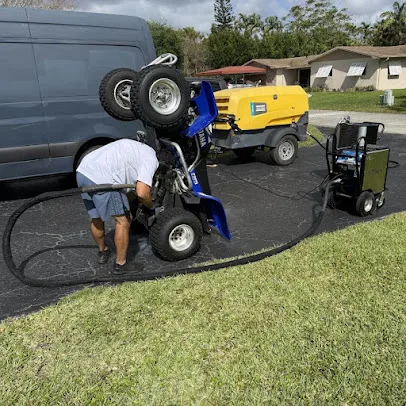
Yes. The rig is mobile and works across South Florida from Miami out to roughly a hundred miles.
What does it cost?
It depends on the equipment, the contaminant and the access. Describe the job and we will give you a real figure rather than a guess over the phone.
What comes off
The deposits we see most
Most calls involve one of the following. The common factor is a bond between two things that should not be bonded.
- Grease and oil
The greasy base coat that traps grit and dust. It releases early and takes the loose material with it.
- Carbon and soot
The hard black crust on a housing, an oven or a weld cell. Bonded by heat, and the first thing to release under thermal shock.
- Adhesive and sealant
Bonded material that outlived whatever it was bonding, usually harder to shift than the part it is on.
- Resin and mold release
Release agent and resin build-up on tooling, where a solvent fix trades one residue for another.
- Paint and coatings
Taken off in a controlled way when what is underneath matters more than speed.
- Salt and corrosion product
Salt deposit and the oxidation it starts. Anything abrasive removes the protection along with the salt.
- Ink and printing residue
Ink and coating on anilox and press rollers, surfaces where changing the texture changes the print.
How a job runs
What happens once you call
If you have not seen this done before, the process is worth reading once. Nothing below is hidden in a footnote.
- We look at access and containment
Access drives the plan: reach, siting, masking, and the route the removed material takes off the job. It is the part customers think about least and we think about most.
- We test a small area
An out-of-sight patch comes first so pressure and pellet size are proven before anything that shows. Soft alloys, older paint and bare metal each want different numbers.
- We blast, then clean up
Nothing is left of the pellet, so the only thing to collect is what was on your equipment. That collection is part of the work we quoted.
- You look before we pack up
Walk it with us before the hose goes away. A second pass while the compressor is still running costs nothing; a return visit costs us both.
- You describe the job
What it is, what is on it and whether it can stop. If the answer is that dry ice is wrong for it, you get that answer first, not last.
The comparison
How this compares to the usual methods
- Media blasting
Grit removes material to do its job, so a machined face or a plated part pays for the cleaning.
- Pressure washing
The water has to go somewhere, and on most equipment that somewhere is inside it.
- Solvent and degreaser
Softens the contaminant but leaves a film, fumes and a disposal problem, and attacks finishes you meant to keep.
- Hand scraping
Labor-intensive and uneven, and whatever you scrape with eventually marks what you are scraping.
- Dry ice
The deposit shrinks away from the surface it is stuck to and releases. The ice is gone before it can do any harm.
What happens in your space
The part will be cold when we finish. Sometimes that means a short wait before handling; sometimes it means a film of condensation as it warms back up.
The rig needs compressed air, which the truck supplies. There is no hookup to find and nothing of yours to plug into.
Masking happens first. Whatever is adjacent and vulnerable gets covered before the hose is picked up.
Dry ice is carbon dioxide in solid form. It is non-toxic and leaves no residue, but it does displace oxygen in an enclosed space, so ventilation is part of the setup rather than an afterthought.
Why us
How we do business
- We clean up after ourselves
Nothing of the blasting media remains, so the only cleanup is the dirt itself, and that is ours to handle.
- Firefighter owned and operated
The owners are firefighters. Preparation, checking your equipment and doing the job properly under pressure are habits that came with them.
- You speak to an owner
The person who picks up is the person doing the work. Nothing gets lost between the quote and the job.
- We will tell you no
Not everything should be dry ice blasted. Being told that early is worth more than being sold the job.
- We test before we commit
Anything unusual gets an inconspicuous test area first. Painted parts, soft alloys and older finishes all behave differently.
- The rig comes to you
We are mobile. The equipment stays where it is and we bring everything needed to it.
Describe what you are dealing with.
Give us the job, the address and a rough description, pictures if you have them. The call back comes from Giancarlo or Kenny directly.