Home / Service areas / Lee County / Cape Coral
Lee County · Florida
Cape Coral dry ice blasting
Cape Coral calls tend to arrive with a constraint attached, which is exactly where this method earns its keep.
How we work in this area
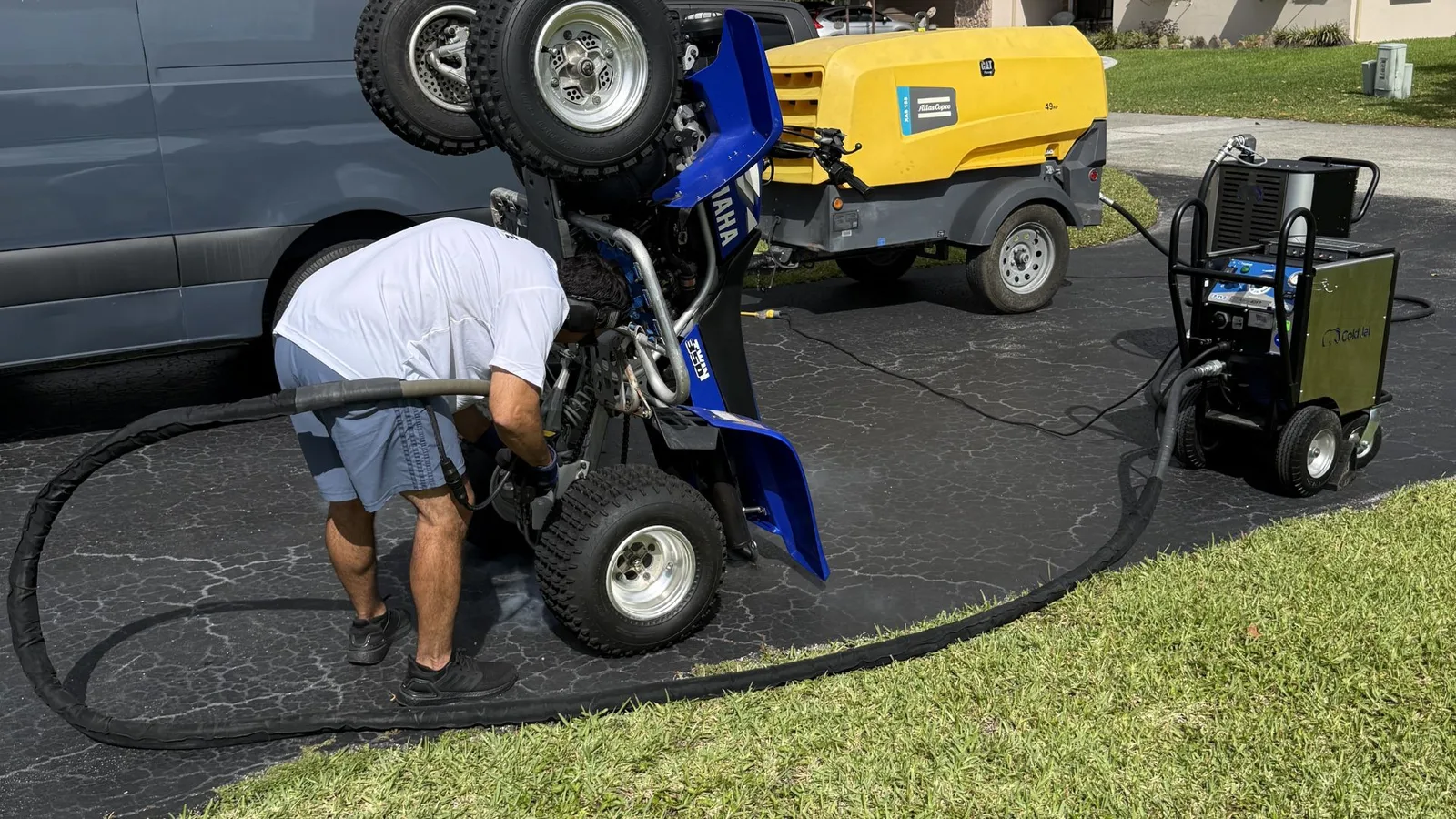
We work on driveways, in yards and inside shops that cannot take water on the floor. So the equipment stays put. Everything that has to move arrives on the truck instead.
Nothing of the ice survives the blast. That removes the entire cleanup problem every other method creates, leaving only the deposit that came off the equipment.
What we clean
What we get called for in Cape Coral
Nearby
Also working across Lee County
Questions from Cape Coral
What sort of work do you get called for?
Everything from an engine bay in a driveway to a production line at shutdown. The process is the same, pointed at a different problem.
Do you charge for the drive?
It depends how far out the job is. We will be straight with you about it when you describe the work.
How do I get started?
Describe the job and send a photo or two. Giancarlo or Kenny will call you, not a scheduler.
Do you actually come out to Cape Coral?
We do. The whole point of a mobile setup is that Cape Coral is no further than any other stop on the schedule.
What do you need from us on site?
Space for the rig and a way to reach the machine. Everything else arrives with us.
How flexible are the hours?
Yes, within reason. Planned outages are easiest because everybody already knows the window.
What the climate does here
Afternoon storms mean equipment that lives outside is wet, then hot, then wet again. It is also why an abrasive method costs you twice: once in the cleaning, again in the finish you removed.
Residential garages and small shops sit alongside the commercial work on any given week. The setup is the same in all of them, because everything the job needs turns up on the van.
The pellet turns to gas, so nothing runs off toward a drain and nothing abrasive stays behind in a bearing. On a cramped Lee County site that usually decides it.
What comes off
What dry ice actually removes
The rule of thumb is simple: anything stuck on rather than built in. These are the deposits we see most.
- Carbon and soot
Heat-bonded black deposit. Because heat put it there, a sudden cold front is what breaks its grip.
- Adhesive and sealant
Cured sealant, old gasket, tape glue and sound deadening, the residue left when something was removed but its bond was not.
- Resin and mold release
Release agent and resin build-up on tooling, where a solvent fix trades one residue for another.
- Paint and coatings
Removed selectively where the substrate underneath has to survive, which rules out most abrasive approaches.
- Salt and corrosion product
The year-round problem on the coast. The finish holding corrosion back has to survive the cleaning.
- Ink and printing residue
Dried ink on precision roller faces, cleaned without altering the cell structure that does the work.
- Food residue
Burnt-on product, fat and sugar on processing gear, with no chemical residue left on a contact surface.
How a job runs
How a job actually runs
The process is short to explain. These are the stages, start to finish, so you know where we are at any point in the job.
- We blast, then clean up
One mess instead of two: the pellet vanishes and we take away what it removed.
- You look before we pack up
If something needs another pass we do it then, on site, while the rig is still running. That is a better outcome for everyone than a callback.
- You describe the job
Tell us the machine, the mess and the constraint. A couple of photos answers more than a long description, and if the honest answer is that something else suits it better, we say so.
- We look at access and containment
Hose run, compressor position, what needs masking, and where the contaminant is collected. For food and electrical jobs the containment plan takes longer to settle than the blasting does.
- We test a small area
Aluminum, cast iron and painted steel all want different settings, and guessing is how surfaces get marked. A small hidden test settles it before the real work starts.
The comparison
What the alternatives actually do
- Pressure washing
The water has to go somewhere, and on most equipment that somewhere is inside it.
- Solvent and degreaser
Trades the deposit for a residue, plus ventilation and waste to deal with, and it is hard on the finish.
- Hand scraping
Hours of work for an inconsistent result, with gouges where the blade slipped.
- Media blasting
Abrasive by definition. Anything with a tolerance or a finish worth keeping comes out changed.
- Dry ice
It is the only one on this list where the media stops existing the moment it has worked.
What the job is like to stand next to
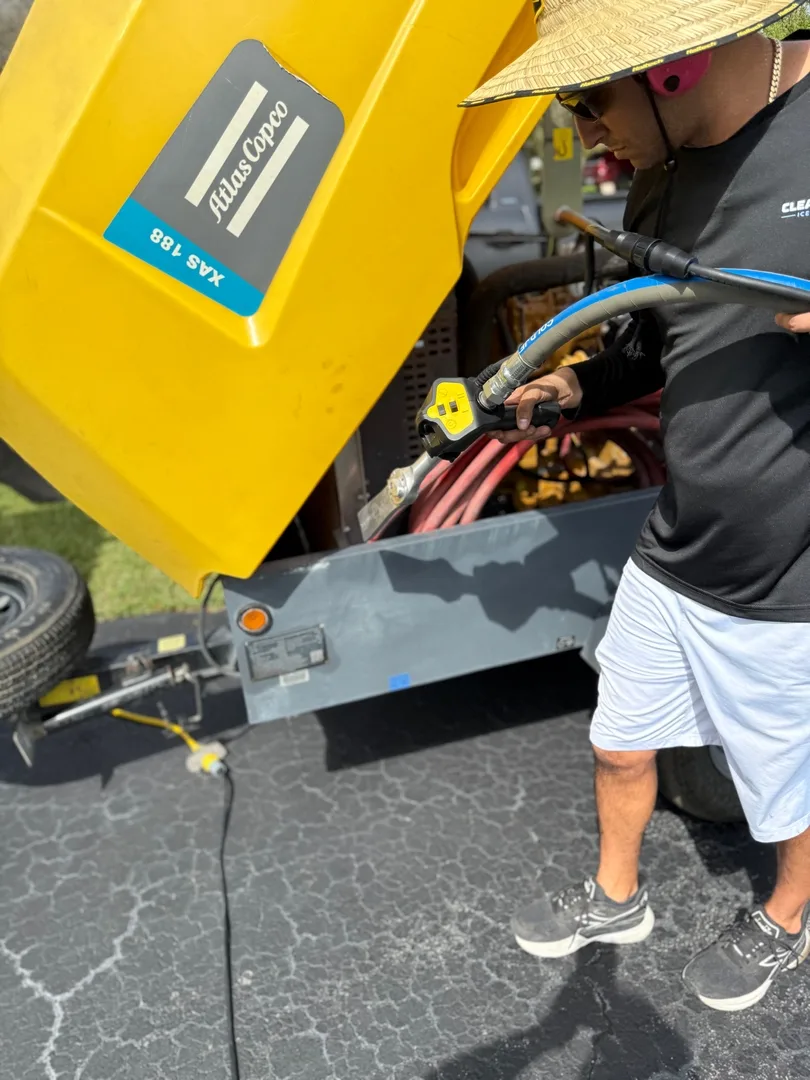
Remote site with no power? That is fine. The air comes from our truck, so we can work wherever we can reach.
Anything nearby that should not be touched gets masked before we start. That is quicker than explaining it afterward.
There is no chemical in this and nothing to wipe off afterward. The gas from the ice still displaces air in a sealed room, so we keep air moving for as long as we are blasting.
The process is loud. Hearing protection is standard for anyone in the working area, which is why you will see ear defenders in most of our photographs.
Describe what you are dealing with.
Tell us what needs cleaning and where it is. Photos are a bonus. Either Giancarlo or Kenny will be the one who responds.