What builds up, and why it matters
On this kind of work the problem is salt, corrosion product, oil, exhaust soot and bilge residue. South Florida salt air never stops working on a vessel. Abrasive cleaning takes the protective finish with the salt; dry ice removes the contamination and leaves the coating.
Work happens dockside, in the yard or aboard. The people who call us about yacht are usually captains, yards and vessel owners, and the thing they are actually worried about is stripping a coating that was the only thing holding corrosion back.

The method
Why dry ice and not the alternatives
- Non-abrasive
Tolerances stay where they were. Nothing hard hits the part, so a mold face or a bearing seat is not worn by the cleaning.
- Low moisture
Bearings and wiring hate water. The ice turns to gas instead of liquid, so there is none to work its way inside.
- No secondary waste
No pile of sand in the corners afterward. The pellet is gone on impact, and only the original contaminant needs cleaning up.
- Often no teardown
Leave it bolted together. Most of what we clean stays assembled, and skipping the teardown is usually worth more than the cleaning itself.
More marine work
Related jobs we get called for
Questions we get asked first
Will it damage the surface underneath?
Done right, no. The risk is in the wrong settings, which is why we start gentle on a test spot and work up instead of opening up on the part itself.
Do you have to take the equipment apart for yacht?
Not often. Because nothing wet goes in, there is no reason to pull covers or remove parts to protect them from water. Where something does need to come off for access, we tell you ahead of time.
How much mess does it make?
Less than you would think. There is no water, so there is no runoff, and no media, so there is nothing to recover except the dirt.
Do you come to us?
Every job is on site. Your car can stay in your garage and your boat at the dock while we work. We cover South Florida, from Miami out to about a hundred miles.
What does a job cost?
The figure is tied to the work itself, so we price it once we know what it is. Keep in mind the bigger saving is often the teardown you no longer pay for. Tell us about the job and we will put a real number on it.
How soon can you look at it?
Pictures get you an answer fastest. A few clear shots of the equipment and the buildup usually tell us enough to talk timing on the first call, before anyone drives out.
The comparison
What the alternatives actually do
- Pressure washing
The water has to go somewhere, and on most equipment that somewhere is inside it.
- Solvent and degreaser
It dissolves the deposit and often the finish underneath, then leaves a film behind either way.
- Hand scraping
It is the fallback when nothing else is available, and it shows on the surface afterward.
- Media blasting
It works by removing material, which is the problem. Acceptable on heavy steel, damaging on soft alloy, plating or a machined surface.
- Dry ice
The pellet is soft and the mechanism is temperature, not abrasion. It turns to gas on impact, so the only thing left to sweep up is what came off.
What comes off
What dry ice actually removes
The rule of thumb is simple: anything stuck on rather than built in. These are the deposits we see most.
- Carbon and soot
Soot and carbon from heat and combustion. It clings hard to hot parts, but cold shrinks it faster than the metal underneath, and that breaks the bond.
- Adhesive and sealant
The stubborn film under old tape, or the gasket that tore and left half of itself behind.
- Resin and mold release
Release agent and resin build-up on tooling, where a solvent fix trades one residue for another.
- Paint and coatings
Removed selectively where the substrate underneath has to survive, which rules out most abrasive approaches.
- Salt and corrosion product
A constant in South Florida. Removing it without stripping the protective finish is the whole trick.
- Ink and printing residue
Dried ink and coating build-up on rollers and press components, where the surface texture is the product.
- Food residue
Burnt-on product, fat and sugar on processing gear, with no chemical residue left on a contact surface.
How a job runs
How a job actually runs
Dry ice blasting looks dramatic on video, but the work itself follows a simple order. These are the steps, in sequence.
- We look at access and containment
Tight sites need a plan for where people walk. We mark out a working zone so staff and visitors stay clear while the hose is live.
- We test a small area
A test spot takes minutes and protects the whole job. It tells us how hard to push on this particular surface, which matters more than any rule of thumb.
- We blast, then clean up
Inside a cabinet or around a motor, nothing gets trapped behind. The ice turns to gas on contact, and the dust and grease it knocks loose is collected before we go.
- You look before we pack up
We would rather you find the missed spot while we are standing there than a week later. Another pass on the day is the cheapest fix available.
- You describe the job
The machine, the deposit and the downtime you can afford. Those three things decide the whole job, and we would rather know all of them before quoting.
What the job is like to stand next to
Part of every indoor job is airflow. Dry ice turns from solid to gas without leaving residue, and that gas displaces oxygen in a closed area. We plan for it at the start, the same way we plan the hose run.
Dry ice blasting is noisy. Anyone close to the work wears hearing protection, and we will ask you to keep your distance or put some on.
When we step back, the surface is chilled. That can mean holding off on handling for a little while, or seeing beads of moisture form briefly as it warms in the open air.
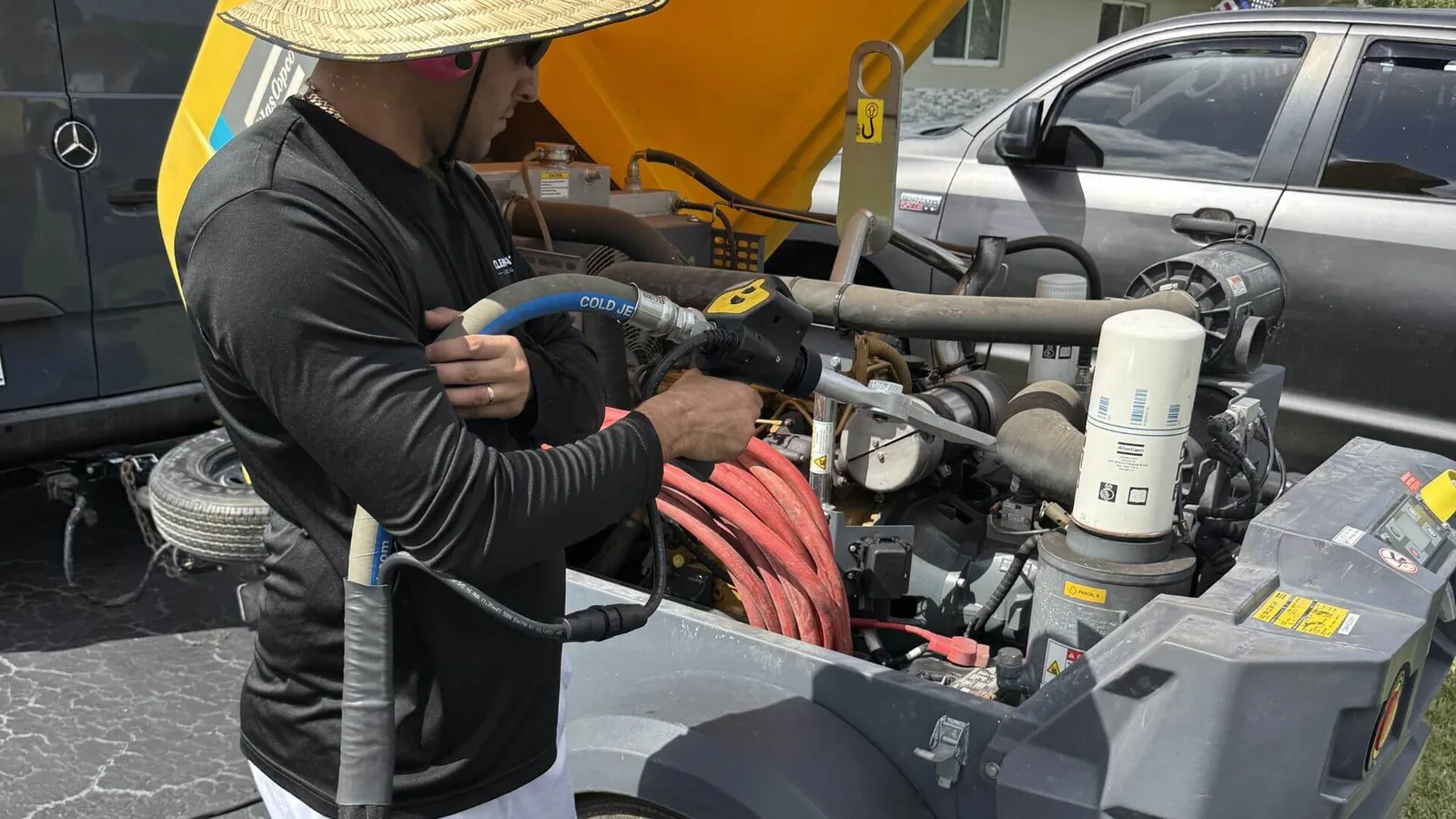
Everything the rig needs arrives with it. No tap, no drain, no outlet.
Tell us what needs cleaning.
A couple of photos and a line about the job gets things moving. You will deal with the people who do the work.