Home / Service areas / Palm Beach County
47 communities · Florida
Dry ice blasting across Palm Beach County
We are mobile, so the job site is wherever the machine is. The compressor, hose and operator come to you anywhere in Palm Beach County.
Working in Palm Beach County
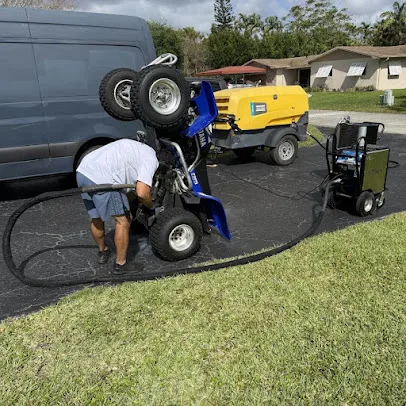
Everything we do runs off our own compressor, so there is no wash pad to find and no drain to worry about. That matters in Palm Beach County, where a lot of the work happens on a driveway, in a yard, or inside a shop that cannot be flooded.
South Florida salt air keeps corrosion moving all year, which is why so much of the work here is about removing what has bonded to a surface without taking the surface with it.
Where we work
Communities across Palm Beach County
Common questions
How flexible are the hours?
Generally yes. Weekend and overnight work is routine, and the limiting factor is usually noise, not us.
What sort of work do you get called for?
Everything from an engine bay in a driveway to a production line at shutdown. The process is the same, pointed at a different problem.
Is there a travel charge?
Distance can factor in. You will hear about it up front, not on the invoice.
How do we book it in?
A short description and a couple of pictures is enough to start. An owner rings you back.
Do you actually come out to Palm Beach County?
We do. The whole point of a mobile setup is that Palm Beach County is no further than any other stop on the schedule.
What do you need from us on site?
Access to the equipment and somewhere to park the compressor. No water hookup, no drain and no wash bay.
What comes off
What dry ice actually removes
The rule of thumb is simple: anything stuck on rather than built in. These are the deposits we see most.
- Adhesive and sealant
Sound deadening, tape residue, gasket material and sealant that has cured onto a face it was never meant to stay on.
- Resin and mold release
Production residue cured onto tooling. Solvent softens it and leaves its own film; the ice lifts it and takes nothing with it.
- Paint and coatings
Selective removal, layer by layer, on parts where media blasting would cut into the substrate.
- Salt and corrosion product
The year-round problem on the coast. The finish holding corrosion back has to survive the cleaning.
- Ink and printing residue
Dried ink on precision roller faces, cleaned without altering the cell structure that does the work.
- Food residue
Carbonized product, fat, starch and sugar build-up on processing equipment, cleaned without chemicals touching a food contact surface.
- Grease and oil
The soft film that holds dust and swarf against metal. It is what makes a part feel dirty long after it looks clean, and it comes off first.
How a job runs
How a job actually runs
Most people have never watched dry ice blasting happen and are not sure what they are agreeing to. Here is the whole sequence, start to finish.
- You look before we pack up
A second pass while everything is still connected is free in every sense. A return trip is not.
- You describe the job
Describe the equipment and the mess. If it cannot come offline that changes the plan, so say so early.
- We look at access and containment
Siting the compressor, masking what must not be touched, and catching what comes off, settled before the first pellet.
- We test a small area
Pressure and pellet size get dialed in on an inconspicuous spot before we touch anything visible. Painted parts, soft alloys and older finishes all behave differently, and the right setting on one is the wrong setting on another.
- We blast, then clean up
There is no spent media to recover, only the deposit, which we collect before packing up.
The comparison
What the alternatives actually do
- Solvent and degreaser
Softens the contaminant but leaves a film, fumes and a disposal problem, and attacks finishes you meant to keep.
- Hand scraping
Labor-intensive and uneven, and whatever you scrape with eventually marks what you are scraping.
- Media blasting
It works by removing material, which is the problem. Acceptable on heavy steel, damaging on soft alloy, plating or a machined surface.
- Pressure washing
Drives water into harnesses, bearings, panels and seams, then everything waits to dry. On electrical work it is simply not an option.
- Dry ice
Thermal contraction cracks the bond between deposit and surface, then the pellet gasses off. Nothing abrasive, nothing wet, nothing left.
Why us
Why people call us back
- You speak to an owner
No dispatcher, no account manager. You talk to whoever is going to be holding the hose.
- We will tell you no
If dry ice is the wrong tool for what you have, we say so on the first call rather than finding out on your equipment. Honest beats a quick buck.
- We test before we commit
Every substrate reacts differently, so settings get proven on a spot nobody sees first.
- The rig comes to you
Shop, yard, driveway or dockside, the van carries the whole setup, so nothing has to be moved.
- We clean up after ourselves
The media disappears, but the contaminant does not. Collecting it is part of the job, not an extra line.
- Firefighter owned and operated
Giancarlo and Kenny both came out of the fire service, and the discipline that job demands is the discipline this one gets.
What the job is like to stand next to
Everything the rig needs arrives with it. No tap, no drain, no outlet.
Anything nearby that should not be touched gets masked before we start. That is quicker than explaining it afterward.
The media is solid CO2, nothing toxic and nothing left behind, but it pushes oxygen out of a closed room. Ventilation gets planned before the hose is connected.
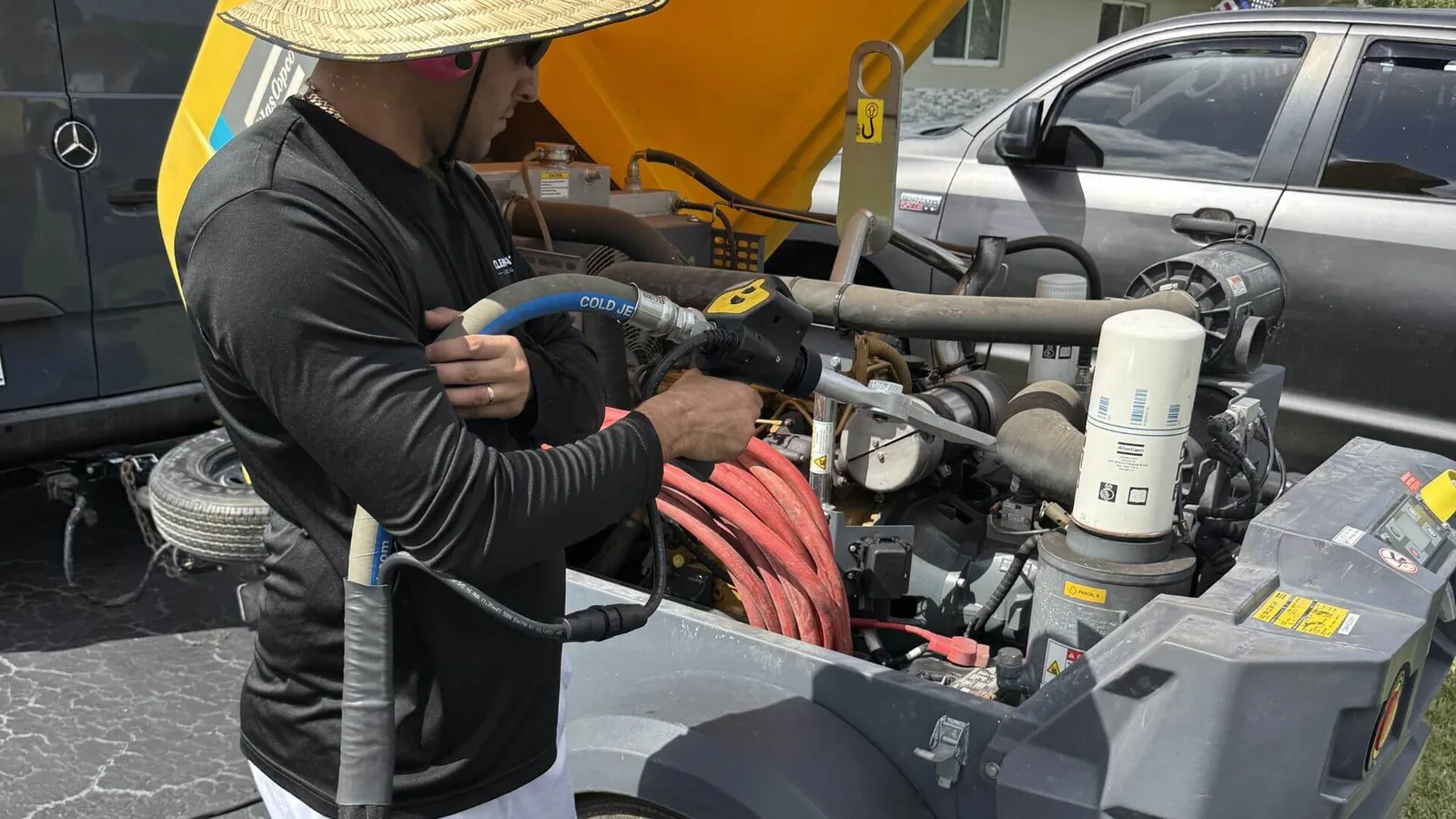
The process is loud. Hearing protection is standard for anyone in the working area, which is why you will see ear defenders in most of our photographs.
Tell us what needs cleaning.
A short description and a location is enough to start. Add photos if you can. You will speak to an owner, not a scheduler.