What builds up, and why it matters
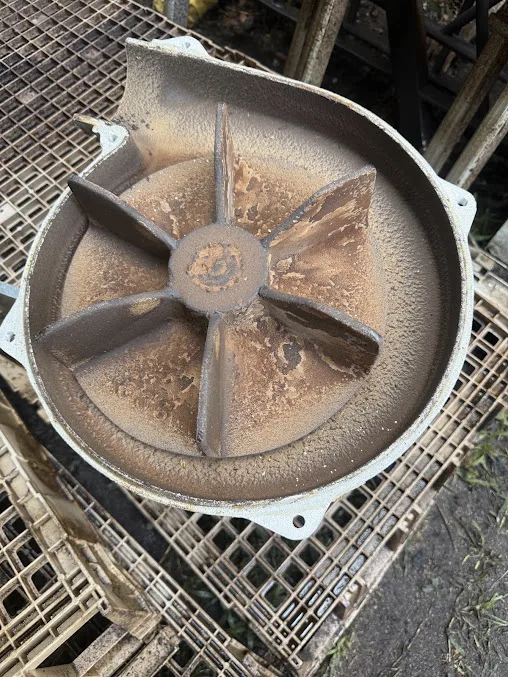
On this kind of work the problem is dried ink, adhesive, paper dust and coating build-up. Anilox and press rollers are precision surfaces. Anything abrasive changes the cell structure and changes the print, which is why solvent soaking and manual scrubbing are the usual compromise.
Presses are cleaned in place between runs or during planned maintenance. The people who call us about ink removal with dry are usually press operators and production managers, and the thing they are actually worried about is altering a roller surface and with it the print result.
The method
Why dry ice and not the alternatives
- Non-abrasive
Rubber seals, wiring and plastic covers can be cleaned in place. With no abrasive in the mix, they are not worn away in the process.
- Low moisture
Nothing gets wet, so nothing has to sit and dry. The time saved goes straight back into running the equipment.
- No secondary waste
Cleanup is just the buildup itself. The media vanishes, so nothing ends up in seams, drains or bearings that needs flushing out later.
- Often no teardown
Panels, guards and assemblies can often stay put. The nozzle reaches into recesses, so the hours normally spent stripping a machine down go back to production.
More printing work
Related jobs we get called for
Questions we get asked first
Will it damage the surface underneath?
That is the whole reason people pick this method. Machined faces, plating, paint and gaskets generally come through untouched, and we prove the setting on a small test patch before working anything you will see.
Do you have to take the equipment apart for ink removal with dry?
In a lot of cases, no. The pellets get into corners and recesses that a brush or scraper cannot reach, so most of the cleaning happens with everything still bolted together.
How much mess does it make?
Some, because the grime has to go somewhere. It falls where we have planned for it to fall, and picking it up is part of what you are paying for.
Do you come to us?
That is the only way we do it. A mobile rig means plants, shops, driveways and docks are all fair game across South Florida, up to roughly a hundred miles out from Miami.
What does a job cost?
We need to understand the job before we can put a number on it, so the first step is you telling us about it. Photos make that faster. The figure you get back comes from one of the owners and reflects the actual work.
How soon can you look at it?
Most of the delay is waiting on details. Once we know what the part is made of and what is stuck to it, we can tell you when we can come and whether dry ice is right for it.
The comparison
Why not just pressure wash it
- Hand scraping
Slow enough to be uneconomic on a machine, and the tool always leaves a trace.
- Media blasting
Abrasive by definition. Anything with a tolerance or a finish worth keeping comes out changed.
- Pressure washing
Drives water into harnesses, bearings, panels and seams, then everything waits to dry. On electrical work it is simply not an option.
- Solvent and degreaser
It dissolves the deposit and often the finish underneath, then leaves a film behind either way.
- Dry ice
The deposit shrinks away from the surface it is stuck to and releases. The ice is gone before it can do any harm.
What comes off
What this takes off
The method does not care much what the contaminant is, only that it sits on top of something. Here is the usual list.
- Food residue
Carbonized product build-up in a plant where neither standing water nor a chemical film is acceptable.
- Grease and oil
On a motor or generator, oily dust packs into the cooling fins and around the housing. Ice takes it off without putting water anywhere near the electrical parts.
- Carbon and soot
The crust that builds on anything near a flame or a weld. Cold makes it contract and lose its grip on the metal, so it lifts off in flakes.
- Adhesive and sealant
Sound deadening, tape residue, gasket material and sealant that has cured onto a face it was never meant to stay on.
- Resin and mold release
Solvents soften resin but can leave a film of their own. The ice removes the residue dry and adds nothing to the tool.
- Paint and coatings
Taken off in a controlled way when what is underneath matters more than speed.
- Salt and corrosion product
A constant in South Florida. Removing it without stripping the protective finish is the whole trick.
How a job runs
The sequence, start to finish
There is no mystery to how these jobs run, and no part of it we would rather you did not ask about.
- We test a small area
We start gentle and work up. The setting that cleans without harming the surface is found on a patch tucked away, never on your front panel.
- We blast, then clean up
Nothing is left of the pellet, so the only thing to collect is what was on your equipment. That collection is part of the work we quoted.
- You look before we pack up
We would rather you find the missed spot while we are standing there than a week later. Another pass on the day is the cheapest fix available.
- You describe the job
Photos do most of the work here. A clear shot of the buildup and one of the space around it tells us what the deposit is and how we would get to it. Add whether the line can be shut down, and we can tell you if this is the right tool.
- We look at access and containment
Hose run, compressor position, what needs masking, and where the contaminant is collected. For food and electrical jobs the containment plan takes longer to settle than the blasting does.
Before we turn the rig on
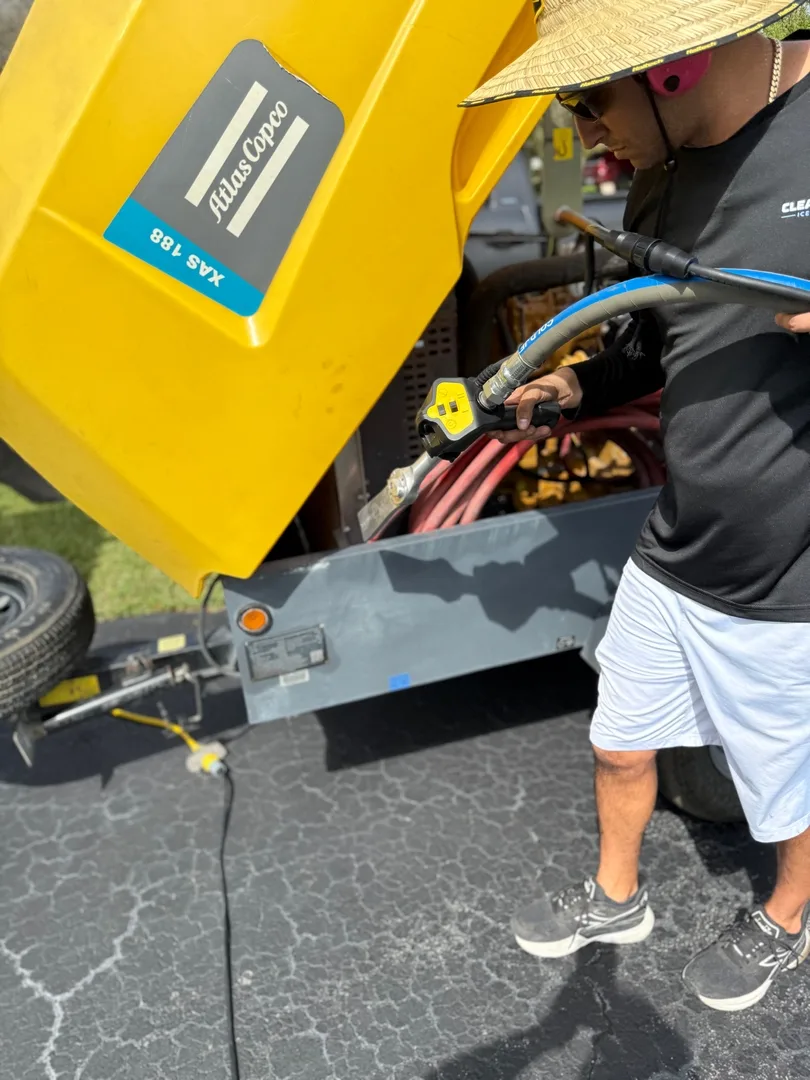
This is not a quiet method. Ear defenders are standard issue on site for anyone nearby.
In humid weather a cold part will sweat as it warms up. That moisture comes out of the air and dries off on its own.
A driveway works as well as a plant floor. Everything the job needs, air included, arrives with us.
Anything nearby that should not be touched gets masked before we start. That is quicker than explaining it afterward.
Tell us what needs cleaning.
Where is it, and how easy is it to get to? Add the equipment and the contaminant, and we have what we need to call you back.