Home / Service areas / Miami-Dade County / Surfside
Miami-Dade County · Florida
Surfside dry ice blasting
Surfside work comes to us the same way most of it does: something is coated in build-up and cannot be sanded, soaked or dissolved.
What a job looks like locally
Nothing about the setup needs a drain, a hookup or a bay. That is the practical reason a mobile rig beats hauling equipment somewhere: the machine never leaves Surfside.
Because the media disappears on impact, there is nothing abrasive left in a bearing and nothing to shovel up afterward. Whatever came off the surface is ours to gather before we leave.
What we clean
What we clean in and around Surfside
Nearby
Also working across Miami-Dade County
Questions from Surfside
Do you charge for the drive?
Sometimes, on the longer runs. Either way it is discussed before anyone commits.
How do we book it in?
A short description and a couple of pictures is enough to start. An owner rings you back.
Will you travel to Surfside?
Yes. Surfside is inside our regular working area, and the rig travels to the job rather than the other way round.
Do you need anything set up before you arrive?
Access to the equipment and somewhere to park the compressor. No water hookup, no drain and no wash bay.
Can you come outside business hours?
Generally yes. Weekend and overnight work is routine, and the limiting factor is usually noise, not us.
What do most jobs look like?
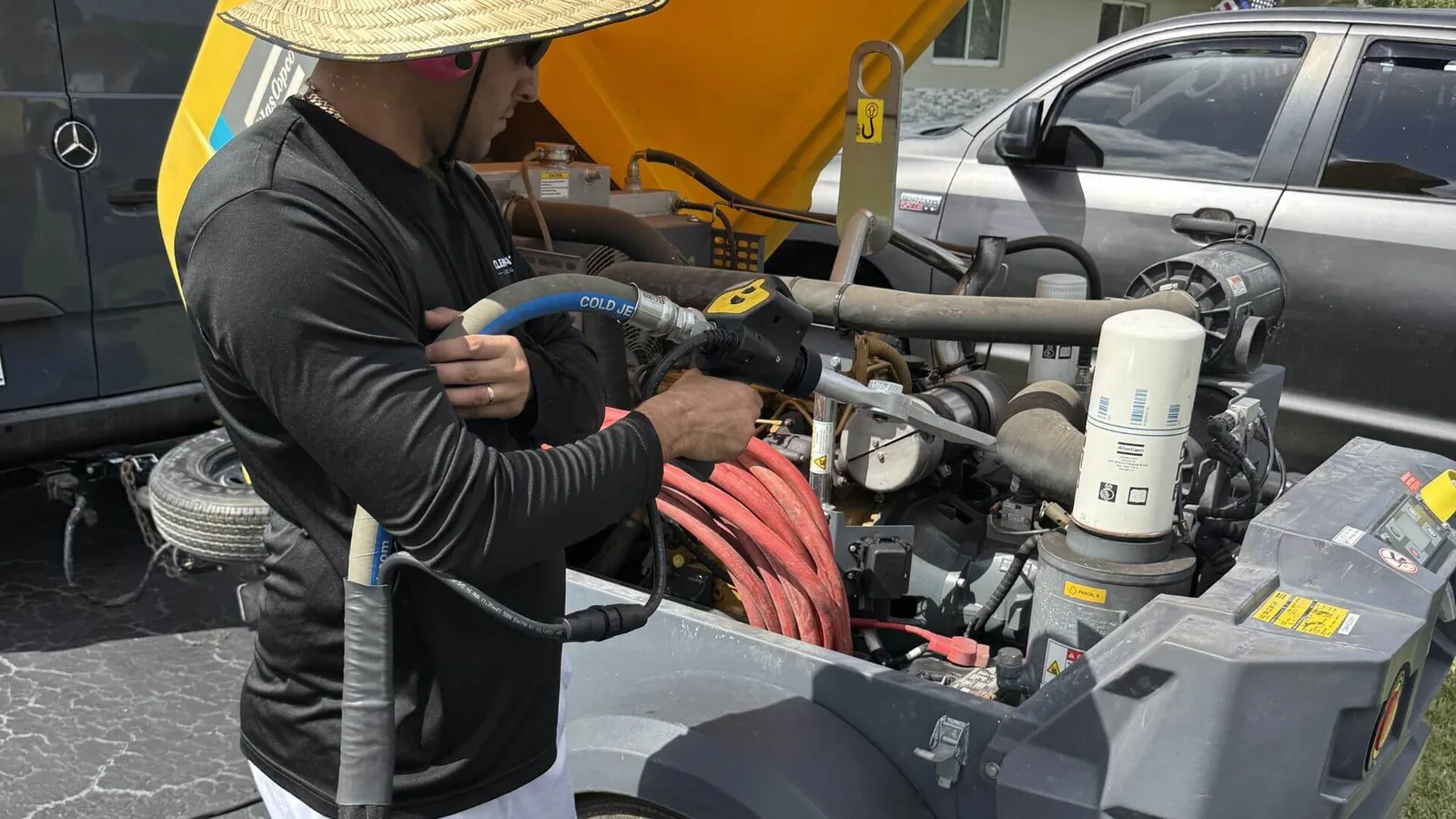
Everything from an engine bay in a driveway to a production line at shutdown. The process is the same, pointed at a different problem.
The local conditions
Afternoon storms mean equipment that lives outside is wet, then hot, then wet again. It is also why an abrasive method costs you twice: once in the cleaning, again in the finish you removed.
Residential garages and small shops sit alongside the commercial work on any given week. Site type barely matters when the air, the hose and the collection all arrive together.
No runoff and no residual grit, which matters more than it sounds on a Miami-Dade County job with neighbors close by.
What comes off
What this takes off
The method does not care much what the contaminant is, only that it sits on top of something. Here is the usual list.
- Adhesive and sealant
Sound deadening, tape residue, gasket material and sealant that has cured onto a face it was never meant to stay on.
- Resin and mold release
Release agent builds up in thin layers until it shows on the finished part. We clean it off the tool without scratching the surface.
- Paint and coatings
Removed selectively where the substrate underneath has to survive, which rules out most abrasive approaches.
- Salt and corrosion product
Salt deposit and the oxidation it starts. Anything abrasive removes the protection along with the salt.
- Ink and printing residue
Dried ink and coating build-up on rollers and press components, where the surface texture is the product.
- Food residue
Carbonized product build-up in a plant where neither standing water nor a chemical film is acceptable.
- Grease and oil
Machinery runs on lubricant, and the overspray collects lint and metal fines around every bearing and housing. The ice takes the film and the dirt stuck in it together.
How a job runs
The sequence, start to finish
There is no mystery to how these jobs run, and no part of it we would rather you did not ask about.
- You look before we pack up
A second pass while everything is still connected is free in every sense. A return trip is not.
- You describe the job
It starts with a conversation about what you have and what is stuck to it. Tell us what you have already tried too. If solvent or pressure washing has failed, that tells us a lot about the bond.
- We look at access and containment
The layout decides the method more often than the contaminant does. We work out reach and containment before quoting anything.
- We test a small area
A test spot takes minutes and protects the whole job. It tells us how hard to push on this particular surface, which matters more than any rule of thumb.
- We blast, then clean up
One mess instead of two: the pellet vanishes and we take away what it removed.
The comparison
Why not just pressure wash it
- Solvent and degreaser
Trades the deposit for a residue, plus ventilation and waste to deal with, and it is hard on the finish.
- Hand scraping
It is the fallback when nothing else is available, and it shows on the surface afterward.
- Media blasting
Cuts into the substrate by design. Fine on structural steel, wrong on aluminum, plating, machined faces or anything with a tolerance.
- Pressure washing
The water has to go somewhere, and on most equipment that somewhere is inside it.
- Dry ice
It is the only one on this list where the media stops existing the moment it has worked.
Before we turn the rig on
Power, water and air are not things you need to provide. The truck covers the air, and the process needs no water at all.
We cover what should not be hit before anything gets blasted. It takes minutes and saves arguments.
Tight, low spaces are where this matters most. The gas is heavier than air and settles low, so we keep air moving through the space the whole time we are working.
Dry ice blasting is noisy. Anyone close to the work wears hearing protection, and we will ask you to keep your distance or put some on.

Send us the job.
There is no sales pitch on the other end. Two firefighters own this business, and one of us will call you to talk through the job.