Home / Service areas / Okeechobee County / Taylor Creek
Okeechobee County · Florida
Taylor Creek dry ice blasting
Taylor Creek work comes to us the same way most of it does: something is coated in build-up and cannot be sanded, soaked or dissolved.
What a job looks like locally
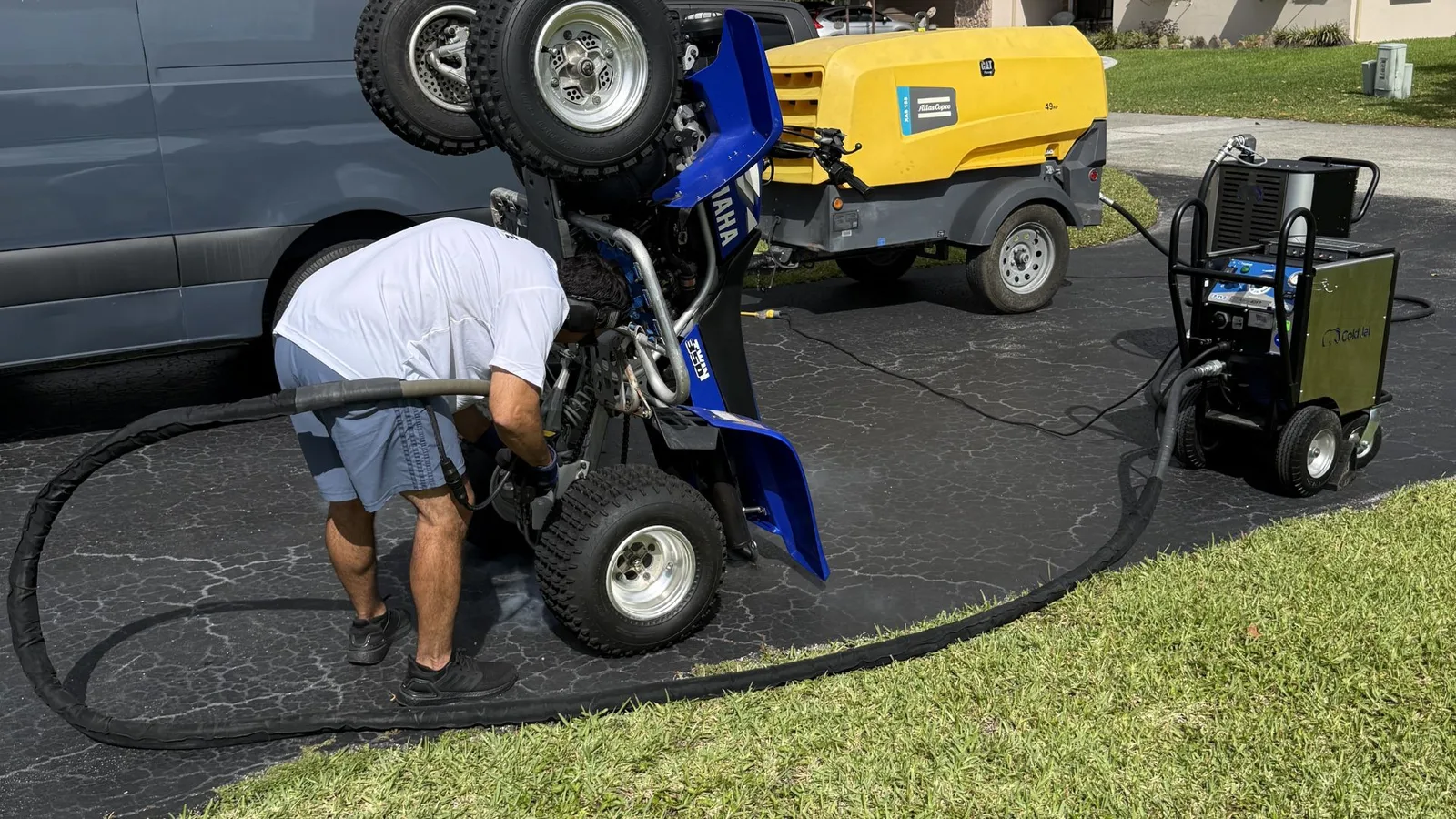
We work on driveways, in yards and inside shops that cannot take water on the floor. That is the practical reason a mobile rig beats hauling equipment somewhere: the machine never leaves Taylor Creek.
Because the media disappears on impact, there is nothing abrasive left in a bearing and nothing to shovel up afterward. Whatever came off the surface is ours to gather before we leave.
What we clean
What we clean in and around Taylor Creek
Questions from Taylor Creek
Is Taylor Creek in your area?
Yes. Taylor Creek is inside our regular working area, and the rig travels to the job rather than the other way round.
What does the site need to have?
Access to the equipment and somewhere to park the compressor. No water hookup, no drain and no wash bay.
Can you work around our schedule?
Nearly always. Give us the hours you can spare and we will say what genuinely fits inside them.
Who calls you around here?
A mix, vehicle work, shop equipment, marine and light industrial. Same rig, different constraint each time.
Does distance affect the price?
Distance can factor in. You will hear about it up front, not on the invoice.
How do we book it in?
Send the equipment, the location and a short description with photos if you have them. One of the owners calls you back.
Why Taylor Creek equipment ends up like this
Salt carries a long way inland here, and it keeps working on metal every day of the year. Which is exactly the situation where a non-abrasive, low-moisture method is worth the call.
Shops, marine yards, warehouses and home garages all end up with the same problem in different forms. Site type barely matters when the air, the hose and the collection all arrive together.
No runoff and no residual grit, which matters more than it sounds on a Okeechobee County job with neighbors close by.

What comes off
What this takes off
The method does not care much what the contaminant is, only that it sits on top of something. Here is the usual list.
- Grease and oil
Old oil soaks into the dirt around a leak and hardens. Cold makes it brittle, which is why it releases where a rag only smears it around.
- Carbon and soot
Hard black buildup on weld cells, ovens and engine parts. Fast cooling cracks it loose from the surface instead of grinding it off.
- Adhesive and sealant
Cured sealant, old gasket, tape glue and sound deadening, the residue left when something was removed but its bond was not.
- Resin and mold release
Release agent and resin build-up on tooling, where a solvent fix trades one residue for another.
- Paint and coatings
Removed selectively where the substrate underneath has to survive, which rules out most abrasive approaches.
- Salt and corrosion product
Salt deposit and the oxidation it starts. Anything abrasive removes the protection along with the salt.
- Ink and printing residue
Ink and coating on anilox and press rollers, surfaces where changing the texture changes the print.
How a job runs
The sequence, start to finish
There is no mystery to how these jobs run, and no part of it we would rather you did not ask about.
- We blast, then clean up
One mess instead of two: the pellet vanishes and we take away what it removed.
- You look before we pack up
Inspect it with the rig still set up. Anything you are not happy with gets another go before we leave.
- You describe the job
How long has the buildup been there, and is it baked on, greasy or sticky? Those details shape the job more than the size of the equipment does.
- We look at access and containment
Access drives the plan: reach, siting, masking, and the route the removed material takes off the job. It is the part customers think about least and we think about most.
- We test a small area
Old paint can be fragile in ways that don’t show until it is hit. A small patch out of view tells us how it will behave.
The comparison
The other ways to do this
- Media blasting
Grit removes material to do its job, so a machined face or a plated part pays for the cleaning.
- Pressure washing
Pressure pushes moisture past seals and into connectors, and then you wait. Panels and motors rule it out.
- Solvent and degreaser
Chemistry works, but you inherit ventilation, waste handling and a film on the surface.
- Hand scraping
Slow enough to be uneconomic on a machine, and the tool always leaves a trace.
- Dry ice
Cold breaks the bond and the media vanishes. The substrate is untouched and there is no second mess to clean up.
Before we turn the rig on
Right after the work, the surface is chilled through. Depending on its size, that means a few minutes before it is comfortable to handle, or some moisture while it recovers.
Everything the rig needs arrives with it. No tap, no drain, no outlet.
We cover what should not be hit before anything gets blasted. It takes minutes and saves arguments.
As a firefighter-owned company, we treat air as part of the job from the first minute. Dry ice is solid carbon dioxide, safe and residue-free, but it lowers oxygen in a confined room, so ventilation is arranged first.
Tell us what needs cleaning.
Send what you have, even a rough description and one photo. You will hear back from Giancarlo or Kenny directly, usually with a few questions.