Home / Service areas / Broward County / Coconut Creek
Broward County · Florida
Coconut Creek dry ice blasting
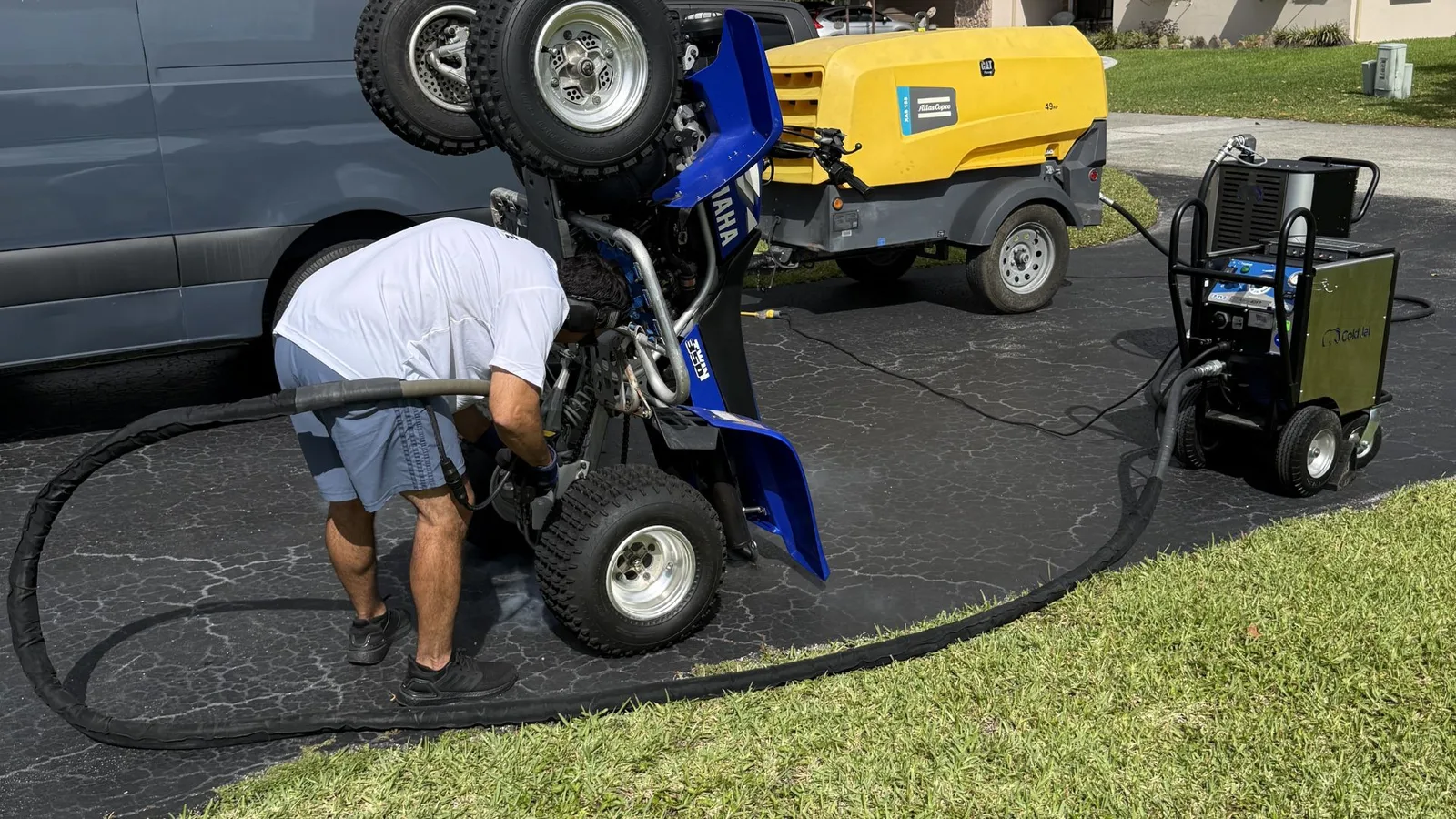
When we take a job in Coconut Creek, the rig comes to the machine rather than the other way round.
How we work in this area
We work on driveways, in yards and inside shops that cannot take water on the floor. So the equipment stays put. Everything that has to move arrives on the truck instead.
Nothing of the ice survives the blast. That removes the entire cleanup problem every other method creates, leaving only the deposit that came off the equipment.

What we clean
What we get called for in Coconut Creek
Nearby
Also working across Broward County
Questions from Coconut Creek
Do you actually come out to Coconut Creek?
We do. The whole point of a mobile setup is that Coconut Creek is no further than any other stop on the schedule.
What do you need from us on site?
Access to the equipment and somewhere to park the compressor. No water hookup, no drain and no wash bay.
How flexible are the hours?
Often yes, a lot of industrial work happens overnight or during a planned outage. Give us the window and we will say straight away whether it is realistic.
What sort of work do you get called for?
It ranges from a single restoration project to a plant maintenance window. The method does not change much.
Does distance affect the price?
It depends how far out the job is. We will be straight with you about it when you describe the work.
How do we book it in?
A short description and a couple of pictures is enough to start. An owner rings you back.
What the climate does here
The heat matters more than people expect: baked-on residue cures harder in a South Florida summer. That is why so much of the work is removing what has bonded to a surface without taking the surface with it.
Light industrial, automotive and marine make up most of what we are called out for. The setup is the same in all of them, because everything the job needs turns up on the van.
The pellet turns to gas, so nothing runs off toward a drain and nothing abrasive stays behind in a bearing. On a cramped Broward County site that usually decides it.
What comes off
What dry ice actually removes
The rule of thumb is simple: anything stuck on rather than built in. These are the deposits we see most.
- Adhesive and sealant
Bonded material that outlived whatever it was bonding, usually harder to shift than the part it is on.
- Resin and mold release
Cured process residue on a mold or fixture. The surface has to come out dimensionally unchanged, which rules out anything abrasive.
- Paint and coatings
Taken off in a controlled way when what is underneath matters more than speed.
- Salt and corrosion product
A constant in South Florida. Removing it without stripping the protective finish is the whole trick.
- Ink and printing residue
Dried ink and coating build-up on rollers and press components, where the surface texture is the product.
- Food residue
Carbonized product, fat, starch and sugar build-up on processing equipment, cleaned without chemicals touching a food contact surface.
- Grease and oil
The greasy base coat that traps grit and dust. It releases early and takes the loose material with it.
How a job runs
How a job actually runs
Most people have never watched dry ice blasting happen and are not sure what they are agreeing to. Here is the whole sequence, start to finish.
- We look at access and containment
Access drives the plan: reach, siting, masking, and the route the removed material takes off the job. It is the part customers think about least and we think about most.
- We test a small area
Settings get proven somewhere nobody looks before they get used somewhere everybody does. What is correct on cast iron will mark aluminum, so the test is not a formality.
- We blast, then clean up
Nothing is left of the pellet, so the only thing to collect is what was on your equipment. That collection is part of the work we quoted.
- You look before we pack up
Walk it with us before the hose goes away. A second pass while the compressor is still running costs nothing; a return visit costs us both.
- You describe the job
Describe the equipment and the mess. If it cannot come offline that changes the plan, so say so early.
The comparison
What the alternatives actually do
- Solvent and degreaser
Trades the deposit for a residue, plus ventilation and waste to deal with, and it is hard on the finish.
- Hand scraping
Slow enough to be uneconomic on a machine, and the tool always leaves a trace.
- Media blasting
Grit removes material to do its job, so a machined face or a plated part pays for the cleaning.
- Pressure washing
Pressure pushes moisture past seals and into connectors, and then you wait. Panels and motors rule it out.
- Dry ice
The pellet is soft and the mechanism is temperature, not abrasion. It turns to gas on impact, so the only thing left to sweep up is what came off.
What the job is like to stand next to
Anything nearby that should not be touched gets masked before we start. That is quicker than explaining it afterward.
The media is solid CO2, nothing toxic and nothing left behind, but it pushes oxygen out of a closed room. Ventilation gets planned before the hose is connected.
This is not a quiet method. Ear defenders are standard issue on site for anyone nearby.
The part will be cold when we finish. Sometimes that means a short wait before handling; sometimes it means a film of condensation as it warms back up.
Send us the job.
A short description and a location is enough to start. Add photos if you can. You will speak to an owner, not a scheduler.