Home / Service areas / Miami-Dade County / Cutler Bay
Miami-Dade County · Florida
Cutler Bay dry ice blasting
Most of what we clean around Cutler Bay is equipment somebody cannot afford to damage.
What a job looks like locally
Everything arrives on the van: compressor, hose, operator and containment. That is the practical reason a mobile rig beats hauling equipment somewhere: the machine never leaves Cutler Bay.
The media is gone by the time it has done its work, so there is no sand to vacuum and no water to mop. Only the contaminant is left, and that leaves with us.
What we clean
What we clean in and around Cutler Bay
Nearby
Also working across Miami-Dade County
Questions from Cutler Bay
What sort of work do you get called for?
A mix, vehicle work, shop equipment, marine and light industrial. Same rig, different constraint each time.
Do you charge for the drive?
Sometimes, on the longer runs. Either way it is discussed before anyone commits.
What is the first step?
Send the equipment, the location and a short description with photos if you have them. One of the owners calls you back.
Do you actually come out to Cutler Bay?
Yes, Cutler Bay is well within range, and the compressor comes on the truck with everything else.
What do you need from us on site?
Space for the rig and a way to reach the machine. Everything else arrives with us.
How flexible are the hours?
Often yes, a lot of industrial work happens overnight or during a planned outage. Give us the window and we will say straight away whether it is realistic.
What the climate does here
Afternoon storms mean equipment that lives outside is wet, then hot, then wet again. It is also why an abrasive method costs you twice: once in the cleaning, again in the finish you removed.
Residential garages and small shops sit alongside the commercial work on any given week. None of those settings need modifying: the compressor, hose and collection all come with us.
No runoff and no residual grit, which matters more than it sounds on a Miami-Dade County job with neighbors close by.

What comes off
What this takes off
The method does not care much what the contaminant is, only that it sits on top of something. Here is the usual list.
- Food residue
Carbonized product build-up in a plant where neither standing water nor a chemical film is acceptable.
- Grease and oil
Machinery runs on lubricant, and the overspray collects lint and metal fines around every bearing and housing. The ice takes the film and the dirt stuck in it together.
- Carbon and soot
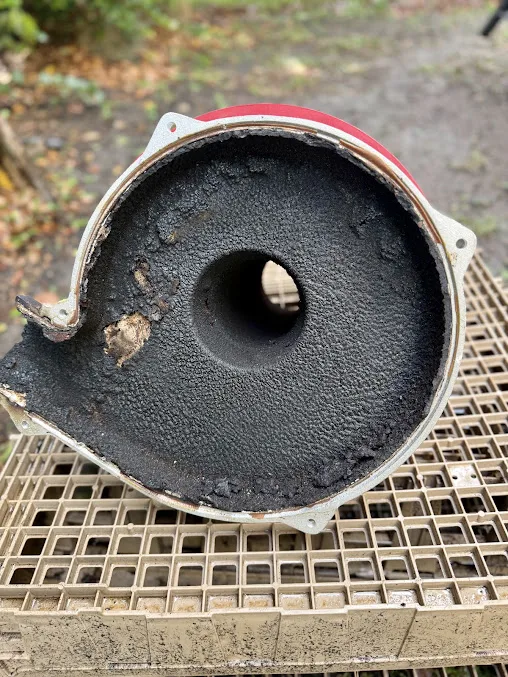
Heat-bonded black deposit. Because heat put it there, a sudden cold front is what breaks its grip.
- Adhesive and sealant
Bonded material that outlived whatever it was bonding, usually harder to shift than the part it is on.
- Resin and mold release
The tacky, then hardened, layer that collects on molds. Cold makes it brittle enough to lift off, and the tool surface is untouched.
- Paint and coatings
Selective removal, layer by layer, on parts where media blasting would cut into the substrate.
- Salt and corrosion product
A constant in South Florida. Removing it without stripping the protective finish is the whole trick.
How a job runs
The sequence, start to finish
There is no mystery to how these jobs run, and no part of it we would rather you did not ask about.
- You describe the job
What it is, what is on it and whether it can stop. If the answer is that dry ice is wrong for it, you get that answer first, not last.
- We look at access and containment
Where the compressor sits, how far the hose has to reach, what gets masked or moved, and where the removed contaminant ends up. On food and electrical work this is most of the planning.
- We test a small area
We dial the rig in on something nobody will notice. Older paint and soft metals in particular can react differently from what you would expect, so we check rather than assume.
- We blast, then clean up
There is no spent media to recover, only the deposit, which we collect before packing up.
- You look before we pack up
A second pass while everything is still connected is free in every sense. A return trip is not.
The comparison
What the alternatives actually do
- Hand scraping
Slow enough to be uneconomic on a machine, and the tool always leaves a trace.
- Media blasting
It works by removing material, which is the problem. Acceptable on heavy steel, damaging on soft alloy, plating or a machined surface.
- Pressure washing
Drives water into harnesses, bearings, panels and seams, then everything waits to dry. On electrical work it is simply not an option.
- Solvent and degreaser
It loosens the mess and leaves its own behind, along with fumes and something to dispose of.
- Dry ice
Thermal contraction cracks the bond between deposit and surface, then the pellet gasses off. Nothing abrasive, nothing wet, nothing left.
Before we turn the rig on
We cover what should not be hit before anything gets blasted. It takes minutes and saves arguments.
Dry ice is plain carbon dioxide. It is not toxic and leaves nothing behind, but in a closed room it crowds out oxygen, so we sort out airflow before we start.
This is not a quiet method. Ear defenders are standard issue on site for anyone nearby.
Thick castings hold the cold longer than thin panels. On heavy pieces, plan on a short wait before anyone works on them.
Send us the job.
A short description and a location is enough to start. Add photos if you can. You will speak to an owner, not a scheduler.