Home / Service areas
11 counties · 218 communities
We are mobile, so the job site is wherever the machine is
Based in Miami and running roughly a hundred miles out. Distances below are straight-line, because a radius claim should mean something.
Counties
Where we work
A hundred miles is a real number
The rig runs off the truck, so the limit is drive time rather than anything about the equipment. The counties at the far edge are extended-area work and we say so on the call instead of quietly adding it later.
Questions about coverage
How far do you travel?
Roughly a hundred miles from Miami. The far markets sit at or past that line, so we treat those as extended-area work and tell you straight when you call.
Do you charge for travel?
It depends how far out the job is. We will be upfront about it.
Do you work in the Keys?
Yes, the Upper and Middle Keys. Salt and corrosion are most of that work.
Can you do multiple sites in one trip?
Often, and it usually makes sense to plan them together.
What if I am just outside your area?
Ask. If it is workable we will say so, and if it is not we will tell you that instead of stringing you along.
How do I book?
Send the equipment, the location and a short description. One of the owners calls back.
What comes off
What dry ice actually removes
The rule of thumb is simple: anything stuck on rather than built in. These are the deposits we see most.
- Food residue
Carbonized product, fat, starch and sugar build-up on processing equipment, cleaned without chemicals touching a food contact surface.
- Grease and oil
Oil film is the layer everything else sticks to. Remove it and half the job is already done.
- Carbon and soot
Baked carbon on a manifold, oven or weld fixture. Thermal shock is exactly the wrong thing for the bond holding it on, which is why this works.
- Adhesive and sealant
Cured sealant, old gasket, tape glue and sound deadening, the residue left when something was removed but its bond was not.
- Resin and mold release
Cured process residue on a mold or fixture. The surface has to come out dimensionally unchanged, which rules out anything abrasive.
- Paint and coatings
Taken off in a controlled way when what is underneath matters more than speed.
- Salt and corrosion product
Salt deposit and the oxidation it starts. Anything abrasive removes the protection along with the salt.
How a job runs
How a job actually runs
Most people have never watched dry ice blasting happen and are not sure what they are agreeing to. Here is the whole sequence, start to finish.
- We look at access and containment
Siting the compressor, masking what must not be touched, and catching what comes off, settled before the first pellet.
- We test a small area
An out-of-sight patch comes first so pressure and pellet size are proven before anything that shows. Soft alloys, older paint and bare metal each want different numbers.
- We blast, then clean up
The ice is gone the moment it does its work. What stays behind is the grease or carbon that came off, and collecting that is part of the job, not an extra.
- You look before we pack up
A second pass while everything is still connected is free in every sense. A return trip is not.
- You describe the job
Tell us the machine, the mess and the constraint. A couple of photos answers more than a long description, and if the honest answer is that something else suits it better, we say so.
The comparison
The other ways to do this
- Hand scraping
It is the fallback when nothing else is available, and it shows on the surface afterward.
- Media blasting
Abrasive by definition. Anything with a tolerance or a finish worth keeping comes out changed.
- Pressure washing
Water gets into everything and has to come out again before the equipment runs. Around electrics it is off the table entirely.
- Solvent and degreaser
Trades the deposit for a residue, plus ventilation and waste to deal with, and it is hard on the finish.
- Dry ice
Cold breaks the bond and the media vanishes. The substrate is untouched and there is no second mess to clean up.
Why us
Why people call us back
- The rig comes to you
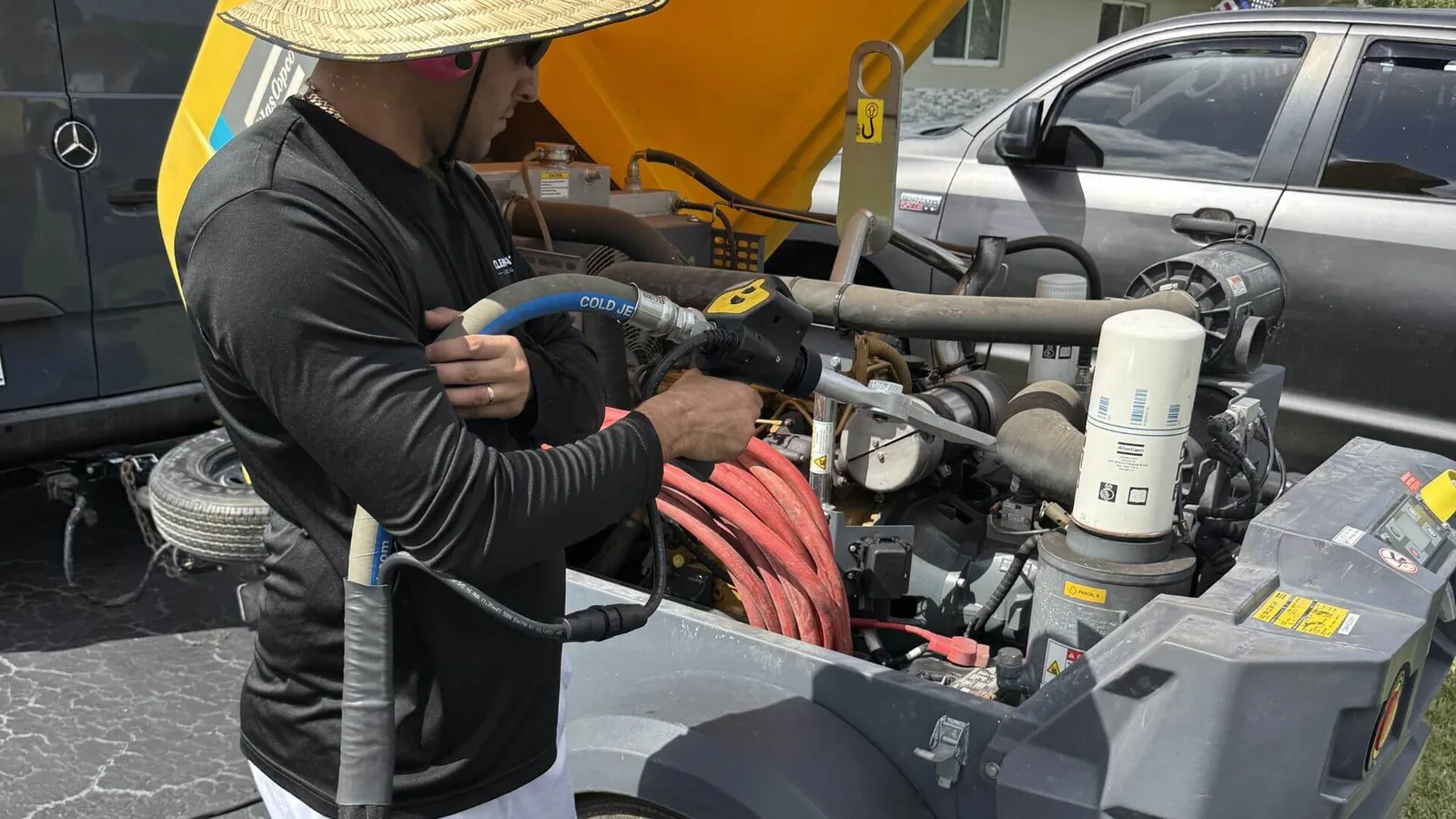
We are mobile. The equipment stays where it is and we bring everything needed to it.
- We clean up after ourselves
Nothing of the blasting media remains, so the only cleanup is the dirt itself, and that is ours to handle.
- Firefighter owned and operated
Giancarlo and Kenny both came out of the fire service, and the discipline that job demands is the discipline this one gets.
- You speak to an owner
No dispatcher, no account manager. You talk to whoever is going to be holding the hose.
- We will tell you no
Some jobs want a different method. We would rather say that up front than discover it on your machine.
- We test before we commit
Every substrate reacts differently, so settings get proven on a spot nobody sees first.
What the job is like to stand next to
Surfaces come out cold. On some jobs that means waiting a few minutes before handling, and on others it means condensation as the part returns to ambient temperature.
Air comes from our own compressor. You do not need to provide power, water or a connection of any kind.
Masking happens first. Whatever is adjacent and vulnerable gets covered before the hose is picked up.
Dry ice is carbon dioxide in solid form. It is non-toxic and leaves no residue, but it does displace oxygen in an enclosed space, so ventilation is part of the setup rather than an afterthought.
Describe what you are dealing with.
Send the equipment, the location and a short description. Photos help. You will hear back from Giancarlo or Kenny, not a call center.