Home / Service areas / Broward County / North Andrews Gardens
Broward County · Florida
North Andrews Gardens dry ice blasting
Most of what we clean around North Andrews Gardens is equipment somebody cannot afford to damage.
How the work runs here
Nothing about the setup needs a drain, a hookup or a bay. It is also why nothing has to be crated up and driven across town, the work happens where the machine already sits in North Andrews Gardens.
Solid to gas on impact. Nothing settles into a bearing, nothing runs toward a drain, and the only residue is what was already on the part.

What we clean
Where this method earns its keep in North Andrews Gardens
Nearby
Also working across Broward County
Questions from North Andrews Gardens
What sort of work do you get called for?
Everything from an engine bay in a driveway to a production line at shutdown. The process is the same, pointed at a different problem.
Is there a travel charge?
Sometimes, on the longer runs. Either way it is discussed before anyone commits.
What is the first step?
Send the equipment, the location and a short description with photos if you have them. One of the owners calls you back.
Do you actually come out to North Andrews Gardens?
We do. The whole point of a mobile setup is that North Andrews Gardens is no further than any other stop on the schedule.
What do you need from us on site?
Access to the equipment and somewhere to park the compressor. No water hookup, no drain and no wash bay.
How flexible are the hours?
Yes, within reason. Planned outages are easiest because everybody already knows the window.
What the climate does here
The heat matters more than people expect: baked-on residue cures harder in a South Florida summer. That is why so much of the work is removing what has bonded to a surface without taking the surface with it.
Light industrial, automotive and marine make up most of what we are called out for. Driveway or plant floor, the requirement is the same: room for the rig and access to the machine.
With no slurry to contain and no media to recover, a confined Broward County site stops being a problem.
What comes off
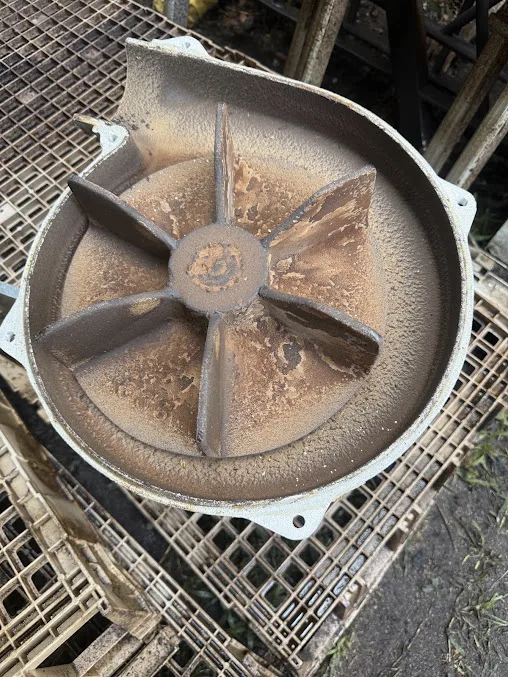
The deposits we see most
Here are the contaminants we see most. Different materials, same basic problem: one thing holding on to another.
- Salt and corrosion product
Salt deposit and the oxidation it starts. Anything abrasive removes the protection along with the salt.
- Ink and printing residue
Ink and coating on anilox and press rollers, surfaces where changing the texture changes the print.
- Food residue
Burnt-on product, fat and sugar on processing gear, with no chemical residue left on a contact surface.
- Grease and oil
Machinery runs on lubricant, and the overspray collects lint and metal fines around every bearing and housing. The ice takes the film and the dirt stuck in it together.
- Carbon and soot
Heat-bonded black deposit. Because heat put it there, a sudden cold front is what breaks its grip.
- Adhesive and sealant
The stubborn film under old tape, or the gasket that tore and left half of itself behind.
- Resin and mold release
Mold release and resin cure onto a tool face over many cycles. The ice lifts them off without changing the shape of the mold.
How a job runs
What happens once you call
There are no surprises built into how we work. Read the steps once and you will know what to expect on the day.
- You describe the job
What it is, what is on it and whether it can stop. If the answer is that dry ice is wrong for it, you get that answer first, not last.
- We look at access and containment
Siting the compressor, masking what must not be touched, and catching what comes off, settled before the first pellet.
- We test a small area
Before the nozzle goes near anything you care about, we run it on a hidden corner. If the setting is too aggressive, that corner is where we find out.
- We blast, then clean up
One mess instead of two: the pellet vanishes and we take away what it removed.
- You look before we pack up
A second pass while everything is still connected is free in every sense. A return trip is not.
The comparison
What the alternatives actually do
- Pressure washing
It is fast and it is wet, which is fine outdoors and unusable on anything with a winding in it.
- Solvent and degreaser
It dissolves the deposit and often the finish underneath, then leaves a film behind either way.
- Hand scraping
Hours of work for an inconsistent result, with gouges where the blade slipped.
- Media blasting
Effective and indiscriminate. On soft metal or a finished surface it does damage you then have to fix.
- Dry ice
Thermal contraction cracks the bond between deposit and surface, then the pellet gasses off. Nothing abrasive, nothing wet, nothing left.
What happens in your space
This is not a quiet method. Ear defenders are standard issue on site for anyone nearby.
If the equipment needs to run right away, tell us. A cold surface can collect condensation, and we can plan around that before it goes back in service.
You will not lose an outlet or a circuit to us. The compressor on the truck runs the blaster on its own.
Masking happens first. Whatever is adjacent and vulnerable gets covered before the hose is picked up.
Send us the job.
Start with the basics and we will ask the rest on the phone. The call comes from one of the owners.