Home / Service areas / Palm Beach County / Lantana
Palm Beach County · Florida
Lantana dry ice blasting
Lantana calls tend to arrive with a constraint attached, which is exactly where this method earns its keep.
The practical side
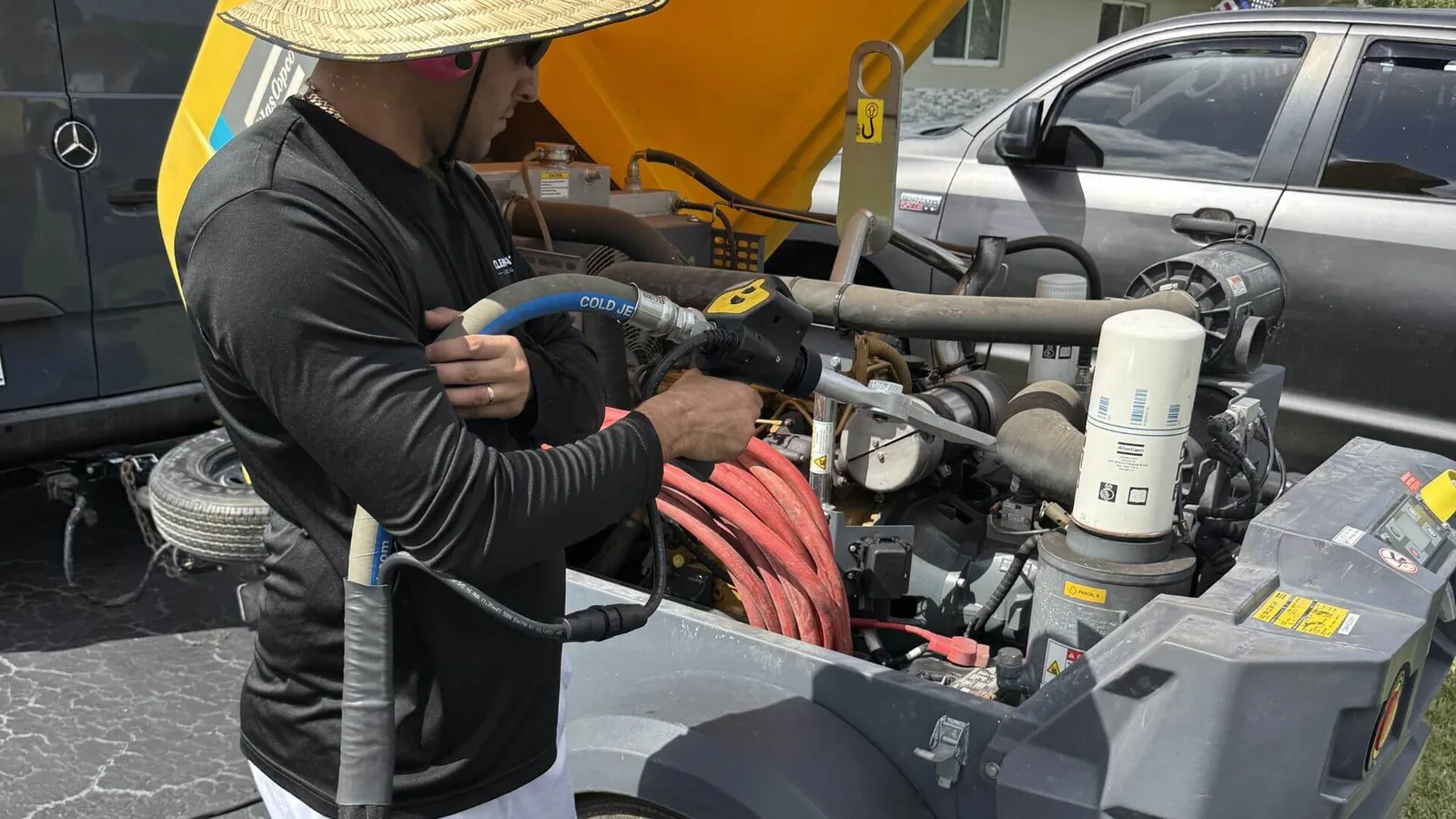
Nothing about the setup needs a drain, a hookup or a bay. Which means no downtime spent in transit and no risk of damage moving it out of Lantana and back.
The media is gone by the time it has done its work, so there is no sand to vacuum and no water to mop. Only the contaminant is left, and that leaves with us.
What we clean
The work we take on around Lantana
Nearby
Also working across Palm Beach County
Questions from Lantana
Do you charge for the drive?
Sometimes, on the longer runs. Either way it is discussed before anyone commits.
How do we book it in?
Describe the job and send a photo or two. Giancarlo or Kenny will call you, not a scheduler.
Do you actually come out to Lantana?
Yes. Lantana is inside our regular working area, and the rig travels to the job rather than the other way round.
What do you need from us on site?
Access to the equipment and somewhere to park the compressor. No water hookup, no drain and no wash bay.
How flexible are the hours?
Often yes, a lot of industrial work happens overnight or during a planned outage. Give us the window and we will say straight away whether it is realistic.
What sort of work do you get called for?
A mix, vehicle work, shop equipment, marine and light industrial. Same rig, different constraint each time.
What the climate does here
Salt carries a long way inland here, and it keeps working on metal every day of the year. Which is exactly the situation where a non-abrasive, low-moisture method is worth the call.
Shops, marine yards, warehouses and home garages all end up with the same problem in different forms. Whatever the setting, the rig arrives with its own compressor and containment, so nothing about the site has to change to accommodate us.
Because the media sublimates, there is no slurry running toward a storm drain and no grit left in a machine. On a tight site in Palm Beach County that is often the deciding factor.
What comes off
What comes off, and why
Dry ice is good at one thing: breaking the grip a deposit has on whatever is underneath. Below are the kinds of buildup that bring in most of our calls.
- Adhesive and sealant
Cured sealant, old gasket, tape glue and sound deadening, the residue left when something was removed but its bond was not.
- Resin and mold release
Production buildup on tooling and fixtures. Solvent trades one film for another; the pellet removes the residue and disappears.
- Paint and coatings
Selective removal, layer by layer, on parts where media blasting would cut into the substrate.
- Salt and corrosion product
Salt deposit and the oxidation it starts. Anything abrasive removes the protection along with the salt.
- Ink and printing residue
Dried ink on precision roller faces, cleaned without altering the cell structure that does the work.
- Food residue
Carbonized product, fat, starch and sugar build-up on processing equipment, cleaned without chemicals touching a food contact surface.
- Grease and oil
On a motor or generator, oily dust packs into the cooling fins and around the housing. Ice takes it off without putting water anywhere near the electrical parts.
How a job runs
Nothing about this should be a surprise
Nobody should have to guess what they booked. This is every stage of a job in the order it happens.
- We test a small area
We start gentle and work up. The setting that cleans without harming the surface is found on a patch tucked away, never on your front panel.
- We blast, then clean up
Nothing is left of the pellet, so the only thing to collect is what was on your equipment. That collection is part of the work we quoted.
- You look before we pack up
A second pass while everything is still connected is free in every sense. A return trip is not.
- You describe the job
What it is, what is on it and whether it can stop. If the answer is that dry ice is wrong for it, you get that answer first, not last.
- We look at access and containment
The layout decides the method more often than the contaminant does. We work out reach and containment before quoting anything.
The comparison
What the alternatives actually do
- Solvent and degreaser
Good at softening, bad at leaving. There is always a residue and always a drum to get rid of.
- Hand scraping
Hours of work for an inconsistent result, with gouges where the blade slipped.
- Media blasting
Abrasive by definition. Anything with a tolerance or a finish worth keeping comes out changed.
- Pressure washing
Forces water where water should not go, looms, bearings, seams, and then the job stops while it dries.
- Dry ice
The pellet is soft and the mechanism is temperature, not abrasion. It turns to gas on impact, so the only thing left to sweep up is what came off.
What to expect on site
People ask whether dry ice is safe to have indoors. It is non-toxic and leaves no residue. The care point is a confined space, where the gas replaces oxygen, so we set up ventilation before the work begins rather than partway through.
Expect it to be loud while the hose is running. If people on your site are still working nearby, we plan for that before we start.
Cold is the one leftover. We will tell you which pieces need a short wait and which might fog up with condensation before they are back to normal.
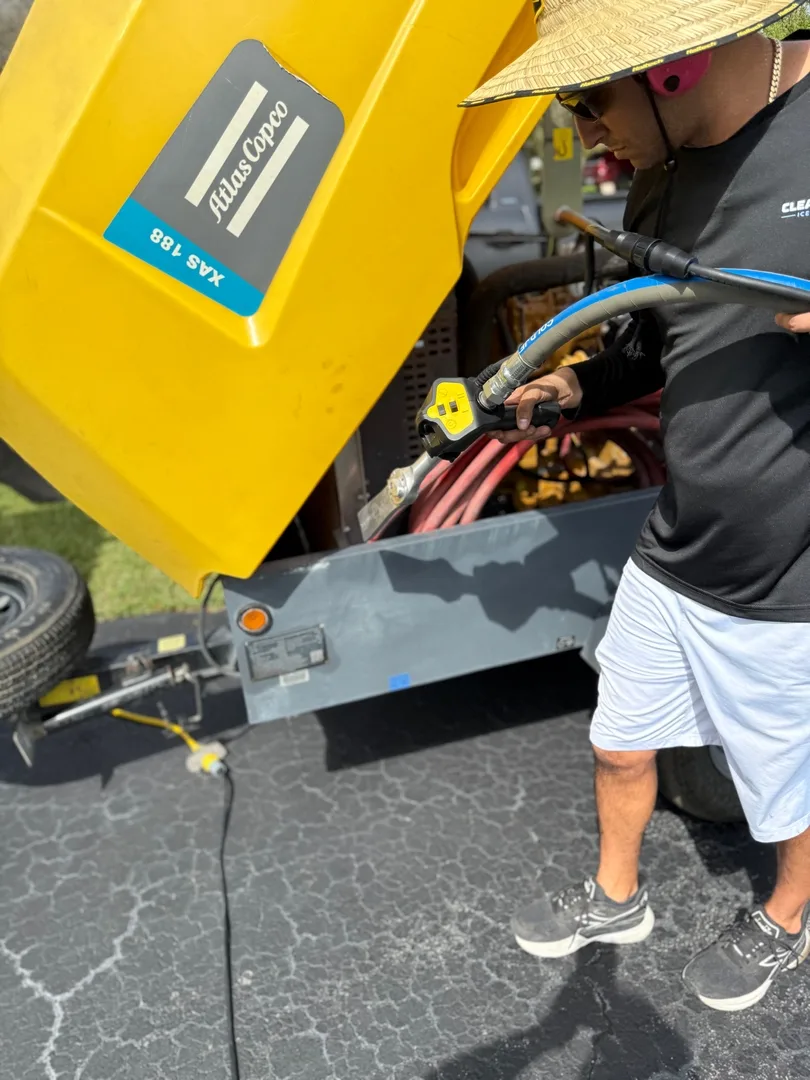
Everything the rig needs arrives with it. No tap, no drain, no outlet.
Tell us what needs cleaning.
Tell us what needs cleaning and where it is. Photos are a bonus. Either Giancarlo or Kenny will be the one who responds.