Home / Service areas / Palm Beach County / Gun Club Estates
Palm Beach County · Florida
Gun Club Estates dry ice blasting
Gun Club Estates work comes to us the same way most of it does: something is coated in build-up and cannot be sanded, soaked or dissolved.
How we work in this area
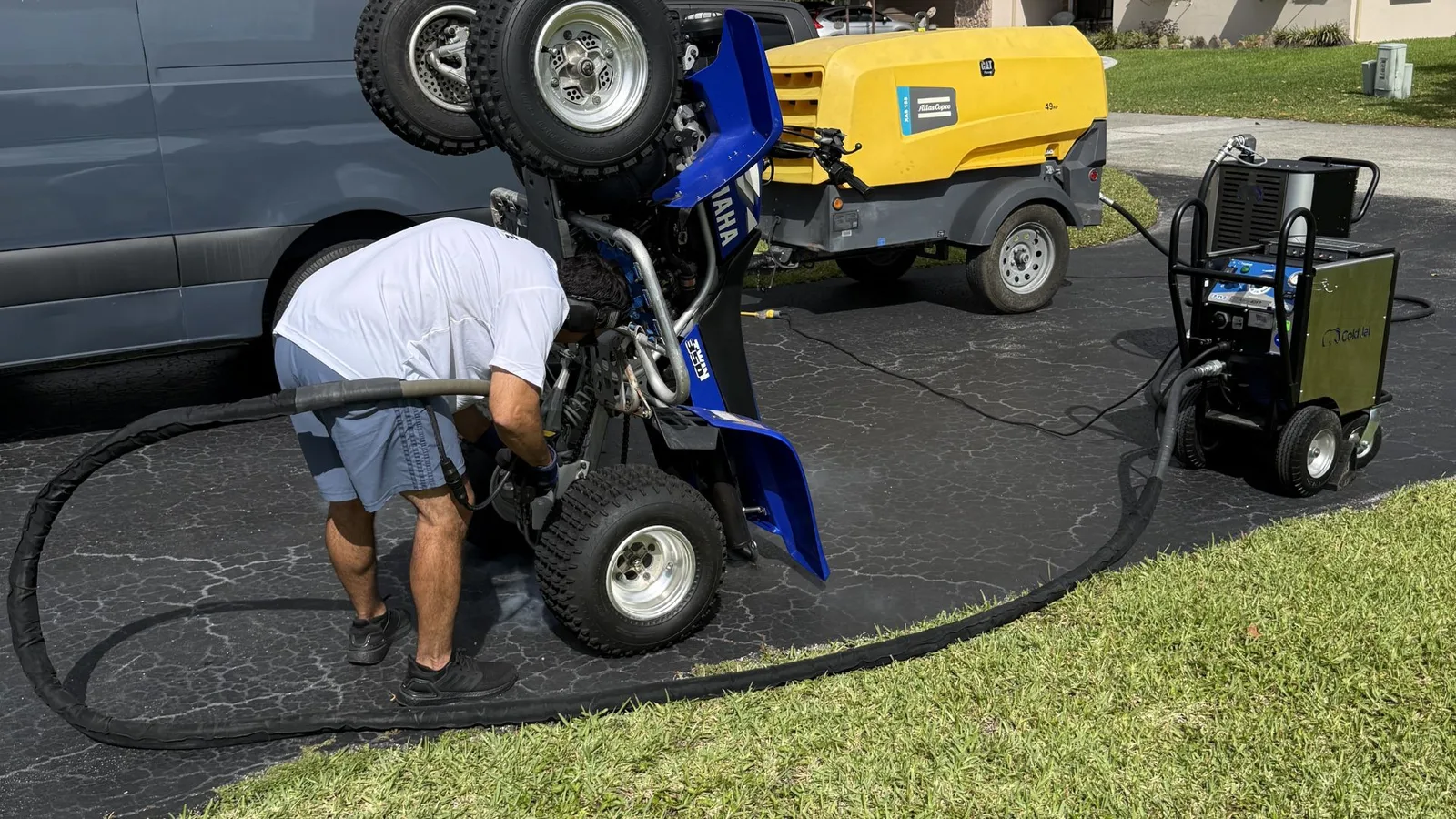
Everything arrives on the van: compressor, hose, operator and containment. So the equipment stays put. Everything that has to move arrives on the truck instead.
The pellet turns straight to gas when it hits, which means no sand in the machine and no sludge on the floor. The only thing to collect is the contaminant itself, and that is included.
What we clean
What we get called for in Gun Club Estates
Nearby
Also working across Palm Beach County
Questions from Gun Club Estates
What does the site need to have?
Space for the rig and a way to reach the machine. Everything else arrives with us.
Can you work around our schedule?
Nearly always. Give us the hours you can spare and we will say what genuinely fits inside them.
Who calls you around here?
A mix, vehicle work, shop equipment, marine and light industrial. Same rig, different constraint each time.
Does distance affect the price?
Sometimes, on the longer runs. Either way it is discussed before anyone commits.
What is the first step?
Describe the job and send a photo or two. Giancarlo or Kenny will call you, not a scheduler.
Is Gun Club Estates in your area?
Yes. Gun Club Estates is inside our regular working area, and the rig travels to the job rather than the other way round.
Why Gun Club Estates equipment ends up like this
Salt carries a long way inland here, and it keeps working on metal every day of the year. Which is exactly the situation where a non-abrasive, low-moisture method is worth the call.
Shops, marine yards, warehouses and home garages all end up with the same problem in different forms. The setup is the same in all of them, because everything the job needs turns up on the van.
The pellet turns to gas, so nothing runs off toward a drain and nothing abrasive stays behind in a bearing. On a cramped Palm Beach County site that usually decides it.
What comes off
What dry ice actually removes
The rule of thumb is simple: anything stuck on rather than built in. These are the deposits we see most.
- Salt and corrosion product
A constant in South Florida. Removing it without stripping the protective finish is the whole trick.
- Ink and printing residue
Dried ink and coating build-up on rollers and press components, where the surface texture is the product.
- Food residue
Carbonized product, fat, starch and sugar build-up on processing equipment, cleaned without chemicals touching a food contact surface.
- Grease and oil
Oil film is the layer everything else sticks to. Remove it and half the job is already done.
- Carbon and soot
Soot and carbon scale from heat and exhaust. It looks permanent, but it is usually among the first deposits to break free under the cold.
- Adhesive and sealant
Cured sealant, old gasket, tape glue and sound deadening, the residue left when something was removed but its bond was not.
- Resin and mold release
Cured resin clings to fixtures and tooling. Grit would wear the tool as it cleaned, which is why this needs something softer.
How a job runs
How a job actually runs
If this is your first time hiring dry ice blasting, the steps below are what to expect. Nothing happens on the day that we have not talked through.
- We test a small area
First pass goes somewhere out of sight. We look at it with you if you want, adjust if needed, and only then work the visible surfaces.
- We blast, then clean up
One mess instead of two: the pellet vanishes and we take away what it removed.
- You look before we pack up
We would rather you find the missed spot while we are standing there than a week later. Another pass on the day is the cheapest fix available.
- You describe the job
Tell us what you are looking at the way you would tell a friend. The machine and what has built up on it, plus where it is. A couple of photos help more than a long description. If we think dry ice is the wrong call, you hear it right then, with no invoice attached.
- We look at access and containment
If your people are still working nearby, we plan around them. That means deciding where the noise and the debris go, and keeping a clear line between the work area and everyone else.
The comparison
The other ways to do this
- Pressure washing
Forces water where water should not go, looms, bearings, seams, and then the job stops while it dries.
- Solvent and degreaser
Softens the contaminant but leaves a film, fumes and a disposal problem, and attacks finishes you meant to keep.
- Hand scraping
Slow enough to be uneconomic on a machine, and the tool always leaves a trace.
- Media blasting
Grit removes material to do its job, so a machined face or a plated part pays for the cleaning.
- Dry ice
Cold breaks the bond and the media vanishes. The substrate is untouched and there is no second mess to clean up.
What the job is like to stand next to
We wear ear protection on every job, and so should anyone who comes into the work area. That rule does not bend for short jobs.
Cold surfaces are the one aftereffect. Depending on the piece that is either a few minutes of patience or some condensation while it returns to room temperature.
The truck carries its own compressor. Nothing on your property has to be plugged in or handed over to us.
Masking happens first. Whatever is adjacent and vulnerable gets covered before the hose is picked up.
Describe what you are dealing with.
Tell us what the equipment is and where it sits. A photo helps a lot. Giancarlo or Kenny will get back to you themselves.