Home / Services / Industrial / Furnace
Industrial · Miami, FL
Furnace Ice Blasting
When people call about furnace, the constraint is usually the same. We clean it without water, without chemicals and without anything abrasive touching the surface.
What builds up, and why it matters
On this kind of work the problem is baked-on process residue, oil film, carbon, swarf and release agent. Production equipment is expensive to take apart and expensive to leave down. Solvent means ventilation and disposal; water means waiting; abrasive means grit in a machine you just cleaned.
Most industrial work happens in place, during a shutdown or a maintenance window. The people who call us about furnace are usually maintenance leads and plant managers, and the thing they are actually worried about is that the line does not come back up on schedule.
The method
Why dry ice and not the alternatives
- Non-abrasive
The pellet is soft and sublimates on impact, so the work is thermal rather than mechanical. Machined faces, plating, paint and gaskets survive it.
- Low moisture
A panel or motor can be cleaned without soaking anything, which is why the method suits electrical work.
- No secondary waste
The pellets turn to gas, so you are left with one thing to deal with: the dirt we took off.
- Often no teardown
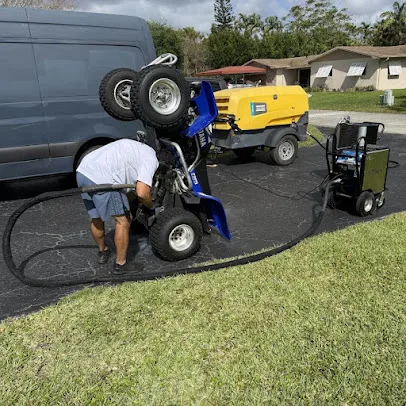
The machine stays where it is and mostly in one piece. Reassembly, where most of the labor normally goes, largely drops out of the job.
More industrial work
Related jobs we get called for
Questions we get asked first
Will it damage the surface underneath?
Dry ice is soft compared with most blasting media and leaves the substrate as it found it. We still check an inconspicuous area first, because an honest answer beats a surprise.
Do you have to take the equipment apart for furnace?
In a lot of cases, no. The pellets get into corners and recesses that a brush or scraper cannot reach, so most of the cleaning happens with everything still bolted together.
How much mess does it make?
Some, because the grime has to go somewhere. It falls where we have planned for it to fall, and picking it up is part of what you are paying for.
Do you come to us?
We do. Everything runs out of our truck, so you never haul anything to us. We work from Miami across South Florida, out to about a hundred miles.
What does a job cost?
Most of the price is time on site, and time depends on how much buildup there is and how easy it is to reach. Send photos and a description and you get an actual number back, not a range pulled out of the air.
How soon can you look at it?
That depends mostly on your calendar. If a line is coming down for maintenance, give us the date and the window, and we will tell you right away whether the rig can be there for it.
The comparison
The other ways to do this
- Hand scraping
Labor-intensive and uneven, and whatever you scrape with eventually marks what you are scraping.
- Media blasting
It works by removing material, which is the problem. Acceptable on heavy steel, damaging on soft alloy, plating or a machined surface.
- Pressure washing
Pressure pushes moisture past seals and into connectors, and then you wait. Panels and motors rule it out.
- Solvent and degreaser
Good at softening, bad at leaving. There is always a residue and always a drum to get rid of.
- Dry ice
The deposit shrinks away from the surface it is stuck to and releases. The ice is gone before it can do any harm.
What comes off
What comes off, and why
Dry ice is good at one thing: breaking the grip a deposit has on whatever is underneath. Below are the kinds of buildup that bring in most of our calls.
- Food residue
Burnt-on product, fat and sugar on processing gear, with no chemical residue left on a contact surface.
- Grease and oil
The greasy base coat that traps grit and dust. It releases early and takes the loose material with it.
- Carbon and soot
Heat-bonded black deposit. Because heat put it there, a sudden cold front is what breaks its grip.
- Adhesive and sealant
Whatever the last repair left stuck to the mating face: gasket, sealant, deadener or adhesive.
- Resin and mold release
Texture and polish on a mold surface carry straight into the part. Dry ice clears the residue and leaves that finish alone.
- Paint and coatings
Taken off in a controlled way when what is underneath matters more than speed.
- Salt and corrosion product
The year-round problem on the coast. The finish holding corrosion back has to survive the cleaning.
How a job runs
Nothing about this should be a surprise
Nobody should have to guess what they booked. This is every stage of a job in the order it happens.
- You look before we pack up
Inspect it with the rig still set up. Anything you are not happy with gets another go before we leave.
- You describe the job
What the equipment is, what is on it, where it lives, and whether it can be shut down. Photos tell us more than a paragraph. If dry ice is the wrong tool we say so on that call rather than after taking your money.
- We look at access and containment
Debris is the part people forget. Grease and carbon have to land somewhere when they come off, so we pick that spot and protect it before we start.
- We test a small area
If you want to see the test, stand with us while we do it. You can look at the patch yourself before we move to anything visible, and nothing goes further until it looks right to both of us.
- We blast, then clean up
Cleanup is short because there is so little of it. With no blasting media to recover, the work at the end is gathering the contaminant and leaving the space usable.
What to expect on site
The part will be cold when we finish. Sometimes that means a short wait before handling; sometimes it means a film of condensation as it warms back up.
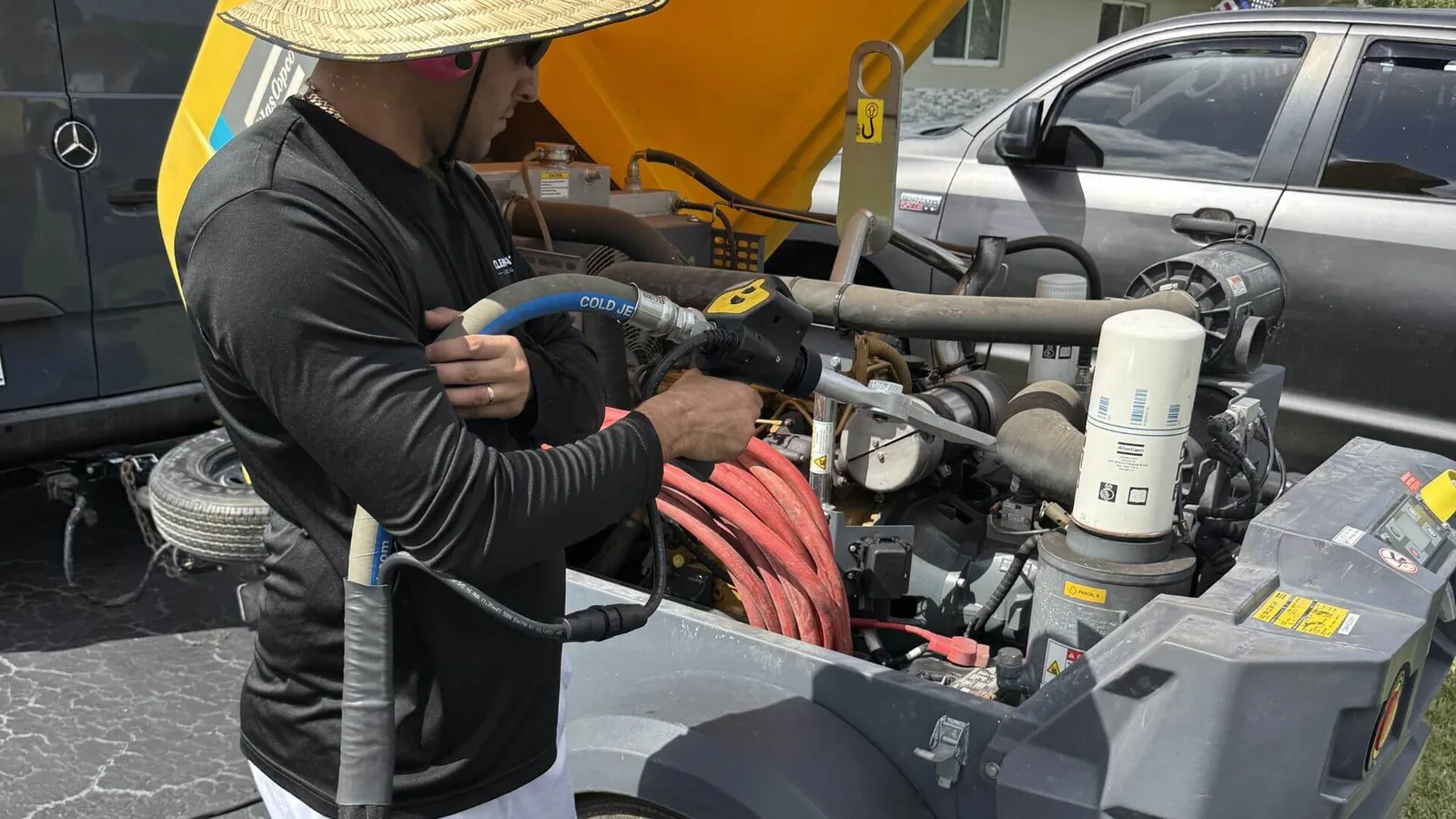
Everything the rig needs arrives with it. No tap, no drain, no outlet.
Anything nearby that should not be touched gets masked before we start. That is quicker than explaining it afterward.
The one thing the ice itself asks for is air. As the CO2 turns to gas it fills an enclosed space, which is why ventilation is part of our setup on every indoor job.
Send us the job.
Start with a short note and a picture. The reply comes from Giancarlo or Kenny, the firefighters who started this company.