Home / Service areas / Palm Beach County / Hypoluxo
Palm Beach County · Florida
Hypoluxo dry ice blasting
Most of what we clean around Hypoluxo is equipment somebody cannot afford to damage.
What a job looks like locally
Nothing about the setup needs a drain, a hookup or a bay. That is the practical reason a mobile rig beats hauling equipment somewhere: the machine never leaves Hypoluxo.
Because the media disappears on impact, there is nothing abrasive left in a bearing and nothing to shovel up afterward. Whatever came off the surface is ours to gather before we leave.
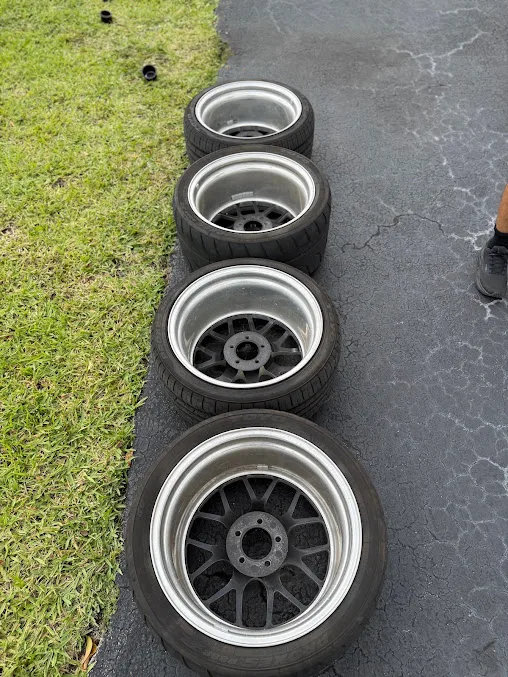
What we clean
What we clean in and around Hypoluxo
Nearby
Also working across Palm Beach County
Questions from Hypoluxo
What kinds of jobs do you take here?
A mix, vehicle work, shop equipment, marine and light industrial. Same rig, different constraint each time.
Does distance affect the price?
Sometimes, on the longer runs. Either way it is discussed before anyone commits.
How do we book it in?
Describe the job and send a photo or two. Giancarlo or Kenny will call you, not a scheduler.
Do you cover Hypoluxo?
Yes. Hypoluxo is inside our regular working area, and the rig travels to the job rather than the other way round.
What do we have to provide?
Just access and parking. There is no tap to find, no drain to use and nothing of yours to plug into.
Will you work during a shutdown?
Most of the time. Shutdowns and after-hours work are normal for us; what matters is knowing the window early.
Conditions around Hypoluxo
The heat matters more than people expect: baked-on residue cures harder in a South Florida summer. That is why so much of the work is removing what has bonded to a surface without taking the surface with it.
Light industrial, automotive and marine make up most of what we are called out for. Whatever the setting, the rig arrives with its own compressor and containment, so nothing about the site has to change to accommodate us.
No runoff and no residual grit, which matters more than it sounds on a Palm Beach County job with neighbors close by.
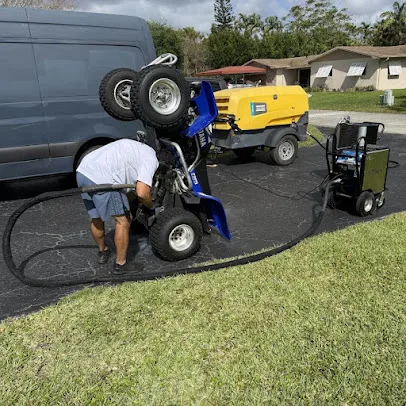
What comes off
What this takes off
The method does not care much what the contaminant is, only that it sits on top of something. Here is the usual list.
- Carbon and soot
The hard black crust on a housing, an oven or a weld cell. Bonded by heat, and the first thing to release under thermal shock.
- Adhesive and sealant
Cured sealant, old gasket, tape glue and sound deadening, the residue left when something was removed but its bond was not.
- Resin and mold release
Production residue cured onto tooling. Solvent softens it and leaves its own film; the ice lifts it and takes nothing with it.
- Paint and coatings
Taken off in a controlled way when what is underneath matters more than speed.
- Salt and corrosion product
The year-round problem on the coast. The finish holding corrosion back has to survive the cleaning.
- Ink and printing residue
Dried ink on precision roller faces, cleaned without altering the cell structure that does the work.
- Food residue
Burnt-on product, fat and sugar on processing gear, with no chemical residue left on a contact surface.
How a job runs
The sequence, start to finish
There is no mystery to how these jobs run, and no part of it we would rather you did not ask about.
- We test a small area
Some coatings are meant to stay. A test on an unseen spot shows whether the ice takes only the grime or starts to work on the finish underneath.
- We blast, then clean up
The ice is gone on impact. What is on the floor afterward came off your machine, and clearing it is ours to do.
- You look before we pack up
The job is not finished because we say so. It is finished when you have looked at it.
- You describe the job
We start with what it is and what is on it. Whether it can come offline matters as much as the contaminant, and a wrong-tool answer is one we give up front rather than after the invoice.
- We look at access and containment
Siting the compressor, masking what must not be touched, and catching what comes off, settled before the first pellet.
The comparison
How this compares to the usual methods
- Pressure washing
Forces water where water should not go, looms, bearings, seams, and then the job stops while it dries.
- Solvent and degreaser
It dissolves the deposit and often the finish underneath, then leaves a film behind either way.
- Hand scraping
It is the fallback when nothing else is available, and it shows on the surface afterward.
- Media blasting
Abrasive by definition. Anything with a tolerance or a finish worth keeping comes out changed.
- Dry ice
It is the only one on this list where the media stops existing the moment it has worked.
Before we turn the rig on
Masking happens first. Whatever is adjacent and vulnerable gets covered before the hose is picked up.
Ventilation comes before anything else on an indoor job. Dry ice is non-toxic and residue-free, but the gas it gives off displaces oxygen in a confined space.
This is not a quiet method. Ear defenders are standard issue on site for anyone nearby.
There is no wet surface to dry and no residue to wipe, only cold metal. Give it a little time, and any condensation goes as the part warms.

Send us the job.
Describe it the way you would to a friend, then add the address and any pictures. Giancarlo or Kenny takes it from there.