Home / Services / Government / Defense Manufacturing
Government · Miami, FL
Defense Manufacturing Ice Blasting
Defense Manufacturing is one of the jobs dry ice blasting was made for. We clean it without water, without chemicals and without anything abrasive touching the surface.
What builds up, and why it matters
On this kind of work the problem is carbon, corrosion product, paint and accumulated field grime on fleet and facility equipment. Public equipment is kept long past the point where replacement is easy, so cleaning has to preserve what is underneath rather than wear it away.
Scheduling works around the department's own operating hours and approvals. The people who call us about defense manufacturing are usually fleet supervisors and facility managers, and the thing they are actually worried about is damaging equipment that is difficult to replace or re-certify.
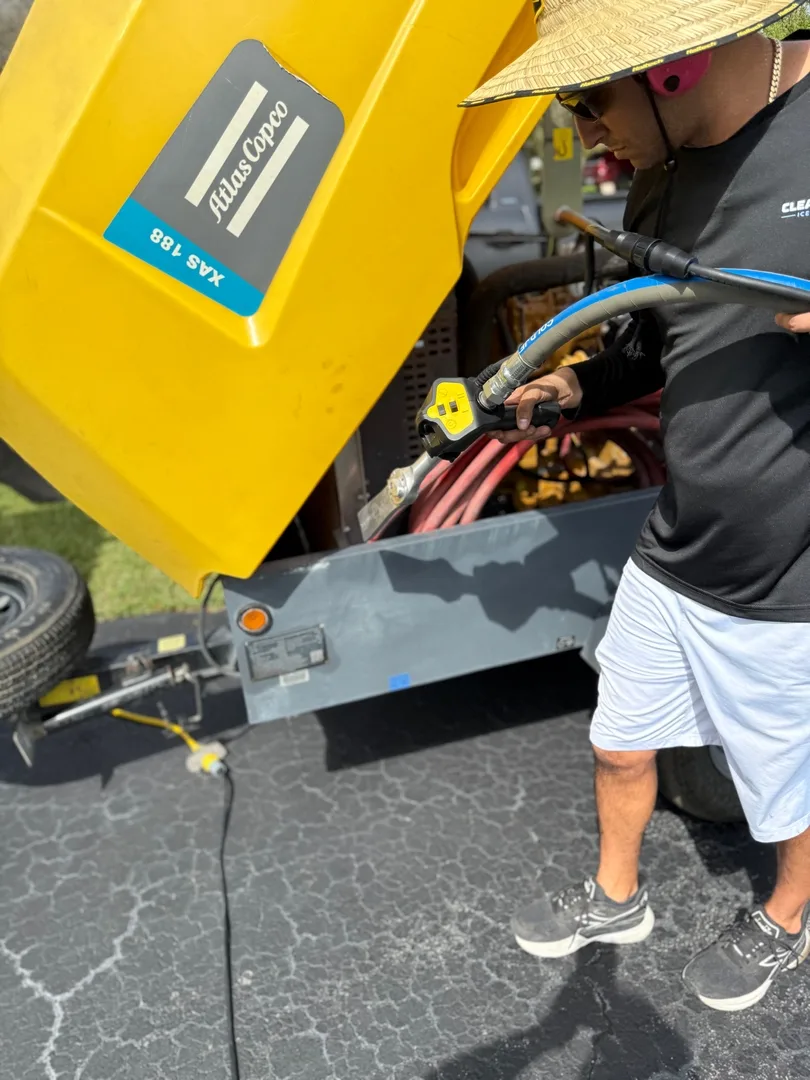
The method
Why dry ice and not the alternatives
- Non-abrasive
There is no grit in the stream, only ice that turns to gas on impact. That is why finishes and machined surfaces come through without scratching.
- Low moisture
No water means no rust starting in a seam you cannot see, and no moisture trapped behind a gasket or under trim.
- No secondary waste
Sand, soda and walnut shell all have to be swept and hauled. Dry ice leaves only the contaminant it removed.
- Often no teardown
Cleaning in place cuts the downtime. A machine that stays assembled is back in service sooner than one that had to be stripped and rebuilt.
More government work
Related jobs we get called for
Questions we get asked first
Will it damage the surface underneath?
It should not. Unlike sand or grit, the pellet does not cut into the material. It shocks the deposit loose with cold and then turns to gas. On anything delicate or unusual we try a hidden area first.
Do you have to take the equipment apart for defense manufacturing?
Not often. Because nothing wet goes in, there is no reason to pull covers or remove parts to protect them from water. Where something does need to come off for access, we tell you ahead of time.
How much mess does it make?
Customers are usually surprised at how little there is. Without blasting media to recover, the pile at the end is small, and we take care of it.
Do you come to us?
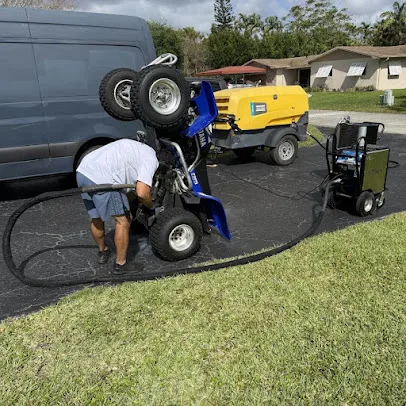
Always. The truck carries the compressor and hose, so we come to wherever the equipment already sits. That covers shops, plants, homes and docks across South Florida, roughly a hundred miles out from Miami.
What does a job cost?
Price follows the work: how much is on the surface and what it takes to get the rig close. Once we have seen photos and know the setup, we give you a real figure.
How soon can you look at it?
Send photos and a short description and one of the owners gets back to you. If you have a shutdown or a deadline, say so up front and we will tell you honestly whether we can hit it.
The comparison
What the alternatives actually do
- Pressure washing
Forces water where water should not go, looms, bearings, seams, and then the job stops while it dries.
- Solvent and degreaser
Softens the contaminant but leaves a film, fumes and a disposal problem, and attacks finishes you meant to keep.
- Hand scraping
Fine on a patch, hopeless on a machine, and the blade leaves its own evidence.
- Media blasting
Cuts into the substrate by design. Fine on structural steel, wrong on aluminum, plating, machined faces or anything with a tolerance.
- Dry ice
Thermal contraction cracks the bond between deposit and surface, then the pellet gasses off. Nothing abrasive, nothing wet, nothing left.
What comes off
What this takes off
The method does not care much what the contaminant is, only that it sits on top of something. Here is the usual list.
- Salt and corrosion product
The year-round problem on the coast. The finish holding corrosion back has to survive the cleaning.
- Ink and printing residue
Dried ink and coating build-up on rollers and press components, where the surface texture is the product.
- Food residue
Burnt-on product, fat and sugar on processing gear, with no chemical residue left on a contact surface.
- Grease and oil
The soft film that holds dust and swarf against metal. It is what makes a part feel dirty long after it looks clean, and it comes off first.
- Carbon and soot
Soot and carbon from heat and combustion. It clings hard to hot parts, but cold shrinks it faster than the metal underneath, and that breaks the bond.
- Adhesive and sealant
Bonded material that outlived whatever it was bonding, usually harder to shift than the part it is on.
- Resin and mold release
Mold release and resin cure onto a tool face over many cycles. The ice lifts them off without changing the shape of the mold.
How a job runs
The sequence, start to finish
There is no mystery to how these jobs run, and no part of it we would rather you did not ask about.
- We test a small area
The hidden test also shows how fast the buildup comes off, which tells us how long the full job should take and whether the plan still makes sense.
- We blast, then clean up
The media disappears on contact; the contaminant does not. Gathering what came off is included, not a line added afterward.
- You look before we pack up
Walk it with us before the hose goes away. A second pass while the compressor is still running costs nothing; a return visit costs us both.
- You describe the job
Send images if you can, they settle most of the questions. A wrong-tool verdict comes on that first call, not after the invoice.
- We look at access and containment
Siting the compressor, masking what must not be touched, and catching what comes off, settled before the first pellet.
Before we turn the rig on
This is not a quiet method. Ear defenders are standard issue on site for anyone nearby.
If the equipment needs to run right away, tell us. A cold surface can collect condensation, and we can plan around that before it goes back in service.
Everything the rig needs arrives with it. No tap, no drain, no outlet.
Anything nearby that should not be touched gets masked before we start. That is quicker than explaining it afterward.
Tell us what needs cleaning.
A couple of photos and a line about the job gets things moving. You will deal with the people who do the work.