What builds up, and why it matters
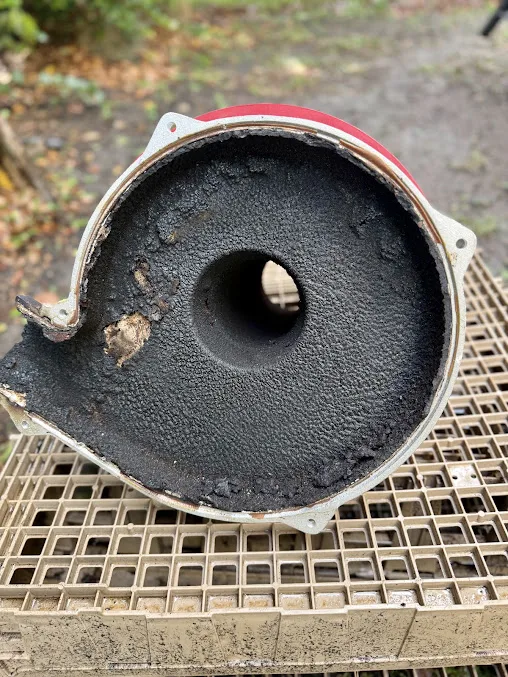
On this kind of work the problem is dried ink, adhesive, paper dust and coating build-up. Anilox and press rollers are precision surfaces. Anything abrasive changes the cell structure and changes the print, which is why solvent soaking and manual scrubbing are the usual compromise.
Presses are cleaned in place between runs or during planned maintenance. The people who call us about adhesive removal with dry are usually press operators and production managers, and the thing they are actually worried about is altering a roller surface and with it the print result.
The method
Why dry ice and not the alternatives
- Non-abrasive
Rubber seals, wiring and plastic covers can be cleaned in place. With no abrasive in the mix, they are not worn away in the process.
- Low moisture
There is no hose of water and no wet floor. The area around the job stays dry while we work.
- No secondary waste
The pellets turn to gas, so you are left with one thing to deal with: the dirt we took off.
- Often no teardown
No water and no grit means nothing has to be protected by taking it out first. Most parts stay installed while we work.
More printing work
Related jobs we get called for
Questions we get asked first
Will it damage the surface underneath?
On metal, painted parts and most finishes, it does not. The process is non-abrasive. Where we are less sure, an old coating or a soft alloy for example, we try it somewhere hidden and look before going further.
Do you have to take the equipment apart for adhesive removal with dry?
For most jobs, no. Reassembly is where time and money normally go, and cleaning in place skips both. If a part has to come off, we raise it when we look at the job, never halfway through.
How much mess does it make?
Far less than the alternatives, because the blasting media disappears. What is left is the contaminant itself, which we contain and clean up.
Do you come to us?
Yes, that is how we work. Nothing needs to be loaded or shipped. We bring the full setup to you anywhere in South Florida, from Miami out to around a hundred miles.
What does a job cost?
We need to understand the job before we can put a number on it, so the first step is you telling us about it. Photos make that faster. The figure you get back comes from one of the owners and reflects the actual work.
How soon can you look at it?
That depends mostly on your calendar. If a line is coming down for maintenance, give us the date and the window, and we will tell you right away whether the rig can be there for it.
The comparison
Why not just pressure wash it
- Pressure washing
Water gets into everything and has to come out again before the equipment runs. Around electrics it is off the table entirely.
- Solvent and degreaser
Softens the contaminant but leaves a film, fumes and a disposal problem, and attacks finishes you meant to keep.
- Hand scraping
Slow, inconsistent, and the tool marks the surface. Fine for a small area, unworkable across a machine.
- Media blasting
It takes the top off whatever it touches. That is the point on rusted plate and the problem everywhere else.
- Dry ice
It is the only one on this list where the media stops existing the moment it has worked.
What comes off
What this takes off
The method does not care much what the contaminant is, only that it sits on top of something. Here is the usual list.
- Salt and corrosion product
The year-round problem on the coast. The finish holding corrosion back has to survive the cleaning.
- Ink and printing residue
Dried ink and coating build-up on rollers and press components, where the surface texture is the product.
- Food residue
Carbonized product build-up in a plant where neither standing water nor a chemical film is acceptable.
- Grease and oil
Oil film is the layer everything else sticks to. Remove it and half the job is already done.
- Carbon and soot
The hard black crust on a housing, an oven or a weld cell. Bonded by heat, and the first thing to release under thermal shock.
- Adhesive and sealant
The stubborn film under old tape, or the gasket that tore and left half of itself behind.
- Resin and mold release
Release agent and resin build-up on tooling, where a solvent fix trades one residue for another.
How a job runs
The sequence, start to finish
There is no mystery to how these jobs run, and no part of it we would rather you did not ask about.
- We look at access and containment
Siting the compressor, masking what must not be touched, and catching what comes off, settled before the first pellet.
- We test a small area
We start gentle and work up. The setting that cleans without harming the surface is found on a patch tucked away, never on your front panel.
- We blast, then clean up
The media disappears on contact; the contaminant does not. Gathering what came off is included, not a line added afterward.
- You look before we pack up
If something needs another pass we do it then, on site, while the rig is still running. That is a better outcome for everyone than a callback.
- You describe the job
The machine, the deposit and the downtime you can afford. Those three things decide the whole job, and we would rather know all of them before quoting.
Before we turn the rig on
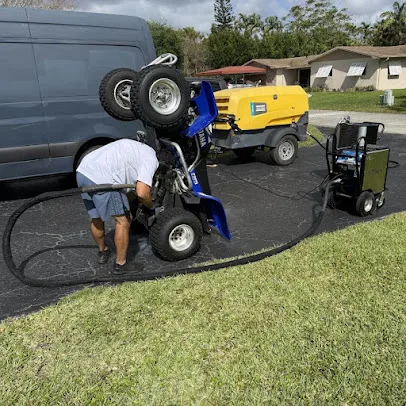
The truck carries its own compressor. Nothing on your property has to be plugged in or handed over to us.
Anything nearby that should not be touched gets masked before we start. That is quicker than explaining it afterward.
Outside on a driveway or a lot, there is not much to set up. Inside, we ask about the size of the room and how it is ventilated before we bring the hose in.
This is not a quiet method. Ear defenders are standard issue on site for anyone nearby.
Describe what you are dealing with.
Already tried degreaser or a pressure washer? Tell us that too. Knowing what did not work helps us tell you quickly whether dry ice will.