Home / Service areas / Broward County / Boulevard Heights
Broward County · Florida
Boulevard Heights dry ice blasting
Boulevard Heights work comes to us the same way most of it does: something is coated in build-up and cannot be sanded, soaked or dissolved.
How the work runs here
Everything arrives on the van: compressor, hose, operator and containment. It is also why nothing has to be crated up and driven across town, the work happens where the machine already sits in Boulevard Heights.
Solid to gas on impact. Nothing settles into a bearing, nothing runs toward a drain, and the only residue is what was already on the part.

What we clean
Where this method earns its keep in Boulevard Heights
Nearby
Also working across Broward County
Questions from Boulevard Heights
What is the first step?
Describe the job and send a photo or two. Giancarlo or Kenny will call you, not a scheduler.
Will you travel to Boulevard Heights?
Yes. Boulevard Heights is inside our regular working area, and the rig travels to the job rather than the other way round.
Do you need anything set up before you arrive?
Space for the rig and a way to reach the machine. Everything else arrives with us.
Can you come outside business hours?
Yes, within reason. Planned outages are easiest because everybody already knows the window.
What do most jobs look like?
It ranges from a single restoration project to a plant maintenance window. The method does not change much.
Does distance affect the price?
Distance can factor in. You will hear about it up front, not on the invoice.
The local conditions
Salt carries a long way inland here, and it keeps working on metal every day of the year. Which is exactly the situation where a non-abrasive, low-moisture method is worth the call.
Shops, marine yards, warehouses and home garages all end up with the same problem in different forms. Driveway or plant floor, the requirement is the same: room for the rig and access to the machine.
With no slurry to contain and no media to recover, a confined Broward County site stops being a problem.
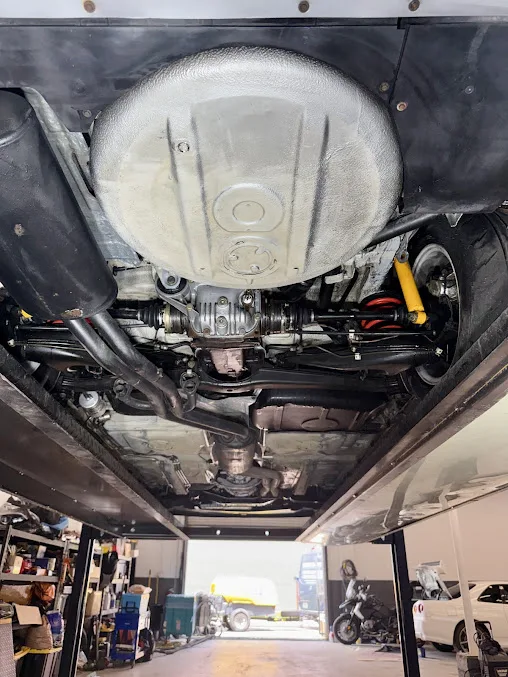
What comes off
The deposits we see most
If you are not sure what you are dealing with, start here. These are the deposits most of our jobs come down to.
- Food residue
Burnt-on product, fat and sugar on processing gear, with no chemical residue left on a contact surface.
- Grease and oil
Grease packs into the corners and recesses a brush cannot reach. The ice gets in there and lifts it without anything scraping the part.
- Carbon and soot
Heat-bonded black deposit. Because heat put it there, a sudden cold front is what breaks its grip.
- Adhesive and sealant
Whatever the last repair left stuck to the mating face: gasket, sealant, deadener or adhesive.
- Resin and mold release
Hardened resin on a fixture shrinks under the cold and lets go, and the metal under it does not lose any material.
- Paint and coatings
Removed selectively where the substrate underneath has to survive, which rules out most abrasive approaches.
- Salt and corrosion product
Salt deposit and the oxidation it starts. Anything abrasive removes the protection along with the salt.
How a job runs
What happens once you call
Worth a quick read if dry ice blasting is new to you. Everything that happens on your job is covered below.
- We blast, then clean up
The media disappears on contact; the contaminant does not. Gathering what came off is included, not a line added afterward.
- You look before we pack up
A second pass while everything is still connected is free in every sense. A return trip is not.
- You describe the job
Send images if you can, they settle most of the questions. A wrong-tool verdict comes on that first call, not after the invoice.
- We look at access and containment
Hose run, compressor position, what needs masking, and where the contaminant is collected. For food and electrical jobs the containment plan takes longer to settle than the blasting does.
- We test a small area
Before the nozzle goes near anything you care about, we run it on a hidden corner. If the setting is too aggressive, that corner is where we find out.
The comparison
Why not just pressure wash it
- Hand scraping
Slow, inconsistent, and the tool marks the surface. Fine for a small area, unworkable across a machine.
- Media blasting
Abrasive by definition. Anything with a tolerance or a finish worth keeping comes out changed.
- Pressure washing
Water gets into everything and has to come out again before the equipment runs. Around electrics it is off the table entirely.
- Solvent and degreaser
It dissolves the deposit and often the finish underneath, then leaves a film behind either way.
- Dry ice
Thermal shock breaks the bond. The pellet sublimates, so nothing abrasive touches the part and nothing is left to collect but the contaminant.
What happens in your space
Ventilation is part of how we plan the job from the first conversation. It is never a step we add halfway through after the room starts to feel stuffy.
If you want to watch, you are welcome to, from a safe distance and with hearing protection on. It is loud enough that conversation waits until we stop.
Some dampness on the surface after we stop is normal. It is the part coming back to air temperature, and it clears without wiping.
Power, water and air are not things you need to provide. The truck covers the air, and the process needs no water at all.
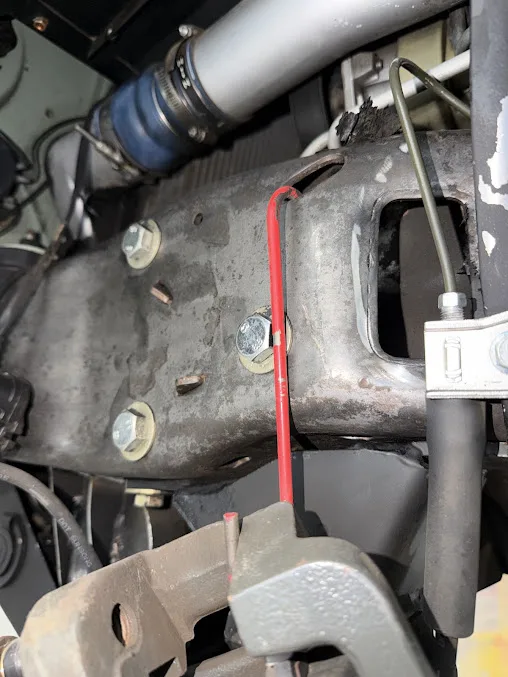
Tell us what needs cleaning.
Tell us what you are working on and what is stuck to it. If there is a deadline or a shutdown date, put that in too.