Home / Service areas / Monroe County
15 communities · Florida
Dry ice blasting across Monroe County
We are mobile, so the job site is wherever the machine is. The compressor, hose and operator come to you anywhere in Monroe County.
Working in Monroe County
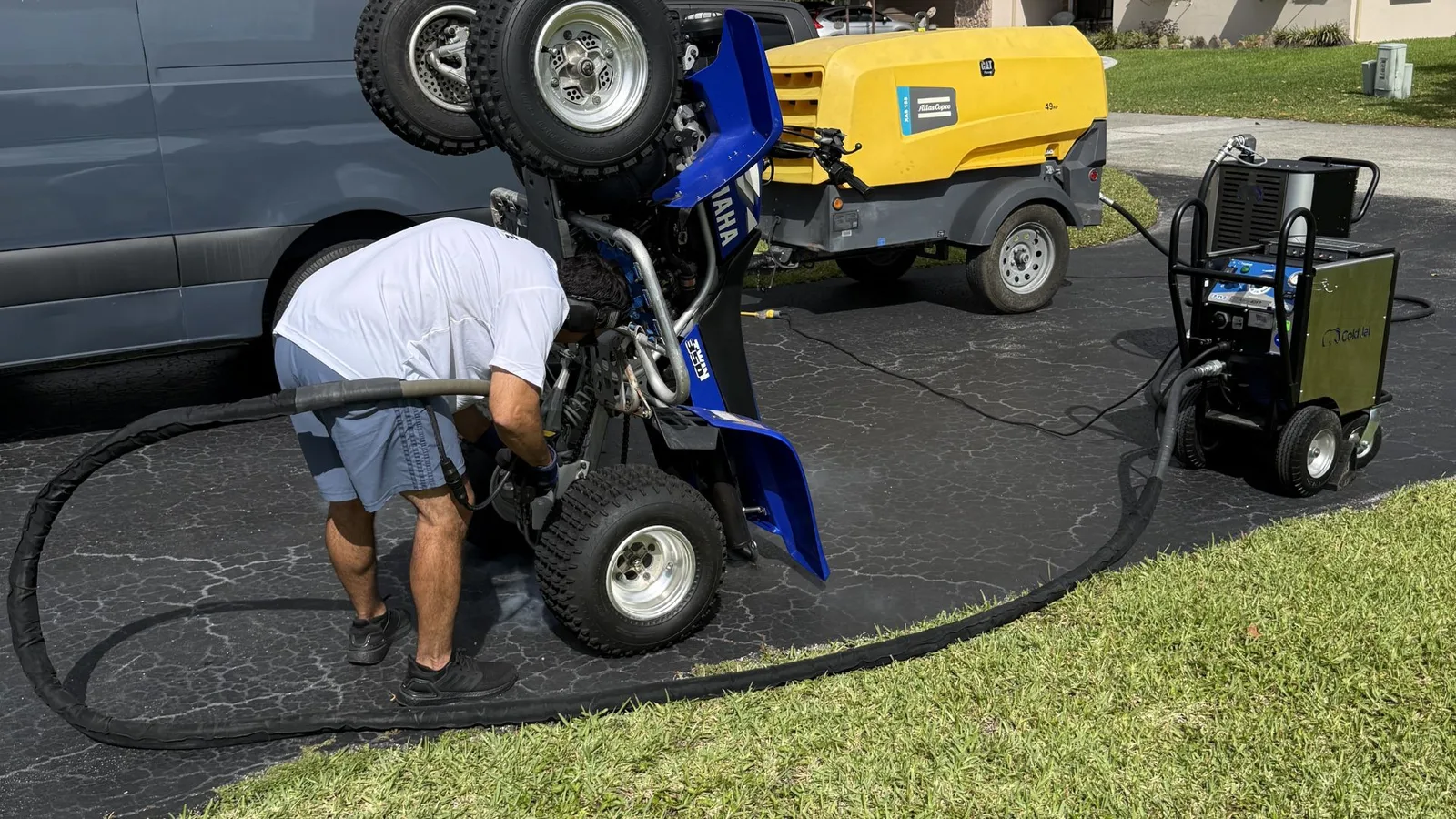
Everything we do runs off our own compressor, so there is no wash pad to find and no drain to worry about. That matters in Monroe County, where a lot of the work happens on a driveway, in a yard, or inside a shop that cannot be flooded.
South Florida salt air keeps corrosion moving all year, which is why so much of the work here is about removing what has bonded to a surface without taking the surface with it.
Where we work
Communities across Monroe County
What people ask before booking
Do you cover Monroe County?
Yes, Monroe County is well within range, and the compressor comes on the truck with everything else.
What do we have to provide?
Space for the rig and a way to reach the machine. Everything else arrives with us.
Will you work during a shutdown?
Usually. Tell us the window you have, including overnight or a planned shutdown, and we will tell you honestly what fits in it.
What kinds of jobs do you take here?
It ranges from a single restoration project to a plant maintenance window. The method does not change much.
Do you charge for the drive?
Sometimes, on the longer runs. Either way it is discussed before anyone commits.
How do we book it in?
Describe the job and send a photo or two. Giancarlo or Kenny will call you, not a scheduler.
What comes off
What this takes off
The method does not care much what the contaminant is, only that it sits on top of something. Here is the usual list.
- Adhesive and sealant
The stubborn film under old tape, or the gasket that tore and left half of itself behind.
- Resin and mold release
Cured process residue on a mold or fixture. The surface has to come out dimensionally unchanged, which rules out anything abrasive.
- Paint and coatings
Selective removal, layer by layer, on parts where media blasting would cut into the substrate.
- Salt and corrosion product
The year-round problem on the coast. The finish holding corrosion back has to survive the cleaning.
- Ink and printing residue
Dried ink on precision roller faces, cleaned without altering the cell structure that does the work.
- Food residue
Burnt-on product, fat and sugar on processing gear, with no chemical residue left on a contact surface.
- Grease and oil
Oil film is the layer everything else sticks to. Remove it and half the job is already done.
How a job runs
The sequence, start to finish
There is no mystery to how these jobs run, and no part of it we would rather you did not ask about.
- You look before we pack up
A second pass while everything is still connected is free in every sense. A return trip is not.
- You describe the job
The machine, the deposit and the downtime you can afford. Those three things decide the whole job, and we would rather know all of them before quoting.
- We look at access and containment
The layout decides the method more often than the contaminant does. We work out reach and containment before quoting anything.
- We test a small area
An out-of-sight patch comes first so pressure and pellet size are proven before anything that shows. Soft alloys, older paint and bare metal each want different numbers.
- We blast, then clean up
One mess instead of two: the pellet vanishes and we take away what it removed.
The comparison
How this compares to the usual methods
- Solvent and degreaser
Trades the deposit for a residue, plus ventilation and waste to deal with, and it is hard on the finish.
- Hand scraping
Fine on a patch, hopeless on a machine, and the blade leaves its own evidence.
- Media blasting
Grit removes material to do its job, so a machined face or a plated part pays for the cleaning.
- Pressure washing
Drives water into harnesses, bearings, panels and seams, then everything waits to dry. On electrical work it is simply not an option.
- Dry ice
Thermal shock breaks the bond. The pellet sublimates, so nothing abrasive touches the part and nothing is left to collect but the contaminant.
Why us
What you get from us
- We test before we commit
Anything unusual gets an inconspicuous test area first. Painted parts, soft alloys and older finishes all behave differently.
- The rig comes to you
Compressor, hose and operator arrive at your shop, plant, driveway or dock. Nothing needs to be transported to us.
- We clean up after ourselves
The media disappears, but the contaminant does not. Collecting it is part of the job, not an extra line.
- Firefighter owned and operated
Both founders came up in the fire service. That background is about preparation, accountability and performing under pressure, and it is how every job gets approached.
- You speak to an owner
Giancarlo or Kenny answers, quotes the work and turns up to do it. There is no call center and no handoff where the details get lost.
- We will tell you no
Not everything should be dry ice blasted. Being told that early is worth more than being sold the job.
Before we turn the rig on
Expect noise. Everybody inside the working area wears hearing protection, us included.
Cold surfaces are the one aftereffect. Depending on the piece that is either a few minutes of patience or some condensation while it returns to room temperature.
Air comes from our own compressor. You do not need to provide power, water or a connection of any kind.
Anything nearby that should not be touched gets masked before we start. That is quicker than explaining it afterward.
Describe what you are dealing with.
Give us the job, the address and a rough description, pictures if you have them. The call back comes from Giancarlo or Kenny directly.