Home / Service areas / Monroe County / Big Coppitt Key
Monroe County · Florida
Big Coppitt Key dry ice blasting
Big Coppitt Key calls tend to arrive with a constraint attached, which is exactly where this method earns its keep.
How the work runs here
The compressor runs off the truck, so there is no wash pad to find and no runoff to manage. It is also why nothing has to be crated up and driven across town, the work happens where the machine already sits in Big Coppitt Key.
Solid to gas on impact. Nothing settles into a bearing, nothing runs toward a drain, and the only residue is what was already on the part.

What we clean
Where this method earns its keep in Big Coppitt Key
Nearby
Also working across Monroe County
Questions from Big Coppitt Key
What kinds of jobs do you take here?
A mix, vehicle work, shop equipment, marine and light industrial. Same rig, different constraint each time.
Does distance affect the price?
It depends how far out the job is. We will be straight with you about it when you describe the work.
What is the first step?
Describe the job and send a photo or two. Giancarlo or Kenny will call you, not a scheduler.
Do you cover Big Coppitt Key?
We do. The whole point of a mobile setup is that Big Coppitt Key is no further than any other stop on the schedule.
What do we have to provide?
Just access and parking. There is no tap to find, no drain to use and nothing of yours to plug into.
Will you work during a shutdown?
Usually. Tell us the window you have, including overnight or a planned shutdown, and we will tell you honestly what fits in it.
Conditions around Big Coppitt Key
Salt carries a long way inland here, and it keeps working on metal every day of the year. Which is exactly the situation where a non-abrasive, low-moisture method is worth the call.
Shops, marine yards, warehouses and home garages all end up with the same problem in different forms. Driveway or plant floor, the requirement is the same: room for the rig and access to the machine.
With no slurry to contain and no media to recover, a confined Monroe County site stops being a problem.
What comes off
The deposits we see most
These are the deposits behind most of our calls. Each one is something stuck to a surface that should have stayed clean.
- Food residue
Burnt-on product, fat and sugar on processing gear, with no chemical residue left on a contact surface.
- Grease and oil
Oil film is the layer everything else sticks to. Remove it and half the job is already done.
- Carbon and soot
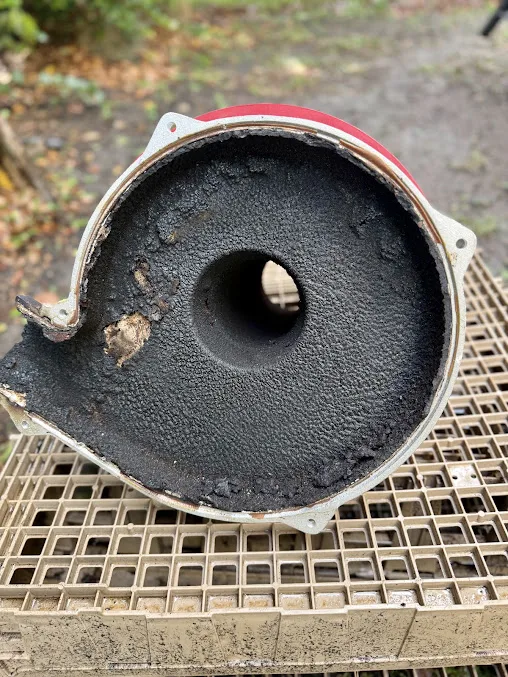
Carbon cooked onto housings and oven walls. It went on with heat, and the sudden cold of the pellet is what makes it let go.
- Adhesive and sealant
Bonded material that outlived whatever it was bonding, usually harder to shift than the part it is on.
- Resin and mold release
Hardened resin on a fixture shrinks under the cold and lets go, and the metal under it does not lose any material.
- Paint and coatings
Removed selectively where the substrate underneath has to survive, which rules out most abrasive approaches.
- Salt and corrosion product
Salt deposit and the oxidation it starts. Anything abrasive removes the protection along with the salt.
How a job runs
What happens once you call
There are no surprises built into how we work. Read the steps once and you will know what to expect on the day.
- You look before we pack up
If something needs another pass we do it then, on site, while the rig is still running. That is a better outcome for everyone than a callback.
- You describe the job
You talk to an owner from the first call. If what you describe sounds like a job for a different method, we will say so then, before any money changes hands.
- We look at access and containment
The layout decides the method more often than the contaminant does. We work out reach and containment before quoting anything.
- We test a small area
A test spot takes minutes and protects the whole job. It tells us how hard to push on this particular surface, which matters more than any rule of thumb.
- We blast, then clean up
Nothing is left of the pellet, so the only thing to collect is what was on your equipment. That collection is part of the work we quoted.
The comparison
How this compares to the usual methods
- Hand scraping
Fine on a patch, hopeless on a machine, and the blade leaves its own evidence.
- Media blasting
It takes the top off whatever it touches. That is the point on rusted plate and the problem everywhere else.
- Pressure washing
Water gets into everything and has to come out again before the equipment runs. Around electrics it is off the table entirely.
- Solvent and degreaser
It loosens the mess and leaves its own behind, along with fumes and something to dispose of.
- Dry ice
It is the only one on this list where the media stops existing the moment it has worked.
What happens in your space
Anything nearby that should not be touched gets masked before we start. That is quicker than explaining it afterward.
Solid carbon dioxide leaves no residue at all. What it does do is displace air, so an enclosed space gets ventilated as part of the job rather than as a precaution added later.
Expect noise. Everybody inside the working area wears hearing protection, us included.
Right after the work, the surface is chilled through. Depending on its size, that means a few minutes before it is comfortable to handle, or some moisture while it recovers.
Send us the job.
A rough outline of the job is fine. Add the location and photos, and expect to hear from Giancarlo or Kenny directly.