September 2026
The window is the whole job
On industrial work the cleaning is rarely the hard part. The hard part is that you have been given thirty-six hours, or a weekend, or one shift, and six trades want the same room. Anything that overruns is not an inconvenience, it is production you do not get back.
So the honest way to talk about cleaning during a shutdown is to talk about the schedule rather than the nozzle. That is where the decision actually lives.
Where the hours really go
Ask a maintenance lead what a cleaning job costs and they will usually quote the cleaning. Look at the last one that ran long and the hours were somewhere else.
Take a weld cell or a gearbox cleaned the conventional way. The sequence is lock out, remove guarding, disconnect services, pull the assembly, move it, tear it down, clean it, reassemble, reinstall, reconnect, align, commission. Cleaning is one line in the middle of eleven.
Now add water to the same job and you get a twelfth line: drying, which nobody schedules and everybody waits for. On a humid South Florida weekend that line is longer than it looks on paper.
Add abrasive instead and you get a different twelfth line: getting the media out of an assembly you now have to prove is clean before it runs.
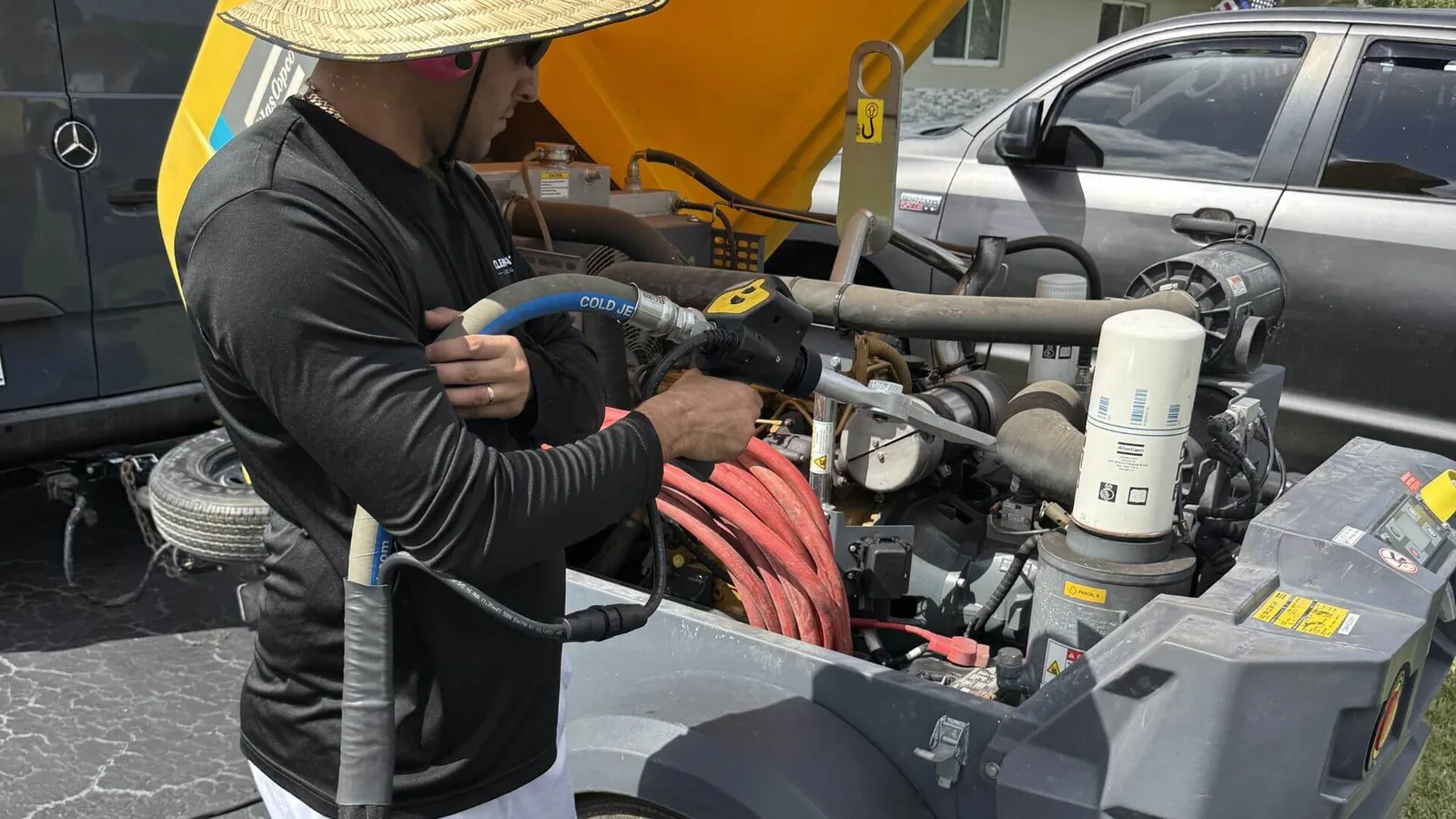
The reason a mobile thermal method fits a window is that it attacks the eleven lines, not the one. Most of the work gets done with the equipment where it stands, wiring and sensors attached, guarding partially in place, and it is dry the second the nozzle stops.
Cleaning in place, practically
In place does not mean untouched. Somebody still locks the machine out, guarding still comes off where access requires it, and masking still happens. What changes is that the assembly does not come apart and does not leave its foundation.
On a press, an extruder, a mixer, a weld cell or a conveyor run, that is the difference between a job that fits inside a weekend and a job that does not.
It also changes what you are risking. An assembly that never gets torn down cannot be reassembled wrong, and a surprising share of post-shutdown faults trace back to reassembly rather than to anything that was actually wrong beforehand.
What we need from you before the window
Every shutdown job that went badly for us went badly because of something in this list that nobody established in advance.
The real window length, start to finish, including the time the room is being handed over. Not the optimistic number.
Who else is in the space and when. Cleaning while a rigger is overhead does not work and neither does the reverse.
Whether the equipment will genuinely be locked out, and by whom, under your procedure.
Where compressed air, power and access come from. We arrive with our own rig, but hose routing through a plant is a real constraint and it is better worked out on a drawing than at six in the morning.
Ventilation, especially anywhere enclosed. Carbon dioxide is heavier than air and displaces oxygen, so pits, tanks, tunnels and small rooms need airflow and monitoring planned rather than assumed.
Most of that is faster to send through the contact page than to work out on a call, and a layout drawing saves everybody an hour on the day.
And the honest condition of the equipment. A machine that has not been properly cleaned in eight years is a different job from one on an annual interval, and we would rather know before we quote the window than discover it inside it.
Scope one thing properly instead of three badly
This is the advice we give most often and it is the least popular.
When a window opens, the temptation is to hand the cleaning contractor a list of everything that has been bothering you for two years. What that produces is a plant where six machines are partially done and none is finished, which is worse than one machine finished and five untouched.
Pick the equipment where fouling is costing you something measurable: a quality defect, a temperature you cannot hold, a motor running hot, an inspection you keep failing. Do that properly. The rest goes on the next window with a known duration behind it.
We would rather tell you what fits than agree to a list and hand you back a half-finished room. That is the part of “honest over a quick buck” that actually shows up on a job site.
What fouling is actually costing between windows
Build-up rarely announces itself as a cleaning problem. It shows up as something else, and it gets budgeted as something else, which is why it survives so long.
Heat is the most common disguise. A fouled cooling passage, a loaded fan wheel or a caked motor frame cannot shed heat, so the machine runs warmer. Warmer means shorter bearing life, shorter insulation life and more current for the same work. Nobody writes that down as a cleaning cost.
Quality is the second. Release agent build-up on tooling starts transferring to the part. Ink or coating build-up on a roller changes what the press lays down. Product residue in a mixer becomes a contamination finding. Each of those gets chased as a process problem for a while before somebody looks at the surface.
Sensors are the third and the sneakiest. A fouled proximity sensor, photo eye or thermocouple gives you intermittent faults that look electrical and are not. Plenty of controls troubleshooting ends with a rag.
The useful exercise before a window is to take the three most annoying recurring issues on a line and ask whether any of them are downstream of a surface nobody has cleaned properly. If one is, that is the machine to spend the window on.
Trial runs beat promises
If you have never had thermal cleaning done, do not put it on the critical path of a major outage first.
Find a smaller planned stop and give us one machine. You get a real duration for that equipment class, your team sees the setup and the containment, and your sanitation or quality people get to review the method with no schedule pressure. Then the number you plan the big outage around is a measured one rather than something a contractor said on the phone.
The industrial work we do repeatedly gets easier to schedule the second time, because the first visit is where the real timing comes from.
Questions from maintenance and reliability
Can you work around other trades in the room?
Sometimes, with a clear separation and a plan. What does not work is overlapping in the same space, because it is loud, there is airborne contaminant, and nobody should be working under a person with a nozzle.
Do we have to de-energize everything?
Anything electrical, yes, and the isolation is yours under your own procedure. Mechanical equipment gets locked out for the obvious reason that we are working inside guarding.
Can it be done hot?
On some equipment, and it is one of the useful properties of the method, because a hot surface often releases residue more readily. It depends on the machine and it is worth asking about specifically rather than assuming either way.
What is left for our team afterward?
Nothing, if we have done the job properly. The contaminant we removed is ours to collect, and you should not be finding evidence of us a week later.
Before you lock in the next window
Tell us the equipment, the window and what the fouling is costing you. Photos help more than a description. Giancarlo at 786-302-6553, or the contact page. We are mobile out of Miami and will tell you honestly what fits inside the time you have.