Firefighter owned & operated · Miami, Florida
Contact Us
Home
Dry Ice Blasting
Categories Core Industrial Electrical Data Government Automotive Aerospace Food Energy Marine Printing Pharmaceutical Construction Removal Residential
Services 208 Core Dry Ice Blasting Dry Ice Cleaning CO₂ Ice Blasting CO₂ Snow Blasting Mobile On-Site Industrial Commercial Residential Precision Non-Abrasive Waterless Residue-Free Low-Pressure High-Pressure Automated Robotic Production-Line Preventative Maintenance Emergency Industrial Industrial Equipment Industrial Machinery Manufacturing Equipment Production Equipment Production Line Factory Equipment Plant Equipment Machine Ice Blasting CNC Machine Injection Mold Mold Ice Blasting Die Ice Blasting Tooling Press Ice Blasting Conveyor Robotic Equipment Welding Equipment Weld Cell Assembly Equipment Industrial Oven Furnace Extruder Mixer Industrial Fan Compressor Electrical Electrical Equipment Electrical Panel Switchgear MCC Busbar Busway Bus Duct Transformer Generator Motor Control Cabinet Electrical Cabinet Substation Equipment Electrical Room Equipment Power Distribution Equipment Data Data Center Data Center Equipment Data Center Electrical Data Center Switchgear Data Center Busway Data Center Bus Duct Data Center Generator Data Center UPS Data Center Cooling Equipment Data Center Mechanical Equipment Data Center Fan Data Center Infrastructure Hyperscale Data Center Colocation Data Center Mission-Critical Facility Government Government Facility Federal Facility Municipal Equipment Government Equipment Government Data Center Military Equipment Military Vehicle Military Facility Equipment Defense Manufacturing Government Fleet Fire Department Equipment Police Fleet Public Works Equipment DOT Equipment Automotive Automotive Vehicle Engine Engine Bay Undercarriage Chassis Transmission Differential Suspension Brake Component Classic Car Restoration Vehicle Race Car Fleet Vehicle Automotive Manufacturing Automotive Tooling Automotive Mold Automotive Production Equipment Aerospace Aerospace Aircraft Component Aircraft Equipment Aerospace Tooling Aerospace Mold Composite Mold Autoclave Aerospace Production Equipment Aircraft Engine Component Landing Gear Component Defense Aerospace Food Food Processing Equipment Food Production Equipment Meat Processing Equipment Poultry Processing Equipment Bakery Equipment Commercial Oven Packaging Equipment Filling Equipment Bottling Equipment Brewery Equipment Beverage Production Equipment Food Production Line Energy Power Plant Power Generation Equipment Turbine Substation Utility Equipment Oil & Gas Equipment Refinery Equipment Oilfield Equipment Pipeline Equipment Pump Valve Wind Turbine Solar Manufacturing Equipment Marine Marine Boat Yacht Ship Shipyard Equipment Commercial Vessel Military Vessel Marine Engine Engine Room Marine Equipment Bilge Equipment Printing Printing Press Printing Equipment Printing Roller Anilox Roller Ink Removal Packaging Machine Labeling Equipment Adhesive Removal Paper Dust Removal Pharmaceutical Pharmaceutical Equipment Pharmaceutical Manufacturing Medical Equipment Laboratory Equipment Cleanroom Equipment Electronics Manufacturing Semiconductor Equipment Microelectronics Equipment Battery Manufacturing Equipment EV Manufacturing Equipment Construction Construction Equipment Heavy Equipment Excavator Skid Steer Loader Crane Equipment Concrete Equipment Asphalt Equipment Paving Equipment Heavy Machinery Construction Tool Removal Grease Removal Oil Removal Carbon Removal Soot Removal Resin Removal Paint Removal Coating Removal Rubber Removal Plastic Residue Removal Mold Release Agent Removal Production Residue Removal Food Residue Removal Combustion Residue Removal Carbonized Material Removal Tar Removal Wax Removal Residential Home Equipment Garage Equipment Home Workshop Equipment Residential Machinery Wood Surface Brick Surface Concrete Surface Stone Surface
Why Clean Slate
The Process How dry ice blasting works What it removes Core blasting methods Mobile and on-site See it on real jobs
Service Areas
Miami-Dade County, FL Miami, FL Miami Beach, FL Hialeah, FL Hialeah Gardens, FL Miami Gardens, FL Miami Springs, FL Miami Shores, FL Miami Lakes, FL North Miami, FL North Miami Beach, FL North Bay Village, FL Opa-locka, FL Coral Gables, FL South Miami, FL West Miami, FL Doral, FL Sweetwater, FL Medley, FL El Portal, FL Aventura, FL Bal Harbour, FL Bay Harbor Islands, FL Biscayne Park, FL Golden Beach, FL Indian Creek, FL Key Biscayne, FL Cutler Bay, FL Florida City, FL Homestead, FL Palmetto Bay, FL Pinecrest, FL Surfside, FL Sunny Isles Beach, FL Virginia Gardens, FL Kendall, FL The Hammocks, FL Tamiami, FL Westchester, FL Westwood Lakes, FL West Little River, FL Gladeview, FL Golden Glades, FL Goulds, FL Naranja, FL Princeton, FL Richmond West, FL Richmond Heights, FL South Miami Heights, FL South West Ranches area, FL Leisure City, FL Ojus, FL Ives Estates, FL Kendale Lakes, FL Kendall West, FL Palm Springs North, FL Pinewood, FL Olympia Heights, FL Country Walk, FL The Crossings, FL Three Lakes, FL University Park, FL West Perrine, FL
Broward County, FL Fort Lauderdale, FL Hollywood, FL Pembroke Pines, FL Miramar, FL Coral Springs, FL Pompano Beach, FL Sunrise, FL Plantation, FL Davie, FL Weston, FL Deerfield Beach, FL Hallandale Beach, FL Dania Beach, FL Lauderdale Lakes, FL Lauderhill, FL Margate, FL Coconut Creek, FL Tamarac, FL North Lauderdale, FL Oakland Park, FL Wilton Manors, FL Cooper City, FL Parkland, FL Lighthouse Point, FL Lauderdale-by-the-Sea, FL Hillsboro Beach, FL Lazy Lake, FL Sea Ranch Lakes, FL Southwest Ranches, FL Pembroke Park, FL West Park, FL Broadview Park, FL Franklin Park, FL Roosevelt Gardens, FL Washington Park, FL Boulevard Gardens, FL Boulevard Heights, FL Carver Ranches, FL Bunche Park, FL Collier Manor, FL Country Club, FL Flamingo Gardens, FL Harbor Inlet, FL Hillsboro Pines, FL Palm Aire, FL Twin Lakes, FL North Andrews Gardens, FL
Palm Beach County, FL West Palm Beach, FL Boca Raton, FL Delray Beach, FL Boynton Beach, FL Palm Beach Gardens, FL Jupiter, FL Wellington, FL Palm Beach, FL Palm Beach Shores, FL Lake Worth Beach, FL Greenacres, FL Riviera Beach, FL North Palm Beach, FL Lake Park, FL Lantana, FL Manalapan, FL Highland Beach, FL Ocean Ridge, FL Gulf Stream, FL South Palm Beach, FL Briny Breezes, FL Hypoluxo, FL Juno Beach, FL Jupiter Inlet Colony, FL Tequesta, FL Cloud Lake, FL Glen Ridge, FL Haverhill, FL Lake Clarke Shores, FL Mangonia Park, FL Royal Palm Beach, FL Belle Glade, FL Pahokee, FL South Bay, FL Acreage, FL Loxahatchee, FL Loxahatchee Groves, FL The Glades, FL Canal Point, FL Westgate, FL Golden Lakes, FL Gun Club Estates, FL Limestone Creek, FL Mission Bay, FL Palm Beach Country Estates, FL Seminole Manor, FL Schall Circle, FL
Monroe County, FL Key Largo, FL Tavernier, FL Islamorada, FL Layton, FL Marathon, FL Key Colony Beach, FL Duck Key, FL Big Pine Key, FL Big Coppitt Key, FL Cudjoe Key, FL Summerland Key, FL Sugarloaf Key, FL Stock Island, FL Conch Key, FL Long Key, FL
Hendry County, FL Clewiston, FL LaBelle, FL Harlem, FL Pioneer Plantation, FL Felda, FL
Glades County, FL Moore Haven, FL Buckhead Ridge, FL Muse, FL Palmdale, FL
Martin County, FL Stuart, FL Palm City, FL Hobe Sound, FL Jupiter Island, FL Indiantown, FL Port Salerno, FL Sewall's Point, FL Ocean Breeze, FL
Okeechobee County, FL Okeechobee, FL Taylor Creek, FL Basswood Estates, FL Cypress Quarters, FL Viking, FL Whispering Pines, FL
Collier County, FL Naples, FL Marco Island, FL Immokalee, FL Everglades City, FL Ave Maria, FL Golden Gate, FL East Naples, FL North Naples, FL Golden Gate Estates, FL Vanderbilt Beach, FL
Lee County, FL Bonita Springs, FL Estero, FL Fort Myers, FL Cape Coral, FL Lehigh Acres, FL San Carlos Park, FL Gateway, FL Buckingham, FL Alva, FL North Fort Myers, FL
St. Lucie County, FL Port St. Lucie, FL Fort Pierce, FL St. Lucie Village, FL Hutchinson Island, FL
Resources Gallery About us Contact
Blog Why Dry Ice Call · 786-302-6553
Skip to content

South Florida Salt Air and Marine Corrosion

September 2026

Salt never takes a day off down here

Everyone who keeps a boat in South Florida understands the general idea. What surprises people is the mechanism, because it is not the salt water that does the damage. It is the salt left behind after the water evaporates.

Sodium chloride is hygroscopic. It pulls moisture out of humid air and holds it against metal. So a dried salt deposit on an engine mount, a bracket or a bilge stringer is not inert residue waiting to be rinsed. It is a wet electrolyte cell running continuously, day and night, for as long as it sits there. That is why a vessel that has not been in the water for six weeks can still be actively corroding.

And this is the part of Florida where the air itself carries it. Coastal Miami-Dade, the Broward marinas, the Palm Beach waterfront and the whole Monroe stretch through the Keys all get airborne salt loading whether the equipment ever goes near a slip or not.

Where it collects on a vessel

Engine rooms are the worst of it, because you get salt plus heat plus oil mist in one enclosed space. The salt lands, the oil mist lands on top, and now the deposit is greasy and holds in place rather than falling away. Freshwater rinses run right over it.

Bilges are second. Whatever makes it into a bilge stays there, layered with oil, fuel residue and whatever came off the sole above it.

Then there is the mechanical inventory that lives in that environment: generators, pumps, strainers, shaft logs, steering gear, hydraulic packs, battery trays and every terminal and bus bar in the boat. Metal fittings, hatch hardware and stainless everywhere.

Trailers deserve a mention, because they get dunked in salt water by design and then parked. A trailer frame is doing worse than most hulls.

The rinse-and-hope cycle

Standard practice is a freshwater wash down, and it is genuinely worth doing. It handles the exposed, accessible surfaces where most people look.

The limits show up in three places. Water will not reach the back of an engine room or the inside of a bilge with any force. It cannot get salt out from under an oil film, because the oil is the barrier. And the pressure needed to move a greasy deposit is exactly the pressure you should not be aiming at electrics, alternators, starters and connectors, which in an engine room is most of what is in range.

So the accessible surfaces get cleaner and the enclosed ones keep working on themselves.

Why abrasive makes it worse

This is the mistake that turns a maintenance job into a corrosion problem.

Abrasive blasting removes salt very effectively, and it also removes the coating, the paint and the passive layer holding corrosion back. In a marine environment that leaves bare metal in the most aggressive atmosphere it will ever see, which is a worse position than the salt was putting you in.

Anything that is going to be recoated immediately, fine, that is a surface prep job and abrasive belongs there. Anything you intend to leave as it is, and abrasive has cost you the only protection the part had.
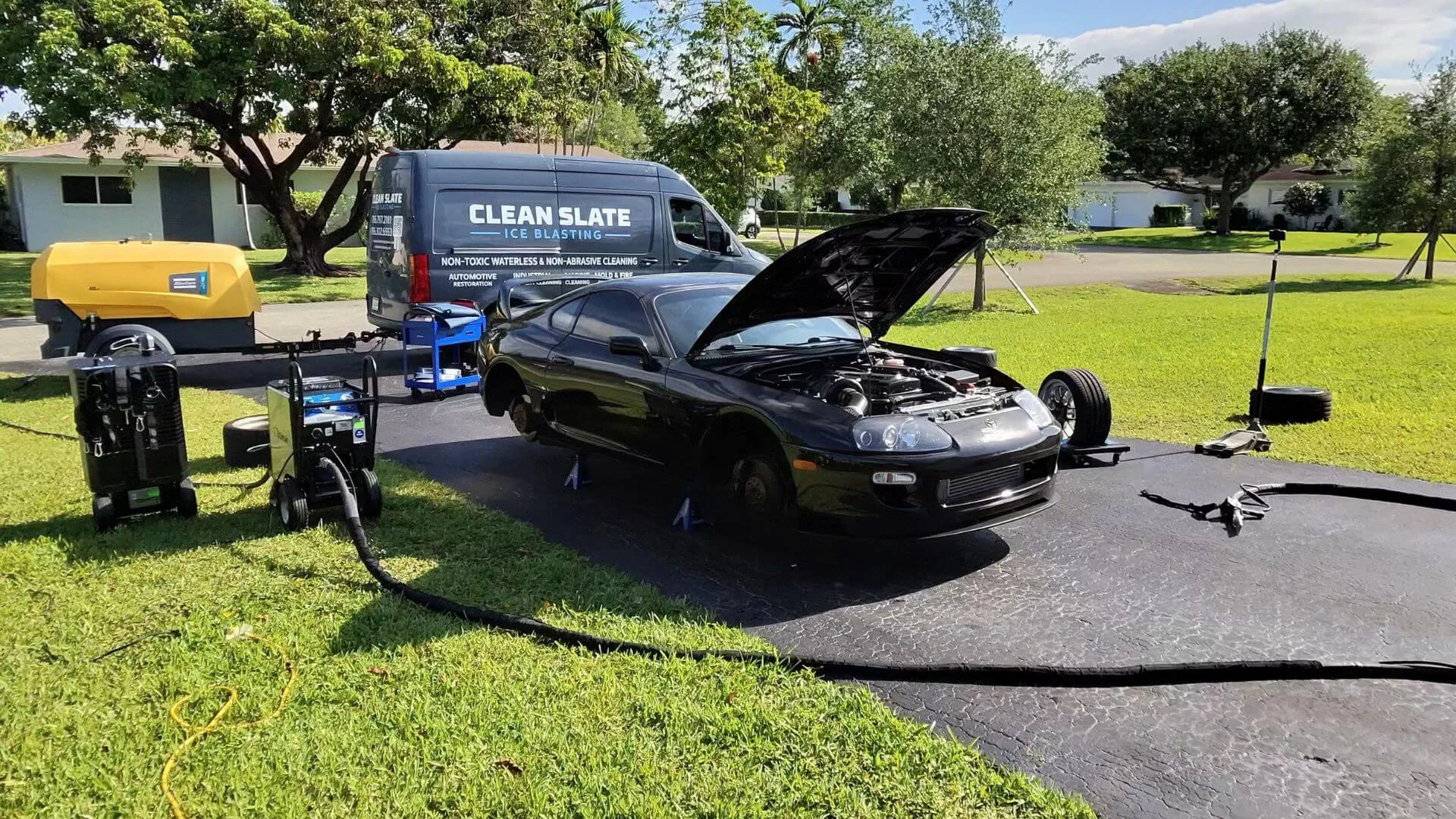
The Clean Slate van, compressor and hose reel set up on a driveway beside a black Supra with the hood raised
The whole rig is mobile. On marine work that means it sets up dockside, in the yard or aboard, rather than the equipment coming to us.

What thermal cleaning does differently

Three things line up with the marine problem specifically.

The coating survives. The pellet is soft and sublimates on impact, so it lifts the salt and the oil-bound deposit off the finish and leaves the finish there doing its job. That is the entire argument, and on a boat it is worth more than speed.

Nothing gets wet. In an engine room full of electrics, adding water to solve a salt problem has always been an uncomfortable trade. This removes that trade.

Nothing is left behind. No media in the bilge, no grit in a strainer or a pump, no rinse water to pump overboard, and nothing extra going into the marina.

The work itself covers engine rooms, bilge areas, engines and running gear, and general vessel and component cleaning on everything from center consoles to commercial hulls.

Dissimilar metals make it faster

The reason marine corrosion moves quicker than people expect is that boats are built out of several metals bolted together, and salt water is a conductor.

Put a stainless fastener into an aluminum bracket, add an electrolyte, and you have a battery. The aluminum gives up material to protect the stainless, which is why the corrosion always seems to appear around the hardware rather than on the flat surfaces. Bronze fittings against aluminum housings do the same thing. So does a steel bracket in a stainless mount.

None of that happens while the interface is dry and clean. It needs the electrolyte to complete the circuit, and the electrolyte is the damp salt deposit sitting across the joint.

That is the practical reason cleaning is corrosion control rather than housekeeping. You are not making the engine room look better, you are taking away the conductor between two metals that are otherwise content to sit next to each other. Anodes handle the part of this that is underwater; nothing handles the part above the waterline except keeping it clean and coated.

When to have it done

Two windows make obvious sense.

Before a survey or a sale, because a clean engine room is the difference between a surveyor reading the machinery and a surveyor guessing at it. Corrosion you can see is corrosion you can price.

Before any service or refit that means somebody working in that space. Nobody does good work lying in a greasy bilge, and contamination on a surface is contamination that ends up in whatever gets opened up.

If either of those is coming up, send the vessel and the timing through the contact page so we can work backward from the date rather than squeezing it in afterward.

The less obvious one is on an interval. Down here the salt loading does not pause for the off season, so cleaning an engine room once a year does more for the boat than most of what people spend money on.

The land-side version of the same problem

It is not only boats. Anything within a few miles of the water here gets salt: rooftop mechanical units, outdoor disconnects and louvered enclosures, dock and marina equipment, trailers, outdoor kitchen equipment, and the underside of any vehicle that spends time near the beach.

The same logic applies. Remove the deposit, keep the coating. On the electrical side that becomes enclosure and panel work, where salt plus humidity is a leakage path rather than a corrosion story.

Common questions from owners and yards

Can you work in the water or does it have to be hauled?

Most interior work, engine rooms and bilges, happens with the vessel in the slip. The rig runs off the dock and the hose comes aboard. Ventilation planning matters in an enclosed engine space, and that is part of setup rather than an afterthought.

Will it take off bottom paint?

Ablative bottom paint is soft and will be affected, so it is not the right tool where you want that coating kept. If the bottom is coming off anyway, that is a different job and worth a separate conversation.

Is it safe around electronics?

That is one of its better uses. Low moisture, non-conductive media and nothing left behind is a much easier conversation than a pressure washer near a helm or a distribution panel.

Does it stop corrosion that has already started?

It removes what is driving it and lets you see the actual condition of the metal. Corrosion that has already eaten into a part is not recoverable by cleaning, and we will tell you plainly when what you are looking at is a repair rather than a cleaning.

If the engine room has gotten away from you

Send a few photos and tell us where the boat sits. Giancarlo at 786-302-6553, or the contact page. We run from Miami out through Broward, Palm Beach and down into the Keys, and we will be honest about the far end of that range when you call.