September 2026
People ask about this on nearly every first phone call, usually somewhere in the middle of describing their equipment. “Wait, you said firefighters?” So here is the actual answer, and why we think it matters to the person hiring us rather than being a line on a truck.
It started as a gap, not a business plan
There was a need in our market. That is the plainest way to put it, and it is how Giancarlo has described it since the beginning: we noticed our community needed this in our market.
Both of us have been around cars our entire lives. That is the part of this that came first. Being in and out of shops and garages in South Florida, you end up in the same conversation over and over: a part is filthy, it matters that it stays original, and every available method is too harsh for it. Media blasting pits the aluminum. A pressure washer floods what it should not. Caustic chemicals take the markings and the plating off with the grease.
So a lot of parts simply stayed dirty. Nobody down here was doing this properly, and we kept running into the gap from the customer side long before we owned a compressor.
What the fire service actually taught us
The connection between fighting fires and cleaning equipment is not obvious, and we would not blame anyone for hearing it as a marketing angle. It is not. It shows up in specific habits.
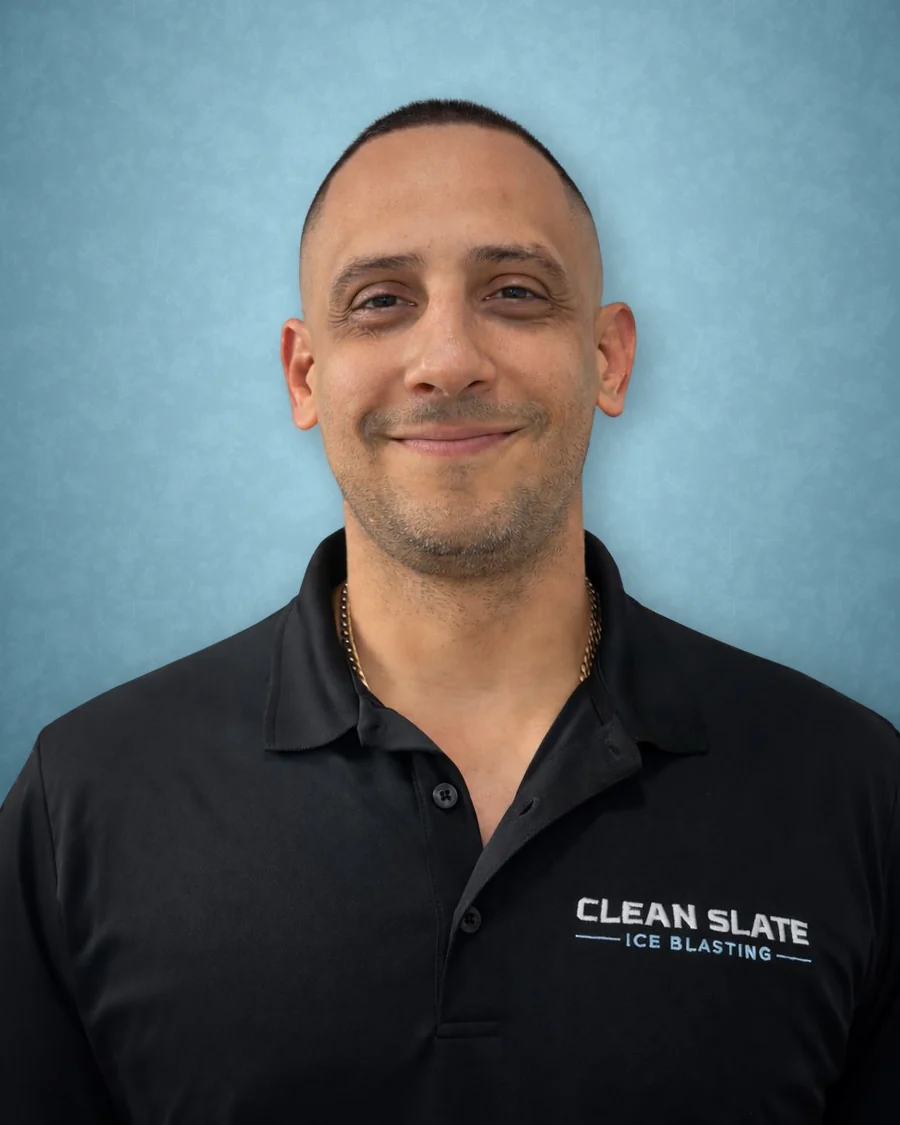
In Giancarlo’s own words: his background as a firefighter taught him responsibility, preparation, and how to perform under pressure. Those are values he applies to every project and every customer. Kenny puts it his own way, that the fire service shaped his work ethic around accountability, teamwork and a commitment to serving others.
Translate that to a job site and it looks like this.
You size up before you act. Nobody walks into a building without knowing what is in it, and nobody should put a nozzle to somebody’s engine bay without knowing what is underneath. That is why we test an inconspicuous corner before committing on anything unusual.
You show up prepared or you do not show up. The equipment is checked before it goes on the truck. That is a habit you do not get to be casual about in the fire service and it does not switch off afterward.
You tell people the truth about what they are looking at. Part of the job in an emergency is being the person who explains the actual situation to someone having a bad day. It turns out that skill transfers directly to telling a customer that dry ice is the wrong tool for their rusted steel, or that the coating on their frame is going to come off along with the undercoating.
The thing we decided early
Kenny and Giancarlo agreed on one rule before there was a company: value being honest over a quick buck.
That reads like something anybody would say. The test of whether a company means it is what they do when honesty costs them the job, so here is what it looks like in practice for us.
We turn down work. Rust, heavy mill scale, anything that needs a surface profile for a coating, loose mud on a piece of yellow iron. Those are not our method and pretending otherwise gets us paid once and costs us the relationship.
We do not throw a number at you over the phone. What a job costs depends on the equipment, the contaminant and the access. Anyone who quotes your machine sight unseen is guessing, and a guess is either going to be padded or it is going to get revised on the day, which is worse. Describe the job and you get a real figure.
We tell you when a window is too short. On industrial work the temptation is to agree to a list and hand back a plant that is half done. We would rather scope one machine properly and finish it.
And the owners are the ones on the phone. You are not passed to a call center and the person who quotes the job is the person holding the nozzle. Anything that comes in through the contact page gets answered by one of us, not by somebody reading from a script.
Why we picked this method and not an easier one
There are cheaper ways into the cleaning business. A pressure washer and a trailer is a weekend and a few hundred dollars, and half the trucks on the road down here are exactly that.
We went the other direction on purpose, because the problem we kept seeing was not “this is dirty”. It was “this is dirty and everything that would clean it would ruin it”. Solving the second problem requires the equipment that actually does that, which means a real compressor, a real blast unit and a supply chain for the ice.
The ice part deserves a note, because it is the least convenient thing about this trade. Dry ice does not keep. It sublimates whether you use it or not, so there is no stocking up. You buy for the day, you plan the route around it, and anything left over is gone by tomorrow. That single fact forces a level of planning on every job that a pressure-wash operation never has to think about.
We were fine with that, because a method with a real barrier to entry is also a method nobody undercuts by cutting corners. The cheap version of this service does not exist.
Why the automotive side runs deeper than the industrial side
Honest answer about where our instincts are sharpest: cars.
We are lifelong car enthusiasts and part of the South Florida automotive community, and that is not a positioning statement, it is why we know what an original inspection marking is worth and why we get nervous about the same things a restorer gets nervous about. When somebody hands us a frame or an engine bay on a car they have spent years on, we understand what is actually at stake, because we would be the customer in that conversation.
The industrial and electrical work grew from the same method rather than from a different company. A plant manager and a restorer are worried about exactly the same thing in different vocabulary: that the cleaning will do more harm than the dirt did.
Still firefighters
Both of us are active in the fire service. That is not a former life, it is the current one, and it shapes the business in one practical way worth being upfront about: this is a two-owner operation and we schedule around real commitments on both sides.
It also means we know one class of equipment better than most cleaning contractors ever will. Apparatus, pumps, compartments, tools and turnout gear storage foul in specific ways, and we have spent years on the using end of that equipment rather than reading about it, which is why fire department equipment is work we take seriously.
What you get out of it is that neither of us is chasing volume for its own sake. What you should expect is that we are specific about scheduling rather than vague about it, and that if a window matters to you, you should say so up front so we can tell you honestly whether we can hit it.
What to do with all of this
The reason to care that we are firefighters is not sentiment. It is that the habits are the product. Preparation, straight answers, testing before committing, and cleaning up after ourselves are not add-ons to this work, they are the work.
If you have something fouled and you have been putting it off because every method looked too risky, that is the exact conversation we started this company to have. Have a look at what the process does, or the automotive side if this began with a car.
Then call Giancarlo at 786-302-6553, or Kenny, or send photos through the contact page. One of us calls back, and if we are the wrong people for your job we will tell you that instead of booking it.