Firefighter owned & operated · Miami, Florida
Contact Us
Home
Dry Ice Blasting
Categories Core Industrial Electrical Data Government Automotive Aerospace Food Energy Marine Printing Pharmaceutical Construction Removal Residential
Services 208 Core Dry Ice Blasting Dry Ice Cleaning CO₂ Ice Blasting CO₂ Snow Blasting Mobile On-Site Industrial Commercial Residential Precision Non-Abrasive Waterless Residue-Free Low-Pressure High-Pressure Automated Robotic Production-Line Preventative Maintenance Emergency Industrial Industrial Equipment Industrial Machinery Manufacturing Equipment Production Equipment Production Line Factory Equipment Plant Equipment Machine Ice Blasting CNC Machine Injection Mold Mold Ice Blasting Die Ice Blasting Tooling Press Ice Blasting Conveyor Robotic Equipment Welding Equipment Weld Cell Assembly Equipment Industrial Oven Furnace Extruder Mixer Industrial Fan Compressor Electrical Electrical Equipment Electrical Panel Switchgear MCC Busbar Busway Bus Duct Transformer Generator Motor Control Cabinet Electrical Cabinet Substation Equipment Electrical Room Equipment Power Distribution Equipment Data Data Center Data Center Equipment Data Center Electrical Data Center Switchgear Data Center Busway Data Center Bus Duct Data Center Generator Data Center UPS Data Center Cooling Equipment Data Center Mechanical Equipment Data Center Fan Data Center Infrastructure Hyperscale Data Center Colocation Data Center Mission-Critical Facility Government Government Facility Federal Facility Municipal Equipment Government Equipment Government Data Center Military Equipment Military Vehicle Military Facility Equipment Defense Manufacturing Government Fleet Fire Department Equipment Police Fleet Public Works Equipment DOT Equipment Automotive Automotive Vehicle Engine Engine Bay Undercarriage Chassis Transmission Differential Suspension Brake Component Classic Car Restoration Vehicle Race Car Fleet Vehicle Automotive Manufacturing Automotive Tooling Automotive Mold Automotive Production Equipment Aerospace Aerospace Aircraft Component Aircraft Equipment Aerospace Tooling Aerospace Mold Composite Mold Autoclave Aerospace Production Equipment Aircraft Engine Component Landing Gear Component Defense Aerospace Food Food Processing Equipment Food Production Equipment Meat Processing Equipment Poultry Processing Equipment Bakery Equipment Commercial Oven Packaging Equipment Filling Equipment Bottling Equipment Brewery Equipment Beverage Production Equipment Food Production Line Energy Power Plant Power Generation Equipment Turbine Substation Utility Equipment Oil & Gas Equipment Refinery Equipment Oilfield Equipment Pipeline Equipment Pump Valve Wind Turbine Solar Manufacturing Equipment Marine Marine Boat Yacht Ship Shipyard Equipment Commercial Vessel Military Vessel Marine Engine Engine Room Marine Equipment Bilge Equipment Printing Printing Press Printing Equipment Printing Roller Anilox Roller Ink Removal Packaging Machine Labeling Equipment Adhesive Removal Paper Dust Removal Pharmaceutical Pharmaceutical Equipment Pharmaceutical Manufacturing Medical Equipment Laboratory Equipment Cleanroom Equipment Electronics Manufacturing Semiconductor Equipment Microelectronics Equipment Battery Manufacturing Equipment EV Manufacturing Equipment Construction Construction Equipment Heavy Equipment Excavator Skid Steer Loader Crane Equipment Concrete Equipment Asphalt Equipment Paving Equipment Heavy Machinery Construction Tool Removal Grease Removal Oil Removal Carbon Removal Soot Removal Resin Removal Paint Removal Coating Removal Rubber Removal Plastic Residue Removal Mold Release Agent Removal Production Residue Removal Food Residue Removal Combustion Residue Removal Carbonized Material Removal Tar Removal Wax Removal Residential Home Equipment Garage Equipment Home Workshop Equipment Residential Machinery Wood Surface Brick Surface Concrete Surface Stone Surface
Why Clean Slate
The Process How dry ice blasting works What it removes Core blasting methods Mobile and on-site See it on real jobs
Service Areas
Miami-Dade County, FL Miami, FL Miami Beach, FL Hialeah, FL Hialeah Gardens, FL Miami Gardens, FL Miami Springs, FL Miami Shores, FL Miami Lakes, FL North Miami, FL North Miami Beach, FL North Bay Village, FL Opa-locka, FL Coral Gables, FL South Miami, FL West Miami, FL Doral, FL Sweetwater, FL Medley, FL El Portal, FL Aventura, FL Bal Harbour, FL Bay Harbor Islands, FL Biscayne Park, FL Golden Beach, FL Indian Creek, FL Key Biscayne, FL Cutler Bay, FL Florida City, FL Homestead, FL Palmetto Bay, FL Pinecrest, FL Surfside, FL Sunny Isles Beach, FL Virginia Gardens, FL Kendall, FL The Hammocks, FL Tamiami, FL Westchester, FL Westwood Lakes, FL West Little River, FL Gladeview, FL Golden Glades, FL Goulds, FL Naranja, FL Princeton, FL Richmond West, FL Richmond Heights, FL South Miami Heights, FL South West Ranches area, FL Leisure City, FL Ojus, FL Ives Estates, FL Kendale Lakes, FL Kendall West, FL Palm Springs North, FL Pinewood, FL Olympia Heights, FL Country Walk, FL The Crossings, FL Three Lakes, FL University Park, FL West Perrine, FL
Broward County, FL Fort Lauderdale, FL Hollywood, FL Pembroke Pines, FL Miramar, FL Coral Springs, FL Pompano Beach, FL Sunrise, FL Plantation, FL Davie, FL Weston, FL Deerfield Beach, FL Hallandale Beach, FL Dania Beach, FL Lauderdale Lakes, FL Lauderhill, FL Margate, FL Coconut Creek, FL Tamarac, FL North Lauderdale, FL Oakland Park, FL Wilton Manors, FL Cooper City, FL Parkland, FL Lighthouse Point, FL Lauderdale-by-the-Sea, FL Hillsboro Beach, FL Lazy Lake, FL Sea Ranch Lakes, FL Southwest Ranches, FL Pembroke Park, FL West Park, FL Broadview Park, FL Franklin Park, FL Roosevelt Gardens, FL Washington Park, FL Boulevard Gardens, FL Boulevard Heights, FL Carver Ranches, FL Bunche Park, FL Collier Manor, FL Country Club, FL Flamingo Gardens, FL Harbor Inlet, FL Hillsboro Pines, FL Palm Aire, FL Twin Lakes, FL North Andrews Gardens, FL
Palm Beach County, FL West Palm Beach, FL Boca Raton, FL Delray Beach, FL Boynton Beach, FL Palm Beach Gardens, FL Jupiter, FL Wellington, FL Palm Beach, FL Palm Beach Shores, FL Lake Worth Beach, FL Greenacres, FL Riviera Beach, FL North Palm Beach, FL Lake Park, FL Lantana, FL Manalapan, FL Highland Beach, FL Ocean Ridge, FL Gulf Stream, FL South Palm Beach, FL Briny Breezes, FL Hypoluxo, FL Juno Beach, FL Jupiter Inlet Colony, FL Tequesta, FL Cloud Lake, FL Glen Ridge, FL Haverhill, FL Lake Clarke Shores, FL Mangonia Park, FL Royal Palm Beach, FL Belle Glade, FL Pahokee, FL South Bay, FL Acreage, FL Loxahatchee, FL Loxahatchee Groves, FL The Glades, FL Canal Point, FL Westgate, FL Golden Lakes, FL Gun Club Estates, FL Limestone Creek, FL Mission Bay, FL Palm Beach Country Estates, FL Seminole Manor, FL Schall Circle, FL
Monroe County, FL Key Largo, FL Tavernier, FL Islamorada, FL Layton, FL Marathon, FL Key Colony Beach, FL Duck Key, FL Big Pine Key, FL Big Coppitt Key, FL Cudjoe Key, FL Summerland Key, FL Sugarloaf Key, FL Stock Island, FL Conch Key, FL Long Key, FL
Hendry County, FL Clewiston, FL LaBelle, FL Harlem, FL Pioneer Plantation, FL Felda, FL
Glades County, FL Moore Haven, FL Buckhead Ridge, FL Muse, FL Palmdale, FL
Martin County, FL Stuart, FL Palm City, FL Hobe Sound, FL Jupiter Island, FL Indiantown, FL Port Salerno, FL Sewall's Point, FL Ocean Breeze, FL
Okeechobee County, FL Okeechobee, FL Taylor Creek, FL Basswood Estates, FL Cypress Quarters, FL Viking, FL Whispering Pines, FL
Collier County, FL Naples, FL Marco Island, FL Immokalee, FL Everglades City, FL Ave Maria, FL Golden Gate, FL East Naples, FL North Naples, FL Golden Gate Estates, FL Vanderbilt Beach, FL
Lee County, FL Bonita Springs, FL Estero, FL Fort Myers, FL Cape Coral, FL Lehigh Acres, FL San Carlos Park, FL Gateway, FL Buckingham, FL Alva, FL North Fort Myers, FL
St. Lucie County, FL Port St. Lucie, FL Fort Pierce, FL St. Lucie Village, FL Hutchinson Island, FL
Resources Gallery About us Contact
Blog Why Dry Ice Call · 786-302-6553
Skip to content

Why You Cannot Wash Electrical Equipment

September 2026

Every facility has one. A panel, a motor control center, a bank of switchgear, and across the whole face of it a film of conductive dust nobody has touched in four years because there is no safe way to touch it. Compressed air moves it around. A rag gets the flat surfaces and none of the places that matter. Water is out of the question. So it sits.

That is the exact gap dry ice blasting fills, and it is the reason the low-moisture part of our process matters more on electrical work than anywhere else.

What is actually on the gear

Electrical enclosures collect a specific mix, and none of it is harmless.

Conductive dust is the big one. Metallic and carbon-bearing particulate settles on insulators, bus bars and standoffs. Individually it does nothing. Built up in a layer, and then dampened by a humid South Florida morning, it becomes a path where the designer put air.

Carbon tracking is worse, because it is evidence. A thin dark trail across an insulator surface means current has already found a route it should not have. That track is permanent and conductive, and every subsequent event follows it more easily than the last.

Then there is oil mist, which is the one people underestimate. Anywhere near a compressor, a machine tool or a hydraulic pack, fine oil hangs in the air and lands on everything. It is sticky, so it captures dust and holds it against the surface instead of letting it fall off. That is why some panels look glazed rather than dusty.

Why every familiar method is wrong here

Water is the obvious no. Washing a panel is not a thing, and nobody argues that point.

The interesting failures are the ones people do try.

Compressed air is the standard reach, and it is the worst of the three. It does not remove contamination, it relocates it. The dust you blew off the insulators is now airborne inside the cabinet and settling on components further back, including places you cannot see. On an energized system it is also a genuine hazard.

Solvent wipes and contact cleaners work on a surface you can physically reach. Most of the surfaces in a motor control center are not reachable without dismantling the thing. And solvent leaves a film, which collects the next round of dust faster than bare material would.

Abrasive is not even in the conversation. Grit in a winding or a contactor is how you turn a cleaning job into a replacement.
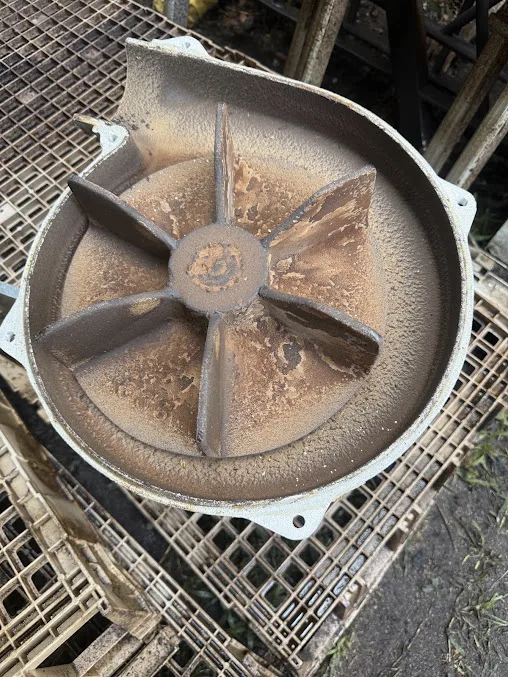
A squirrel-cage fan wheel heavy with brown deposit before cleaning
A squirrel-cage fan wheel loaded with brown deposit. The same buildup lands on everything downstream of it, which is how mechanical fouling becomes an electrical problem.

Why dry ice works where the others do not

Three properties of the process line up with what electrical equipment needs.

The media is non-conductive. Solid carbon dioxide does not carry current, and neither does the gas it becomes.

The process is low-moisture. Nothing is left standing in a cabinet, a harness, a terminal block or a winding. That is not a marketing line, it is the technical reason this method exists in the electrical space at all.

And the media disappears. There is no residue in the enclosure afterward, because the only thing that was ever in the stream turned into air.

What comes off is the dust, the carbon film and the oil-bound grime, and we contain and collect it rather than blowing it deeper into the assembly.

How the job actually gets set up

This is the part worth being clear about, because it is where an unserious operator gives you a problem.

Equipment gets de-energized before anything starts. Not “mostly off”, not “we will work around the live section”. Your own electrical safe work procedure governs the job and your people do the isolation. We plan around it.

The area gets ventilated. Carbon dioxide is heavier than air and it displaces oxygen in a confined space, so airflow and monitoring are part of setup in any enclosed room, vault or pit. Nobody should be casual about that and we are not.

We look at what needs masking and where the removed contaminant goes. In a clean electrical room, containment is most of the planning time.

Then we test a small area. Insulator materials, labels, older plastics and coatings on bus all behave differently, and the right setting on one is the wrong setting on another. The test tells us the pressure and pellet size before anything visible gets touched.

If your safe work procedure has specific requirements we should be planning around, send them through the contact page with the job and we will scope to them rather than turning up with assumptions.

What gets cleaned

The usual list on a facility job runs through panels and enclosures, switchgear, motor control centers, bus and bus duct, insulators and standoffs, motors, and generators.

Motors and generators are where the schedule argument gets strongest. Cleaning windings, frames and cooling passages normally means pulling the machine. Doing it in place, with the low-moisture method, means the machine does not leave its mount.

When to schedule it

Two triggers we see over and over.

The first is a planned outage. If the gear is going to be de-energized anyway for testing, relay work or thermographic inspection, cleaning it in that same window costs you nothing extra in downtime. That is the cheapest cleaning you will ever buy.

The second is a thermal scan that came back with something you cannot explain. A hot spot on a connection that torques correctly is often a contamination story, and a clean surface makes the next scan meaningful.

There is a third trigger nobody likes: you already had an event. In that case the soot and the carbon have to come off before anything gets re-energized, and the soot removal side of the work is what that becomes.

The South Florida factor

Humidity changes the math on all of this, and it is the reason we see more contamination-driven electrical problems here than the textbooks suggest.

Dust on an insulator in a dry climate is mostly inert. The same layer here spends half the year absorbing moisture out of the air every night and giving it back every afternoon. That cycle is what turns a cosmetic film into a leakage path. It is also why a panel that read fine two years ago can read badly now with no change in the dust load, only in how long it has been sitting there.

Add salt. Anything within a few miles of the coast pulls a fine salt loading into every louvered enclosure, rooftop unit and outdoor disconnect. Salt attracts water and conducts once it has it, so a coastal panel is dealing with two problems stacked on each other. Washing it is exactly what you cannot do, which is how these enclosures end up untouched for a decade.

Practical consequence: down here, cleaning electrical gear is not a cosmetic line item you defer. It is maintenance with the same logic as torque checks and thermal scans, and it belongs on the same interval.

Common questions from facility teams

Can you clean it energized?

No. We do not work on live gear and you should be wary of anyone who says they will. The equipment is isolated under your procedures first.

Does the cold cause condensation when we re-energize?

The surfaces come back up to ambient quickly and the process itself does not introduce water. On a humid day in Miami we still account for it in sequencing rather than pretending humidity does not exist, and we talk it through with your electrician before we start.

Will it damage insulation or labels?

Settings do the work here. Older brittle plastics and adhesive labels get a lighter touch or get masked. That is what the test area establishes, and it is why we would rather spend ten minutes on a corner than explain a mistake afterward.

If you have a panel you have been avoiding

Tell us what the gear is, roughly how old, and when it can be taken out of service. Photos of the enclosure face help more than anything you can write. Reach Giancarlo at 786-302-6553 or use the contact page, and we will be straight with you about whether this is the right method for what you have.