Home / Services / Government / Fire Department Equipment
Government · Miami, FL
Fire Department Equipment Ice Blasting
When people call about fire department equipment, the constraint is usually the same. We clean it without water, without chemicals and without anything abrasive touching the surface.
What builds up, and why it matters
On this kind of work the problem is carbon, corrosion product, paint and accumulated field grime on fleet and facility equipment. Public equipment is kept long past the point where replacement is easy, so cleaning has to preserve what is underneath rather than wear it away.
Scheduling works around the department's own operating hours and approvals. The people who call us about fire department equipment are usually fleet supervisors and facility managers, and the thing they are actually worried about is damaging equipment that is difficult to replace or re-certify.

The method
Why dry ice and not the alternatives
- Non-abrasive
Cold does most of the work here. The contaminant shrinks and lets go, and the surface below it is left as it was.
- Low moisture
Nothing is left wet, so no water sits in seams, channels or behind covers. The equipment goes back into service dry.
- No secondary waste
Other blast media becomes a second mess. Dry ice sublimates on contact, so nothing extra is left to dispose of.
- Often no teardown
Much of this work is done in place, which is usually where the real saving is. The labor is in the disassembly, not the cleaning.
More government work
Related jobs we get called for
Questions we get asked first
Will it damage the surface underneath?
On metal, painted parts and most finishes, it does not. The process is non-abrasive. Where we are less sure, an old coating or a soft alloy for example, we try it somewhere hidden and look before going further.
Do you have to take the equipment apart for fire department equipment?
Less than with almost any other method. There is no water to keep out and no grit to flush from inside afterward, so parts can stay where they are while we clean.
How much mess does it make?
Most of the mess is the buildup coming off in flakes and dust. We contain it while we work and clean it up before we leave.
Do you come to us?
Yes. We arrive with the truck and everything it carries, wherever you are in South Florida, up to roughly a hundred miles from Miami.
What does a job cost?
There is no flat rate, because no two jobs carry the same buildup or the same access. Tell us what it is and where it sits, and send a photo. We will come back with a real price, never a teaser to get us through the door.
How soon can you look at it?
As soon as we have seen what the job is. Send a description and a photo, an owner reads it and comes back with a date, and because the rig travels to you there is nothing of yours to ship first.
The comparison
How this compares to the usual methods
- Media blasting
Effective and indiscriminate. On soft metal or a finished surface it does damage you then have to fix.
- Pressure washing
Drives water into harnesses, bearings, panels and seams, then everything waits to dry. On electrical work it is simply not an option.
- Solvent and degreaser
Good at softening, bad at leaving. There is always a residue and always a drum to get rid of.
- Hand scraping
Slow enough to be uneconomic on a machine, and the tool always leaves a trace.
- Dry ice
Thermal contraction cracks the bond between deposit and surface, then the pellet gasses off. Nothing abrasive, nothing wet, nothing left.
What comes off
What comes off, and why
If it is bonded to the surface rather than part of it, there is a good chance this takes it off. The list below covers most of what we are called out for.
- Paint and coatings
Removed selectively where the substrate underneath has to survive, which rules out most abrasive approaches.
- Salt and corrosion product
Salt deposit and the oxidation it starts. Anything abrasive removes the protection along with the salt.
- Ink and printing residue
Dried ink and coating build-up on rollers and press components, where the surface texture is the product.
- Food residue
Burnt-on product, fat and sugar on processing gear, with no chemical residue left on a contact surface.
- Grease and oil
Oil film is the layer everything else sticks to. Remove it and half the job is already done.
- Carbon and soot
Soot and carbon scale from heat and exhaust. It looks permanent, but it is usually among the first deposits to break free under the cold.
- Adhesive and sealant
Whatever the last repair left stuck to the mating face: gasket, sealant, deadener or adhesive.
How a job runs
Nothing about this should be a surprise
Nobody should have to guess what they booked. This is every stage of a job in the order it happens.
- You describe the job
Send images if you can, they settle most of the questions. A wrong-tool verdict comes on that first call, not after the invoice.
- We look at access and containment
The layout decides the method more often than the contaminant does. We work out reach and containment before quoting anything.
- We test a small area
Aluminum, cast iron and painted steel all want different settings, and guessing is how surfaces get marked. A small hidden test settles it before the real work starts.
- We blast, then clean up
Nothing is left of the pellet, so the only thing to collect is what was on your equipment. That collection is part of the work we quoted.
- You look before we pack up
If something needs another pass we do it then, on site, while the rig is still running. That is a better outcome for everyone than a callback.
What to expect on site
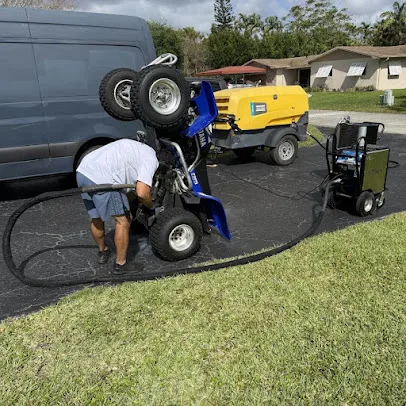
Setup does not depend on what your building has. Our own compressor supplies the air, so we can start as soon as the hose is run.
Anything nearby that should not be touched gets masked before we start. That is quicker than explaining it afterward.
The one thing the ice itself asks for is air. As the CO2 turns to gas it fills an enclosed space, which is why ventilation is part of our setup on every indoor job.
The process is loud. Hearing protection is standard for anyone in the working area, which is why you will see ear defenders in most of our photographs.
Tell us what needs cleaning.
Write a line or two about the job and where it is. One of the owners, Giancarlo or Kenny, gets back to you with honest answers.