Home / Service areas / Broward County / Lauderhill
Broward County · Florida
Lauderhill dry ice blasting
Lauderhill work comes to us the same way most of it does: something is coated in build-up and cannot be sanded, soaked or dissolved.
How we work in this area
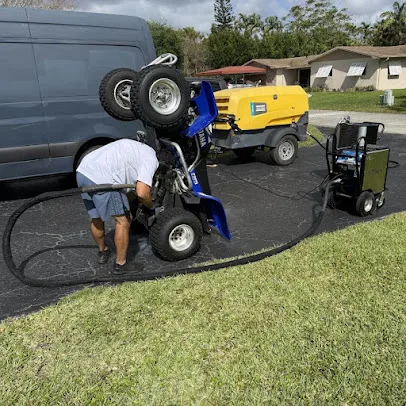
The compressor runs off the truck, so there is no wash pad to find and no runoff to manage. So the equipment stays put. Everything that has to move arrives on the truck instead.
Nothing of the ice survives the blast. That removes the entire cleanup problem every other method creates, leaving only the deposit that came off the equipment.
What we clean
What we get called for in Lauderhill
Nearby
Also working across Broward County
Questions from Lauderhill
Is Lauderhill in your area?
Yes. Lauderhill is inside our regular working area, and the rig travels to the job rather than the other way round.
What does the site need to have?
Space for the rig and a way to reach the machine. Everything else arrives with us.
Can you work around our schedule?
Nearly always. Give us the hours you can spare and we will say what genuinely fits inside them.
Who calls you around here?
It ranges from a single restoration project to a plant maintenance window. The method does not change much.
Is there a travel charge?
It depends how far out the job is. We will be straight with you about it when you describe the work.
How do we book it in?
Describe the job and send a photo or two. Giancarlo or Kenny will call you, not a scheduler.
Why Lauderhill equipment ends up like this
Humidity is the constant. Anything bare oxidizes faster than it would almost anywhere else. So the job is usually less about scrubbing harder and more about not making the underlying problem worse.
The mix here runs from vehicle work in driveways to production equipment inside industrial units. The setup is the same in all of them, because everything the job needs turns up on the van.
The pellet turns to gas, so nothing runs off toward a drain and nothing abrasive stays behind in a bearing. On a cramped Broward County site that usually decides it.
What comes off
What dry ice actually removes
The rule of thumb is simple: anything stuck on rather than built in. These are the deposits we see most.
- Grease and oil
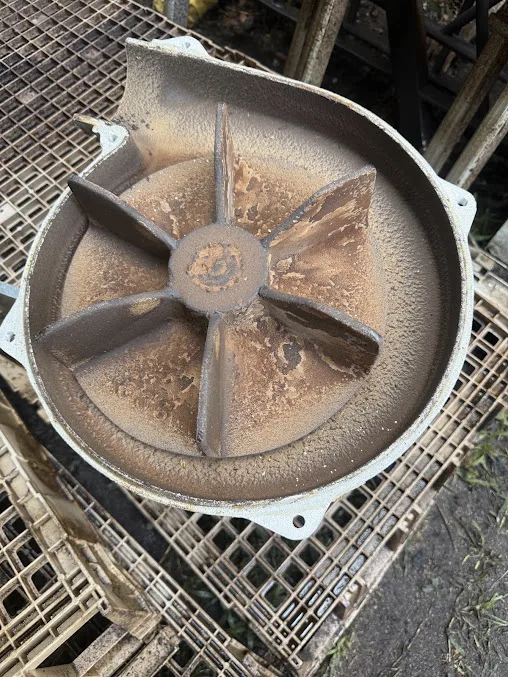
On a motor or generator, oily dust packs into the cooling fins and around the housing. Ice takes it off without putting water anywhere near the electrical parts.
- Carbon and soot
Carbon on parts that run hot all day. It is bonded by heat, which is exactly why a blast of cold undoes it.
- Adhesive and sealant
Cured sealant, old gasket, tape glue and sound deadening, the residue left when something was removed but its bond was not.
- Resin and mold release
Release agent and resin build-up on tooling, where a solvent fix trades one residue for another.
- Paint and coatings
Selective removal, layer by layer, on parts where media blasting would cut into the substrate.
- Salt and corrosion product
The year-round problem on the coast. The finish holding corrosion back has to survive the cleaning.
- Ink and printing residue
Dried ink and coating build-up on rollers and press components, where the surface texture is the product.
How a job runs
How a job actually runs
People ask what they are actually paying for. This is the full order of work, so you can picture the day before it arrives.
- You describe the job
Tell us the machine, the mess and the constraint. A couple of photos answers more than a long description, and if the honest answer is that something else suits it better, we say so.
- We look at access and containment
The layout decides the method more often than the contaminant does. We work out reach and containment before quoting anything.
- We test a small area
Two parts that look identical can be different underneath. One may have been repainted and one may be bare, so we check before we commit, starting low and only stepping up as far as the surface allows.
- We blast, then clean up
One mess instead of two: the pellet vanishes and we take away what it removed.
- You look before we pack up
Inspect it with the rig still set up. Anything you are not happy with gets another go before we leave.
The comparison
The other ways to do this
- Media blasting
Effective and indiscriminate. On soft metal or a finished surface it does damage you then have to fix.
- Pressure washing
Pressure pushes moisture past seals and into connectors, and then you wait. Panels and motors rule it out.
- Solvent and degreaser
Softens the contaminant but leaves a film, fumes and a disposal problem, and attacks finishes you meant to keep.
- Hand scraping
Labor-intensive and uneven, and whatever you scrape with eventually marks what you are scraping.
- Dry ice
It is the only one on this list where the media stops existing the moment it has worked.
What the job is like to stand next to
Setup does not depend on what your building has. Our own compressor supplies the air, so we can start as soon as the hose is run.
Masking happens first. Whatever is adjacent and vulnerable gets covered before the hose is picked up.
Working in a garage? Expect the door to be open while we blast. The ice leaves no residue behind, but the gas it gives off needs somewhere to go.
It sounds like heavy compressed-air work, because that is what it is. Hearing protection is standard for us and for anyone standing near.
Describe what you are dealing with.
Tell us what the equipment is and where it sits. A photo helps a lot. Giancarlo or Kenny will get back to you themselves.